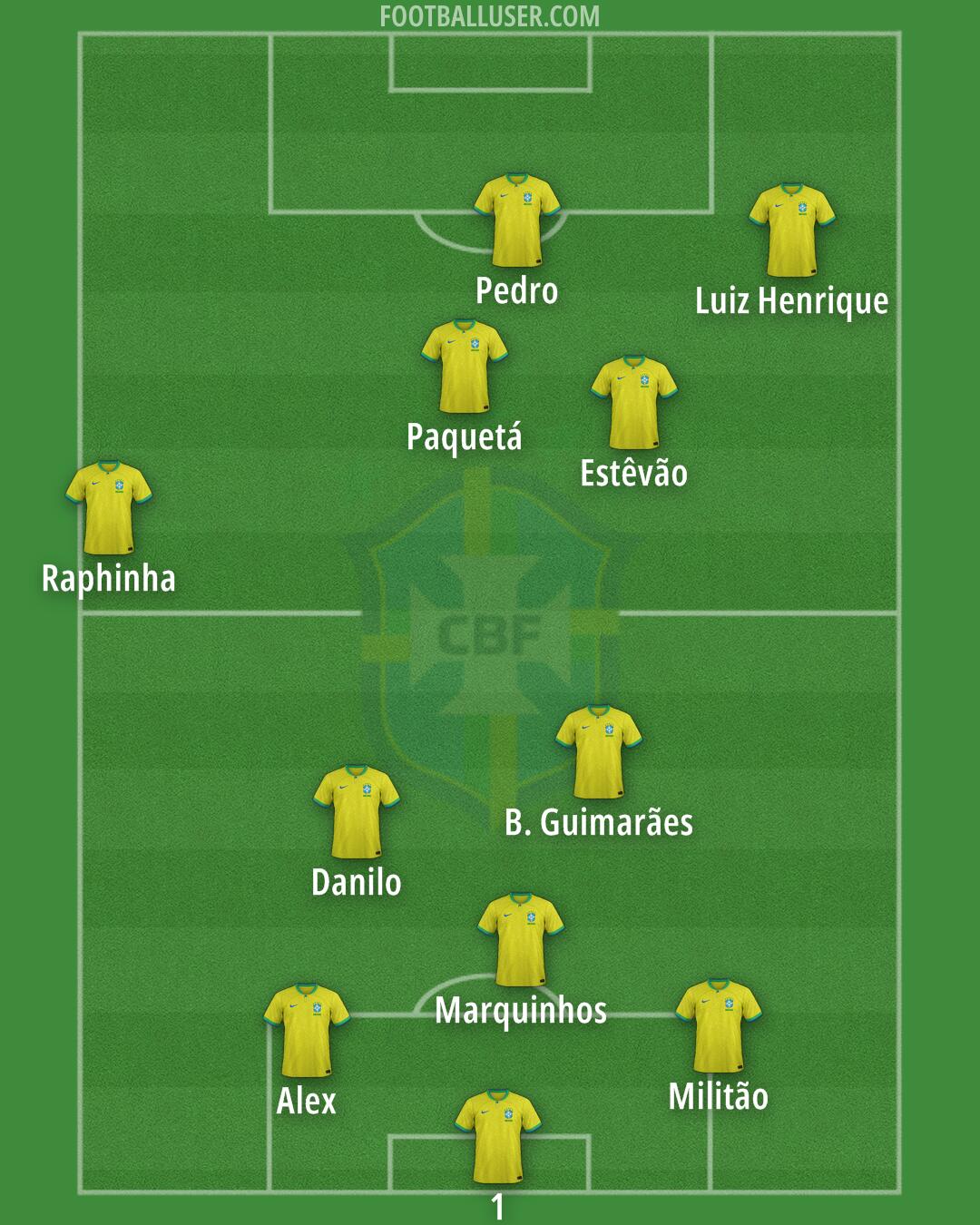

Brazil National Football Team Formation
 November 2, 2025
 Franco Salamone


Starting Lineup
1 · Militão · Marquinhos · Alex · Raphinha · Danilo · B. Guimarães · Pedro · Estêvão · Paquetá · Luiz HenriquePrioritizing defensive solidity and quick vertical transitions, Brazil employs a 5-3-2 formation. This lineup focuses on keeping a compact block when defending and using wide areas to launch attacks. The selection aims to absorb pressure before breaking lines with direct passing to the front two.
The goalkeeper, 1, sits behind a back five that provides immense cover across the width of the pitch. Marquinhos acts as a central pillar in the defense, while Danilo and B. Guimarães operate as the left and right central defenders to secure the zone. Militão occupies the right wing back role to push high, whereas Alex provides the width on the left. This defensive unit works to sit deep and protect the box, relying on the aerial strength of the center backs to clear crosses.
The midfield operates as a three man unit designed to control the central zone. Raphinha acts as the single pivot to shield the defense and break the play. Ahead of him, Estêvão and Paquetá occupy the central midfield positions to connect the defense to the attack. Paquetá uses his passing range to switch play, while Estêvão looks to drive forward into space. This trio must track back to help the wing backs and ensure the middle remains tight.
In the final third, Brazil uses two forwards to stretch the opposition. Pedro plays as the left striker to hold up the ball and link play, while Luiz Henrique operates as the right striker. They work in tandem to pressure the opposition center backs and create space for the advancing wing backs. The attack relies on the movement of the strikers to pull defenders out of position, allowing Alex and Militão to overlap and deliver crosses into the area.
One major advantage for Brazil is the ability to create wide overloads when the wing backs push up. By moving the wing backs into attacking positions, the team forces opposing wide players to track back, which can create numerical superiority in the final third. Another strength is the compactness of the formation, which makes it very difficult for opponents to play through the middle once the team sits deep.
This formation offers a robust foundation for teams that want to defend a lead or hit teams on the break. It is best suited for matches against heavy possession sides that can be exploited in wide channels.