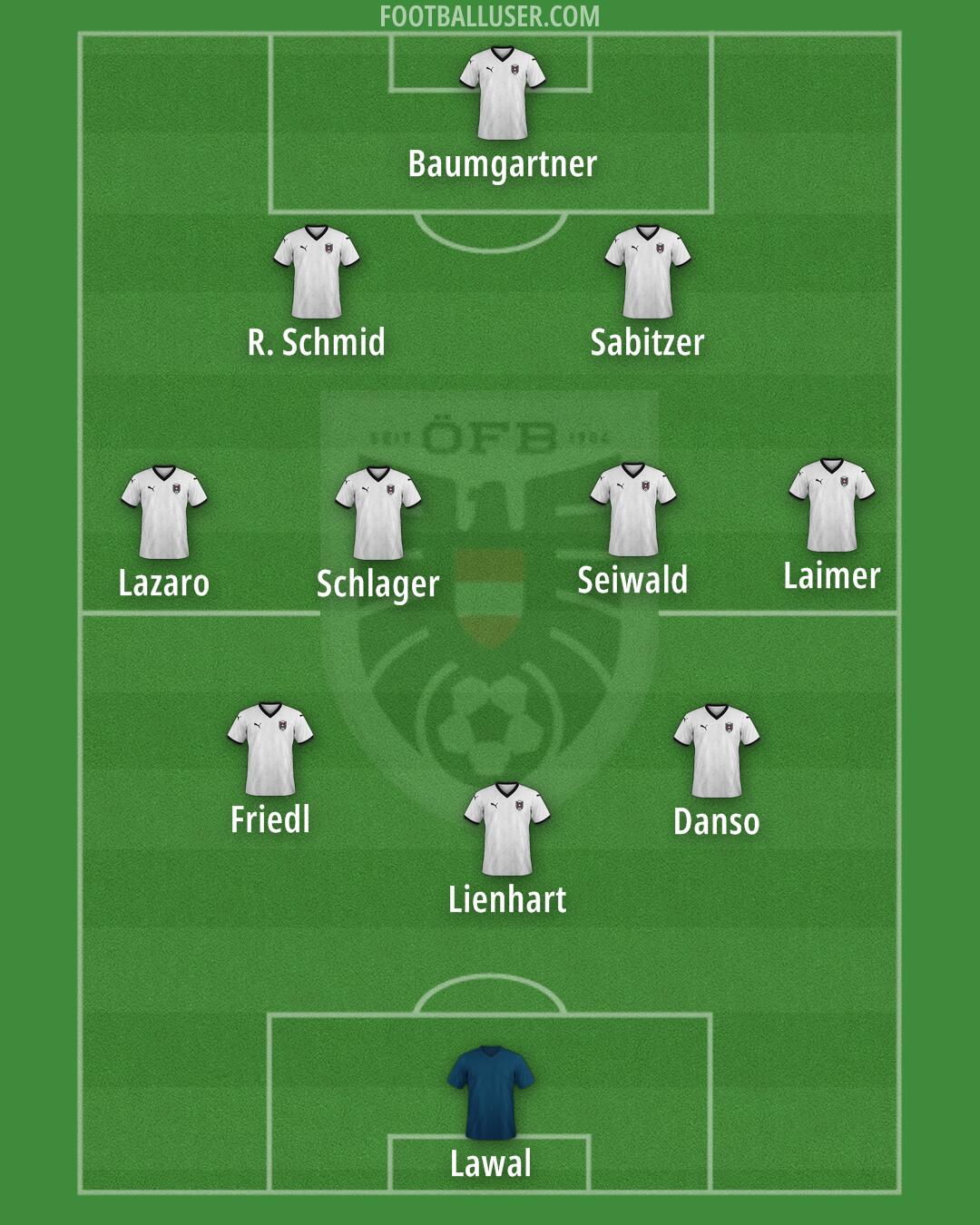

Austria National Football Team Formation
 November 2, 2025


Starting Lineup
Lazaro · Laimer · R. Schmid · Friedl · Lienhart · Danso · Schlager · Seiwald · Baumgartner · Sabitzer · LawalAustria focuses on a heavy high press and quick verticality through a 3-4-3 formation. This lineup aims to win the ball back high up the pitch and transition into attack with speed. The team seeks to control the middle of the field while using wide areas to stretch the opposition. This style of football requires constant movement and high physical intensity to keep the opponent pinned back.
Lawal stays between the posts to organize the back line. A trio of central defenders forms the base with Lienhart, Danso, and Friedl working as a unit. Danso provides aerial strength and physicality in the right channel, while Friedl covers the left side. Lienhart acts as the central anchor to direct the defensive line. The wide players, Lazaro and Laimer, must track back to cover the flanks and help the defenders when the team sits deep or faces wide attacks.
The midfield operates with two central players, Schlager and Seiwald, acting as a double pivot. Seiwald works to intercept passes and break up play, while Schlager pushes into advanced areas to link the defense to the front line. This central duo provides the necessary cover to allow the wide players to push forward. By controlling the central zone, the Austrian midfield can quickly switch play to the wings or drive through the middle to break the line.
In the final third, the team uses three attackers to put pressure on the opposition. Baumgartner acts as the lone striker, tasked to hold up the ball and lead the press from the front. On the wings, R. Schmid and Sabitzer provide width and look to cut inside to create goal scoring chances. These three forwards stay high to keep the opposition defenders occupied, creating space for the late runs of the midfielders.
One major advantage is the ability to press high in coordinated waves, using the front three and the midfield to squeeze the opponent. The wide players, Lazaro and Laimer, allow for wide overloads when they push up to join the attack. This creates numerical superiority in the final third, making it difficult for the defense to track every run. The team can also shift quickly from a compact defensive block to a direct attacking threat.
This 3-4-3 formation is built for a high intensity team that wants to dominate through pressing and rapid transitions. It is particularly effective against opponents who struggle to play out from the back under pressure.