
Pisa Football Formation
 November 2, 2025


Starting Lineup
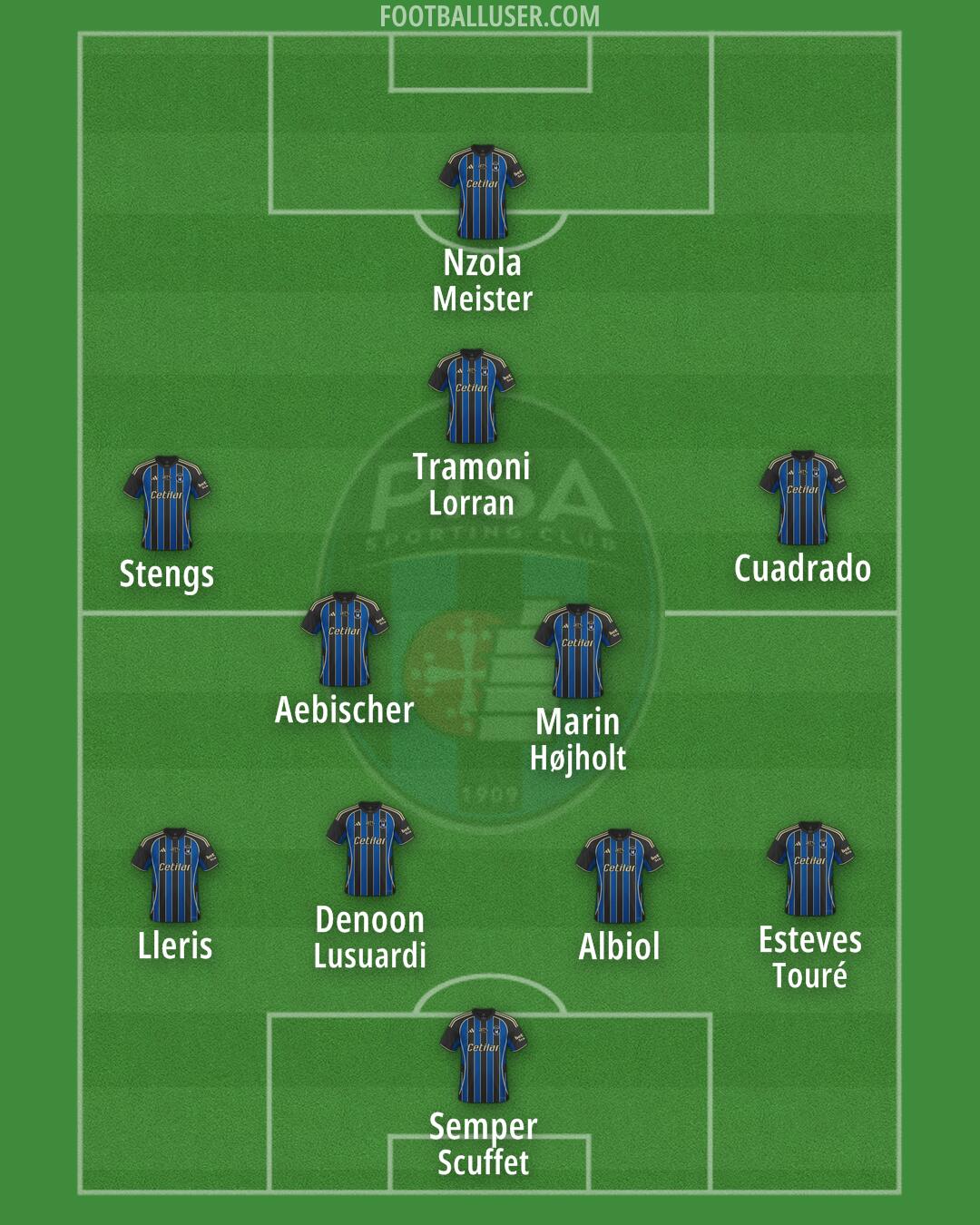
Semper (Scuffet) · Esteves (Touré) · Albiol · Denoon (Lusuardi) · Cuadrado · Stengs · Tramoni (Lorran) · Aebischer · Lleris · Nzola (Meister) · Marin (Højholt)Focusing on a compact and disciplined style, Pisa operates with a 4-5-1 formation. This lineup aims to control the central areas and remain hard to break down by sitting deep when out of possession. The team looks to win the ball in the middle third and launch quick transitions to exploit space behind the opposition defense.
Semper sits between the posts to command the penalty area. In front of him, the back four consists of Albiol and Denoon acting as the central pairing, while Esteves and Lleris occupy the wide positions. Albiol provides aerial strength and experience to the defensive line, whereas Denoon works to cover the space behind him. Esteves and Lleris are tasked to hold their positions and track back to prevent crosses, ensuring the team maintains a solid block.
The midfield functions as a central engine room with a double pivot to shield the defense. Marin and Aebischer sit in front of the back four to intercept passes and break up play. Further forward, Stengs and Cuadrado operate in the half spaces to connect the defensive unit with the attack. Tramoni plays as the attacking ten, operating in the hole to find pockets of space and deliver through balls to the forward.
Up front, the attacking burden falls on Nzola, who acts as a lone striker. He is required to hold up the ball and fight for physical duels to allow the midfielders to push forward. The wide players in the midfield must tuck in to provide support, creating a narrow structure that forces the opponent outside. The attacking movements rely on Nzola dropping deep to drag defenders out of position, which opens lanes for Tramoni to run into.
Pisa uses this formation to create a compact unit that is difficult to play through centrally. By utilizing Marin and Aebischer in the pivot, the team gains numerical superiority against single pivots used by other sides. The width provided by the full backs and the movement of the attacking ten allows the team to switch play quickly once the ball is recovered.
This 4-5-1 formation is built for teams that want to absorb pressure and strike on the break. It is best suited for matches against dominant sides where defensive compactness and quick transitions are necessary to secure a result.