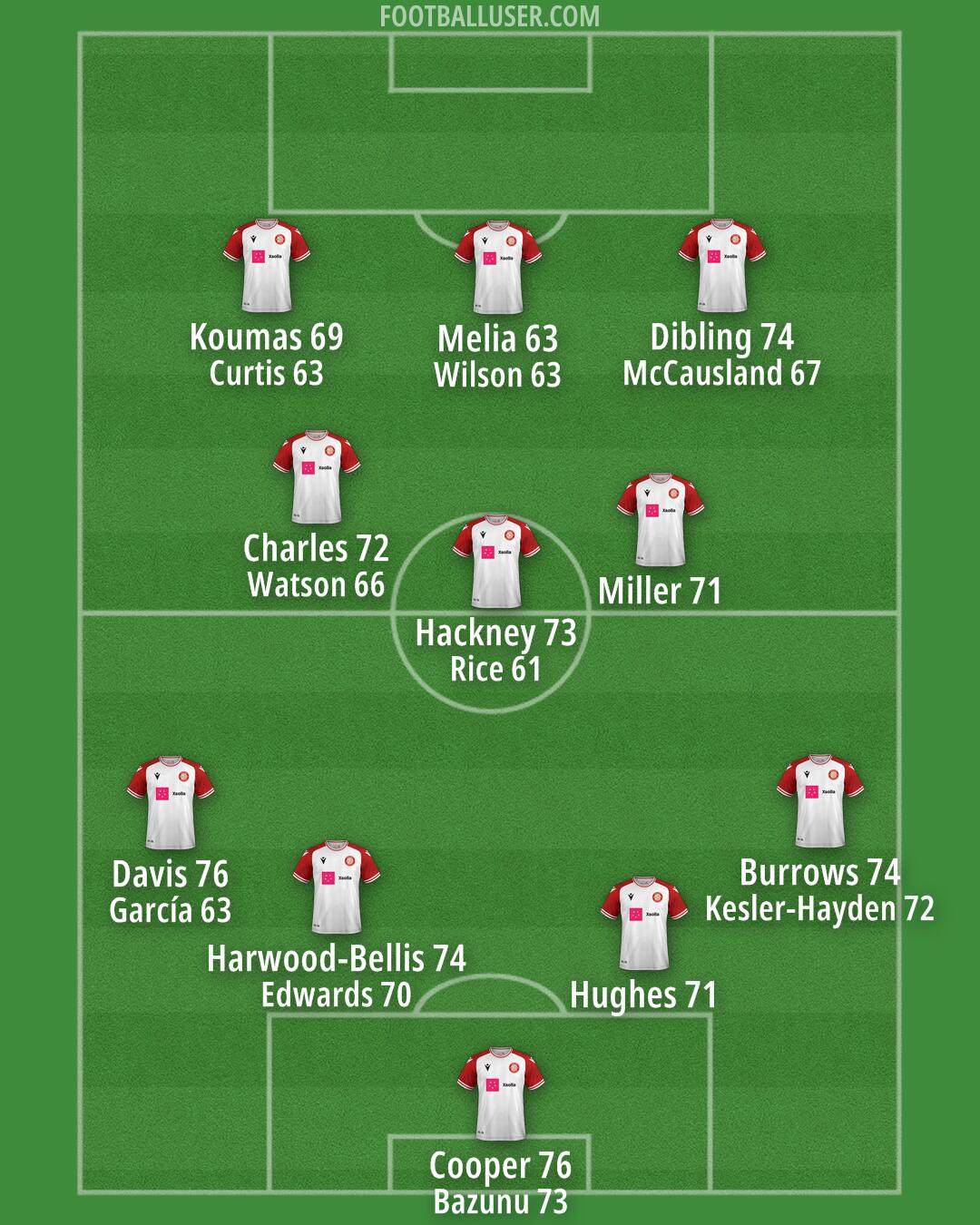
Stevenage Football Formation
 November 3, 2025


Starting Lineup
Dibling 74 (McCausland 67) · Miller 71 · Koumas 69 (Curtis 63) · Hackney 73 (Rice 61) · Melia 63 (Wilson 63) · Charles 72 (Watson 66) · Davis 76 (García 63) · Harwood-Bellis 74 (Edwards 70) · Cooper 76 (Bazunu 73) · Burrows 74 (Kesler-Hayden 72) · Hughes 71Stevenage focuses on a high press and quick transitions using a 4-3-3. This formation allows the side to win the ball high up the pitch and move the play forward with verticality. The lineup is built to press opponents aggressively and use the width of the pitch to stretch the opposition defense.
Cooper stays between the posts to organize the back four. Harwood-Bellis and Hughes act as the central defenders, with Harwood-Bellis using his aerial strength to clear crosses and Hughes covering the space behind. Burrows and Davis form the wide defensive line, where Burrows looks to overlap to provide width and Davis tracks back to cover the flank. The defensive unit sits with a high line to keep the team compact.
The midfield works as a three-man unit to control the center of the pitch. Hackney operates as a central pivot to shield the defense and intercept passes. Charles and Miller sit on either side of him to connect the defense to the attack. Miller drives forward to break the line with his ball carrying, while Charles stays close to the center to recycle possession and switch play.
The attacking front line uses three players to pressure the opponent. Melia plays as a lone striker to hold up the ball and pin the central defenders. Dibling and Koumas act as wide wingers who cut inside to create goal scoring chances. This setup forces the opposition defenders to stay wide, which creates pockets of space in the middle for the midfielders to run into.
Stevenage gains a huge advantage through their ability to press high in coordinated waves. The front three and the midfield three work together to squeeze the space. Another strength is the speed of transition, as players like Dibling and Koumas can quickly exploit space when the ball is won. This allows the team to create overloads in wide areas through the combination of the wingers and the full backs.
This 4-3-3 formation is built for a high intensity game that relies on winning the ball back quickly. It is best suited for facing teams that try to build play from the back through short passing.