
Brazil National Football Team Formation
 November 9, 2025


Starting Lineup
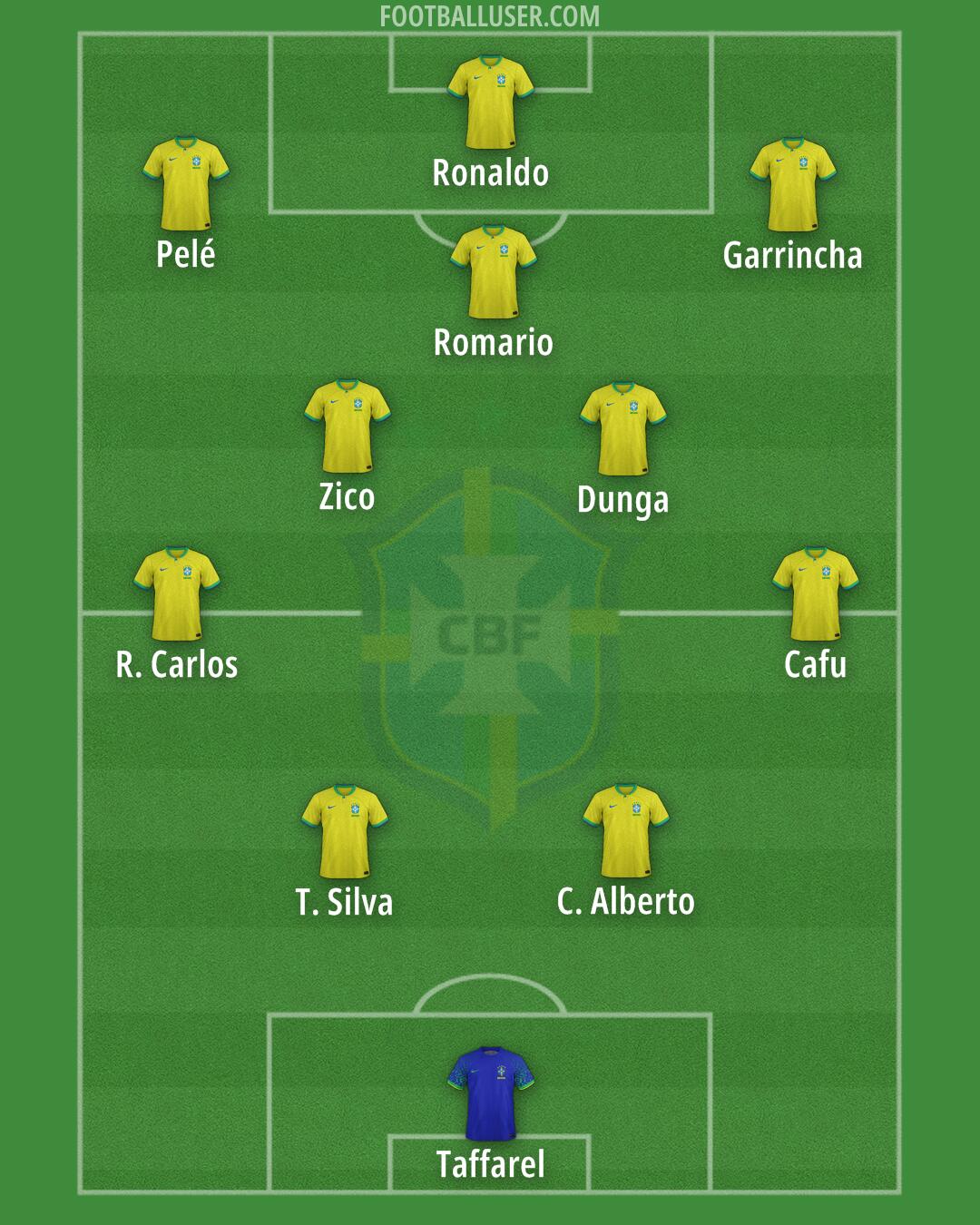
R. Carlos · Cafu · T. Silva · C. Alberto · Ronaldo · Romario · Pelé · Garrincha · Zico · Dunga · TaffarelThis Brazil lineup focuses on high intensity attacking and heavy pressure through a 2-5-3 formation. The team looks to dominate the ball in the final third and overwhelm the opposition with numbers. Every player in this selection is tasked with pushing forward to ensure constant pressure on the opponent.
Taffarel sits between the posts to guard the goal. In front of him, the defensive unit consists of a two man back line with T. Silva and C. Alberto. T. Silva uses his aerial strength and reading of the game to cover space, while C. Alberto acts as a ball playing defender to start attacks. Because there are only two central defenders, the team relies on the midfielders to drop back and block passing lanes when the opponent breaks.
The midfield functions as a central engine to control the tempo. Dunga sits in the middle to shield the defense and break up play. He works alongside Zico, who uses his passing range and set piece delivery to create chances. To the flanks, Cafu and R. Carlos operate as wide midfielders who provide extreme width. Cafu is known for his tireless running and ability to overlap, while R. Carlos uses his speed to push up the left side. Romario operates in the space between the midfield and the front line to connect the play.
The attack is built around a devastating trio of forwards. Ronaldo plays as a lone striker, using his explosive pace and dribbling style to break the line. Pelé occupies the left wing to cut inside and find pockets of space, while Garrincha stays wide on the right to take on defenders one on one. These three players press high to force mistakes and use their movement to pull the opposing defense apart.
One major advantage of this Brazil formation is the ability to create wide overloads. When Cafu and R. Carlos push up, they create numerical superiority against the opposition full backs. Another strength is the speed of transition, as the midfield can quickly switch play to the wingers. The team can also press high in coordinated waves to win the ball back immediately in the attacking third.
This formation creates a massive attacking threat that can overwhelm most defenses through sheer talent and width. It is best suited for games where the team wants to dictate play and keep the opponent pinned in their own half.