
Italy National Football Team Formation
 November 15, 2025


Starting Lineup
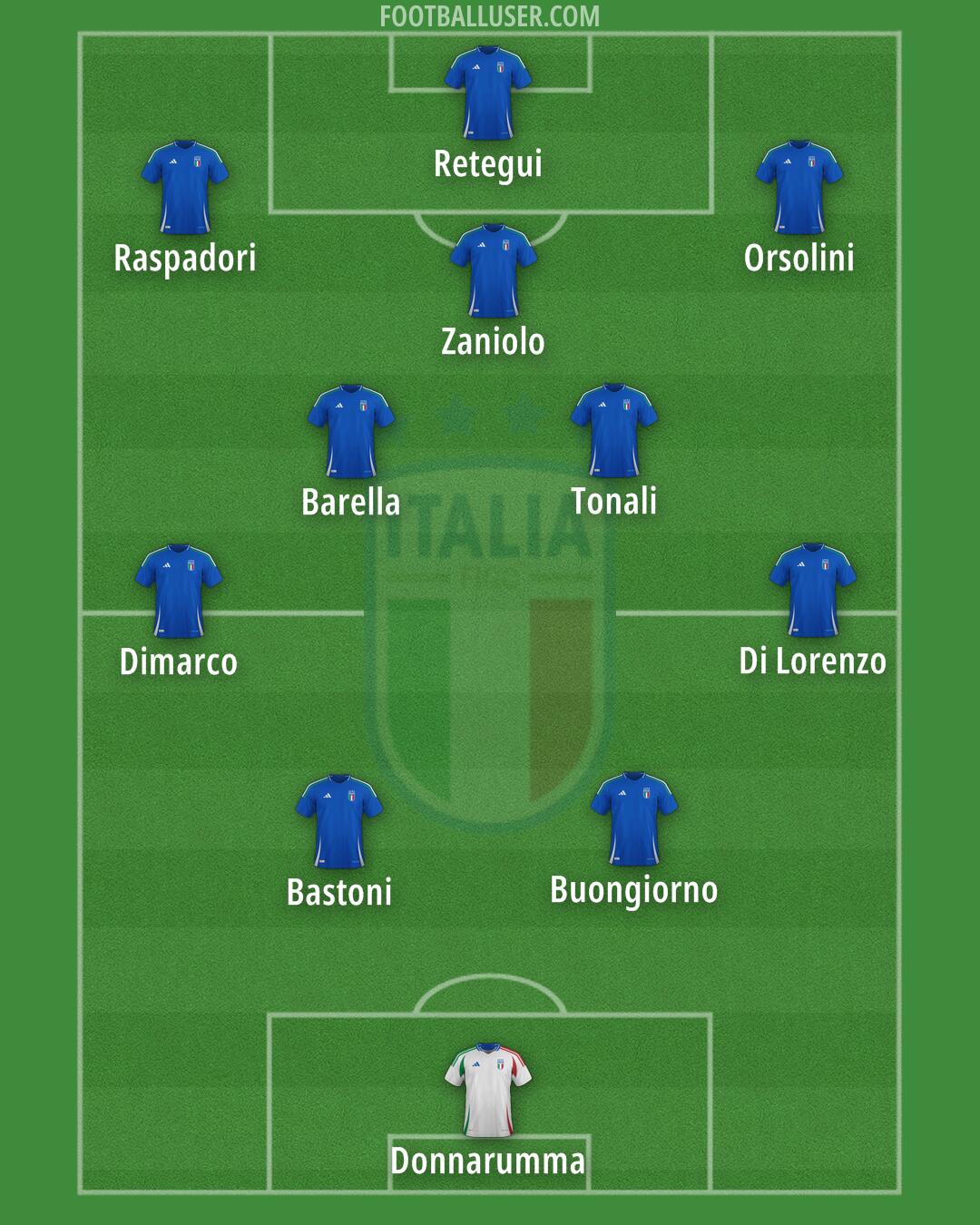
Dimarco · Di Lorenzo · Bastoni · Buongiorno · Retegui · Tonali · Barella · Zaniolo · Raspadori · Orsolini · DonnarummaItaly focuses on a heavy high press and rapid verticality through a 2-5-3 formation. This lineup seeks to control the middle of the pitch and overwhelm opponents with numbers in the central zones. By crowding the center, the team looks to win the ball back quickly and push forward immediately to catch the opposition out of position.
Donnarumma stays between the posts to manage the space behind the defense. The back line consists of a pair of central defenders, Bastoni and Buongiorno, who must maintain a high line to compress the playing area. Bastoni uses his ball playing ability to start attacks from deep, while Buongiorno provides aerial strength and physical presence to block crosses. These two defenders must step up together to intercept long balls and cover the space left by the advancing midfield.
The midfield works as a compact unit to control the center of the park. Dimarco and Di Lorenzo act as wide midfielders who provide width and cover the flanks, often pushing high to support the attack. In the center, Barella uses his high pressing intensity to disrupt play, while Tonali connects the defense to the front line with his passing range. Zaniolo operates as the attacking ten, roaming between the lines to find pockets of space and drive the ball forward into the final third.
A front three leads the pressure and creates constant movement. Raspadori plays on the left wing, looking to cut inside and create chances, while Orsolini stays wide on the right to deliver crosses. Retegui acts as the lone striker, tasked to hold up the ball and make runs into the channels to stretch the opposing defense. This front line presses in coordination, forcing defenders into mistakes and creating quick turnovers.
The Italy lineup offers significant tactical advantages through its central density. The presence of Barella, Tonali, and Zaniolo creates numerical superiority in the middle, making it difficult for opponents to play through the center. This formation also allows for wide overloads when Dimarco and Di Lorenzo push forward to support the wingers. These movements force the opposing defense to shift constantly, often leaving gaps for the attackers to exploit.
This 2-5-3 formation is built for aggressive, high intensity football that relies on winning the ball in advanced areas. It is best suited for matches where Italy can dominate possession and use vertical passing to break down a deep sitting opponent.