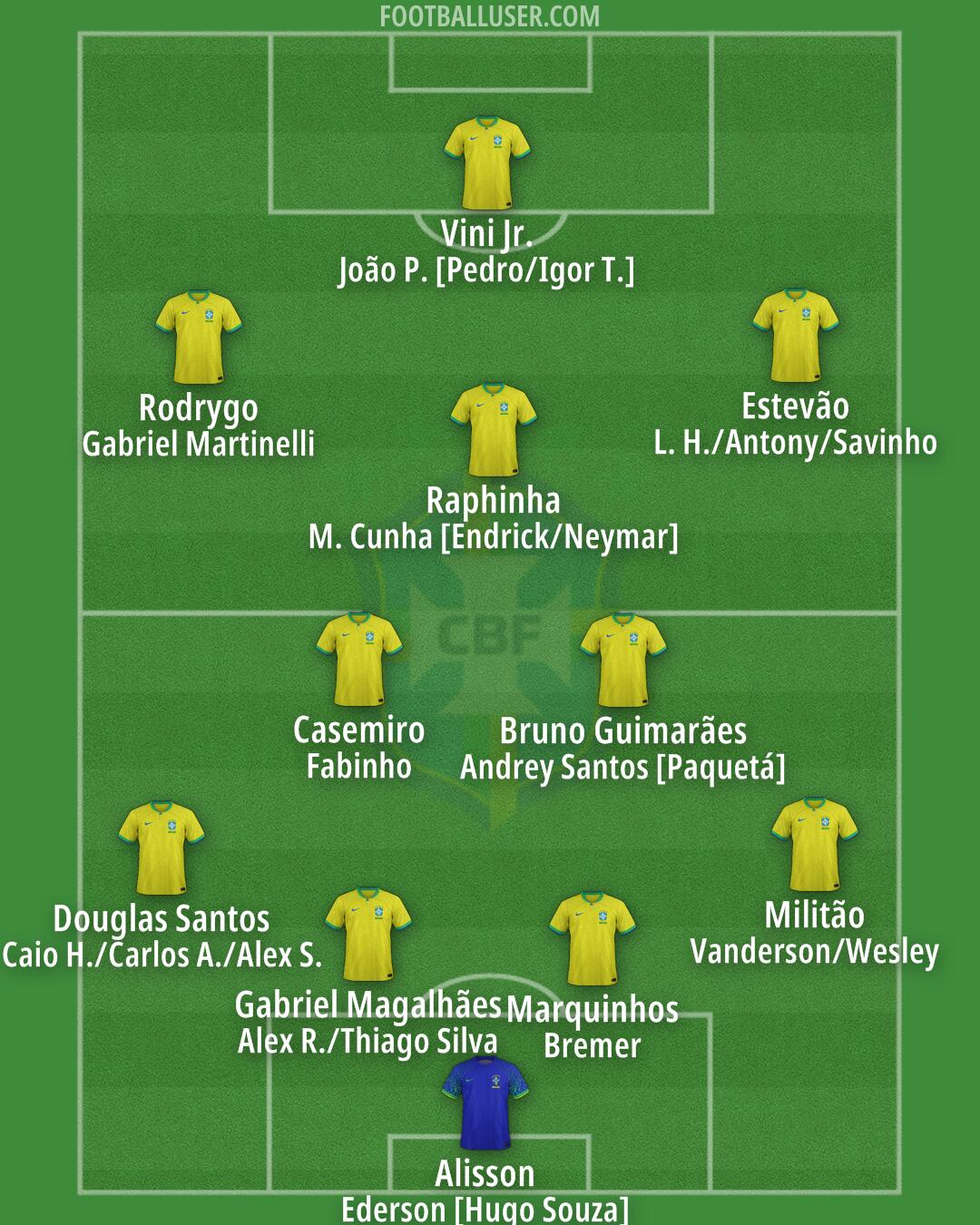

Brazil National Football Team Formation
 November 20, 2025


Starting Lineup
Alisson (Ederson [Hugo Souza]) · Gabriel Magalhães (Alex R./Thiago Silva) · Marquinhos (Bremer) · Militão (Vanderson/Wesley) · Casemiro (Fabinho) · Bruno Guimarães (Andrey Santos [Paquetá]) · Estevão (L. H./Antony/Savinho) · Raphinha (M. Cunha [Endrick/Neymar]) · Vini Jr. (João P. [Pedro/Igor T.]) · Rodrygo (Gabriel Martinelli) · Douglas Santos (Caio H./Carlos A./Alex S.)Seeking to dominate through high pressing and quick transitions, the Brazil lineup operates in a 4-3-3. This formation allows the Seleção to control the tempo through central ball progression while maintaining the ability to strike rapidly once the ball is recovered. It is a system built to squeeze opponents into their own half and use wide areas to stretch the opposition.
Alisson sits between the posts to organize the back line and sweep up long balls. The defensive unit utilizes a flat back four where Marquinhos plays as a ball playing defender with great composure. Gabriel Magalhães provides aerial strength and physical presence in the center to block crosses. Militão acts as an aggressive right back who can step up into midfield, while Douglas Santos provides width on the left to overlap during the build up. This defensive group works together to maintain a high line and intercept passes before they reach the penalty area.
The midfield works as a single pivot with Casemiro sitting deep to shield the defense and intercept play. He uses his physical strength to win tackles and disrupt the opponent. Moving ahead of him, Bruno Guimarães acts as the engine, driving forward to break the line with his passing range. Raphinha operates as an attacking ten in the center, linking the midfield to the front three. He finds pockets of space to create chances and connect the lines between the central players and the attackers.
In the attacking third, Brazil utilizes three attackers to pin the opposition back. Vini Jr. plays as a central striker, using his incredible dribbling style and pace to run behind the defense. On the flanks, Rodrygo cuts inside from the left to create central overloads, while Estevão stays wide on the right to stretch the play. The forwards press in coordinated waves to force mistakes high up the pitch. This movement creates space for the midfielders to push up and join the attack.
One major advantage of this Brazil formation is the ability to create numerical superiority in the middle of the pitch when Raphinha steps up. Another strength is the speed of transition, as the players can switch play quickly to the wide runners. The combination of Militão and Douglas Santos allows for constant width, which can isolate wide players in one on one situations. These tactical elements make the team very difficult to defend against when they play with high intensity.
This 4-3-3 lineup relies on aggressive pressing and rapid verticality to break down opponents. It is a formation best suited for games where the team needs to dominate possession and force errors through high pressure.