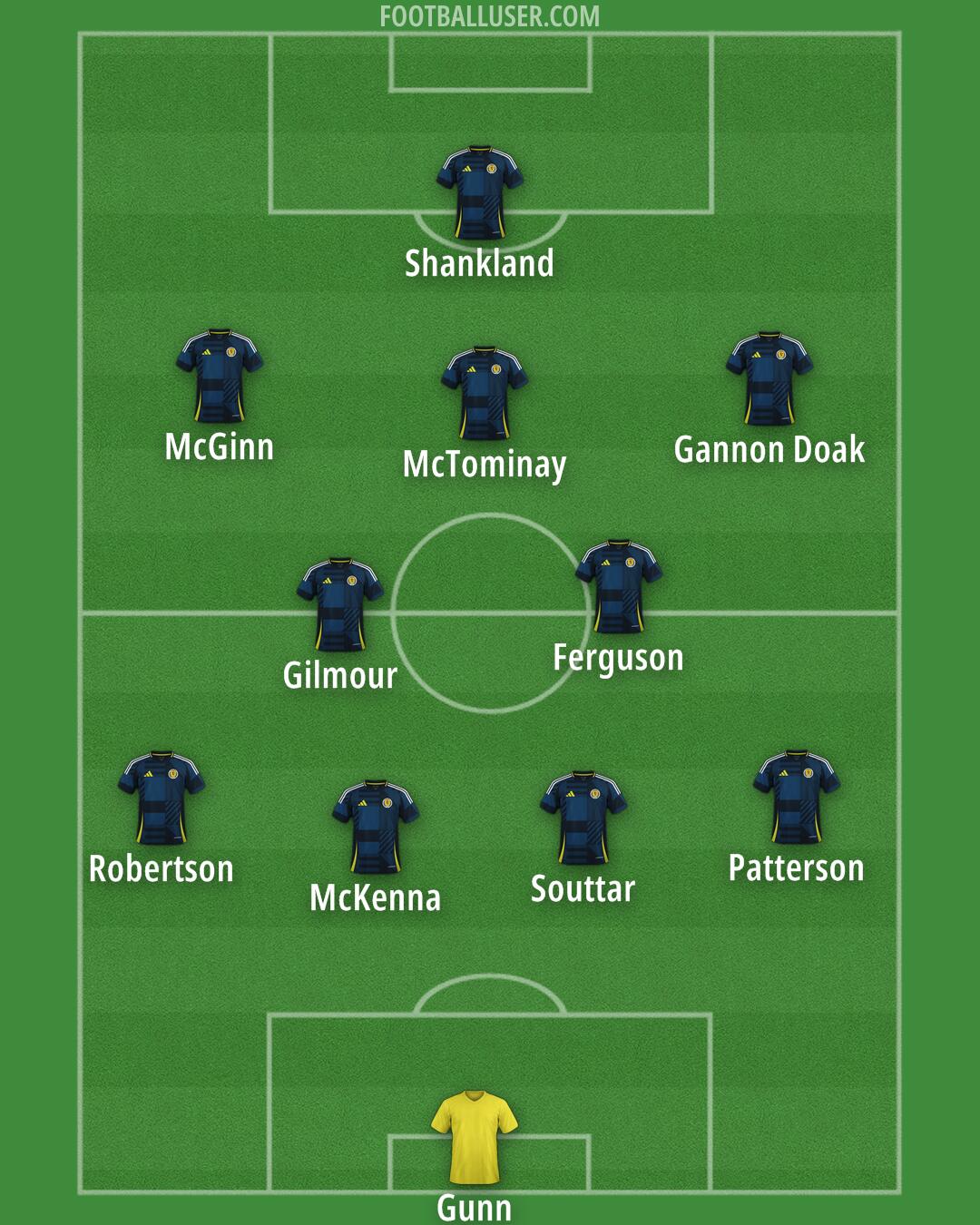
Scotland National Football Team Formation
 November 20, 2025


Starting Lineup
Gunn · Robertson · McKenna · Souttar · Patterson · Gilmour · Ferguson · McGinn · Gannon Doak · McTominay · ShanklandPrioritizing verticality and quick transitions, Scotland operates in a 4-2-4 formation. This lineup is built to push the opposition back through direct play and high intensity, looking to exploit spaces left behind as teams try to build from the back. The goal is to overwhelm opponents in the final third by committing many bodies forward during the attacking phase.
Gunn stays between the posts to command the area and organize the back line. The defensive unit functions with a flat back four where Souttar uses his aerial strength to defend crosses and clear danger. McKenna plays as the partner to Souttar to cover ground and intercept passes, while Robertson and Patterson provide width. Robertson often pushes high to support the attack, whereas Patterson stays closer to the center to manage the wide areas when the team shifts.
The midfield relies on a double pivot to connect the defense with the attack. Gilmour and Ferguson work to control the center of the pitch, with Gilmour looking to break the line with vertical passes. Ferguson provides the energy needed to track back and protect the central zone when the team loses the ball. This pair must hold their positions carefully to prevent the opposition from playing through the middle against Scotland.
In the attacking phase, the team uses a heavy front line consisting of two wide players and two central attackers. McGinn and Gannon Doak stay wide to stretch the opposing defense, with McGinn often cutting inside to create more central presence. Shankland and McTominay act as the two central strikers, with McTominay using his ability to arrive late in the box to score. These four forwards press the opposition high to force mistakes and win the ball back quickly.
This formation offers the advantage of significant wide overloads when the full backs push forward to join the wingers. Scotland can also create numerical superiority in the attacking third, making it difficult for a back four to mark everyone. The speed of transition is a major strength, as the team can move from a defensive block to a full attacking wave in seconds.
This 4-2-4 lineup is designed for high intensity football that aims to punish teams through directness. It is best suited for matches where Scotland wants to dominate the final third and exploit a high defensive line.