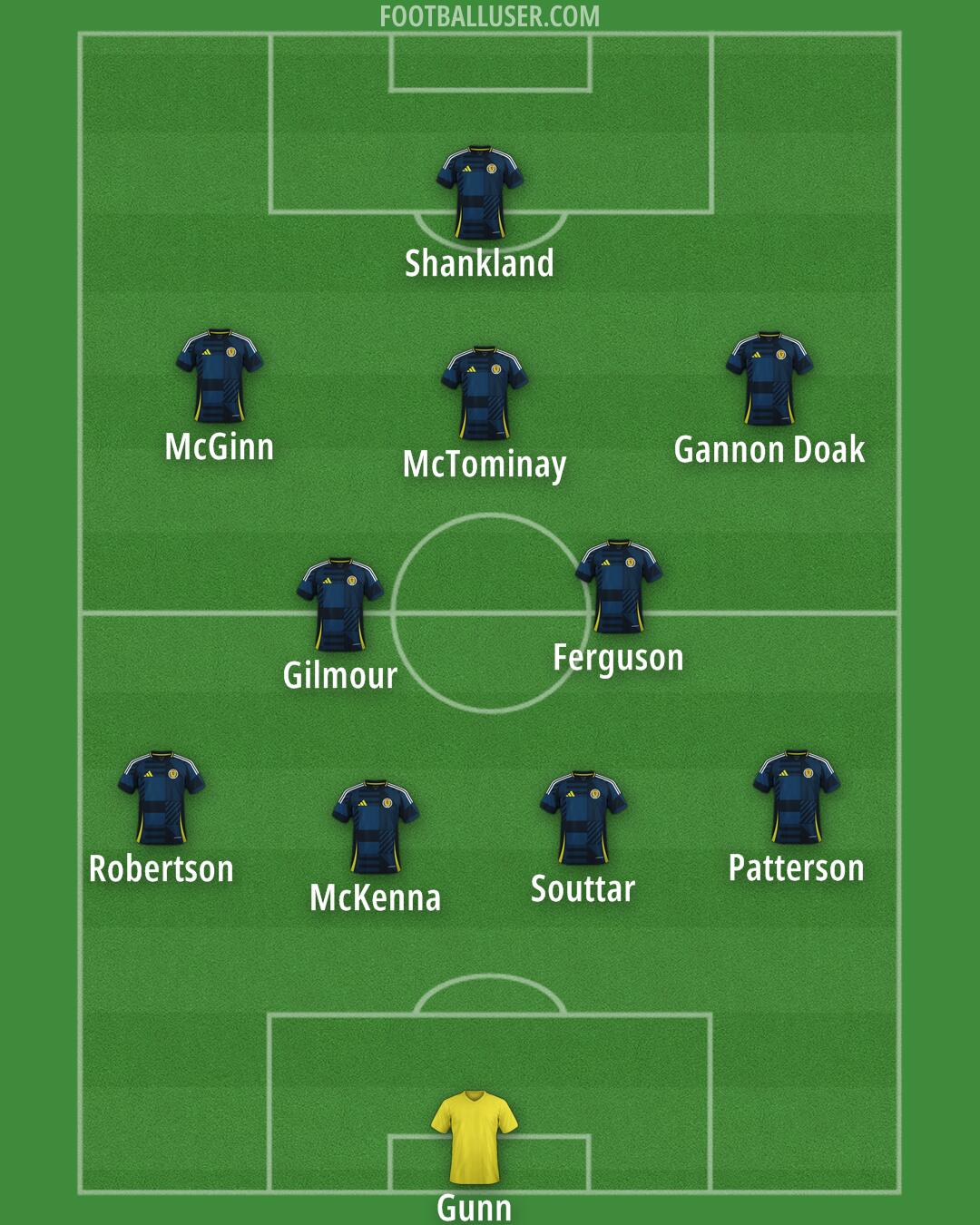
Scotland National Football Team Formation
 November 20, 2025


Starting Lineup
Gunn · Robertson · McKenna · Souttar · Patterson · Gilmour · Ferguson · McGinn · Gannon Doak · McTominay · ShanklandFocusing on high intensity and verticality, Scotland utilizes a 4-2-4 formation to overwhelm opponents. This lineup is built to play with directness, looking to push the ball forward quickly through the center and wide channels. The goal is to exert pressure high up the pitch and force errors in the opposition half.
Gunn stands between the posts to organize the back line. The defensive unit operates with a flat back four that must remain compact. Souttar provides aerial strength and presence in the air to defend crosses, while McKenna covers the left side of the central defense. Robertson works as an attacking left back to provide width, whereas Patterson pushes up the right flank to support the attack. The unit must track back quickly to prevent being caught out on the break.
The midfield relies on a double pivot to control the center of the pitch. Gilmour looks to find space between the lines and uses his passing range to connect the defense to the attack. Ferguson works alongside him to press high and disrupt the opposition. This pair must sit deep when the team loses the ball to protect the central defenders and ensure Scotland does not get bypassed in transition.
Up front, the attack uses four players to pin back the opposing defense. McGinn operates on the left wing, often looking to cut inside and drive at the goal. Gannon Doak provides width and pace on the right wing. In the central roles, McTominay and Shankland operate as two forwards. McTominay makes late runs into the box to score, while Shankland focuses on holding up the ball and finishing chances created by the wingers and midfielders.
One major advantage is the ability to press high in coordinated waves, using the front four to squeeze the opposition. Scotland can also create wide overloads when Robertson and Patterson push forward to join the wingers. This creates many options for a cross or a cut back into the box. The formation also allows for rapid transitions, moving the ball from the double pivot to the forwards in very few passes.
This 4-2-4 formation is designed for aggressive, high-pressing football that seeks to dominate the final third. It is best suited for games where the team needs to hunt for goals against a side that sits deep.