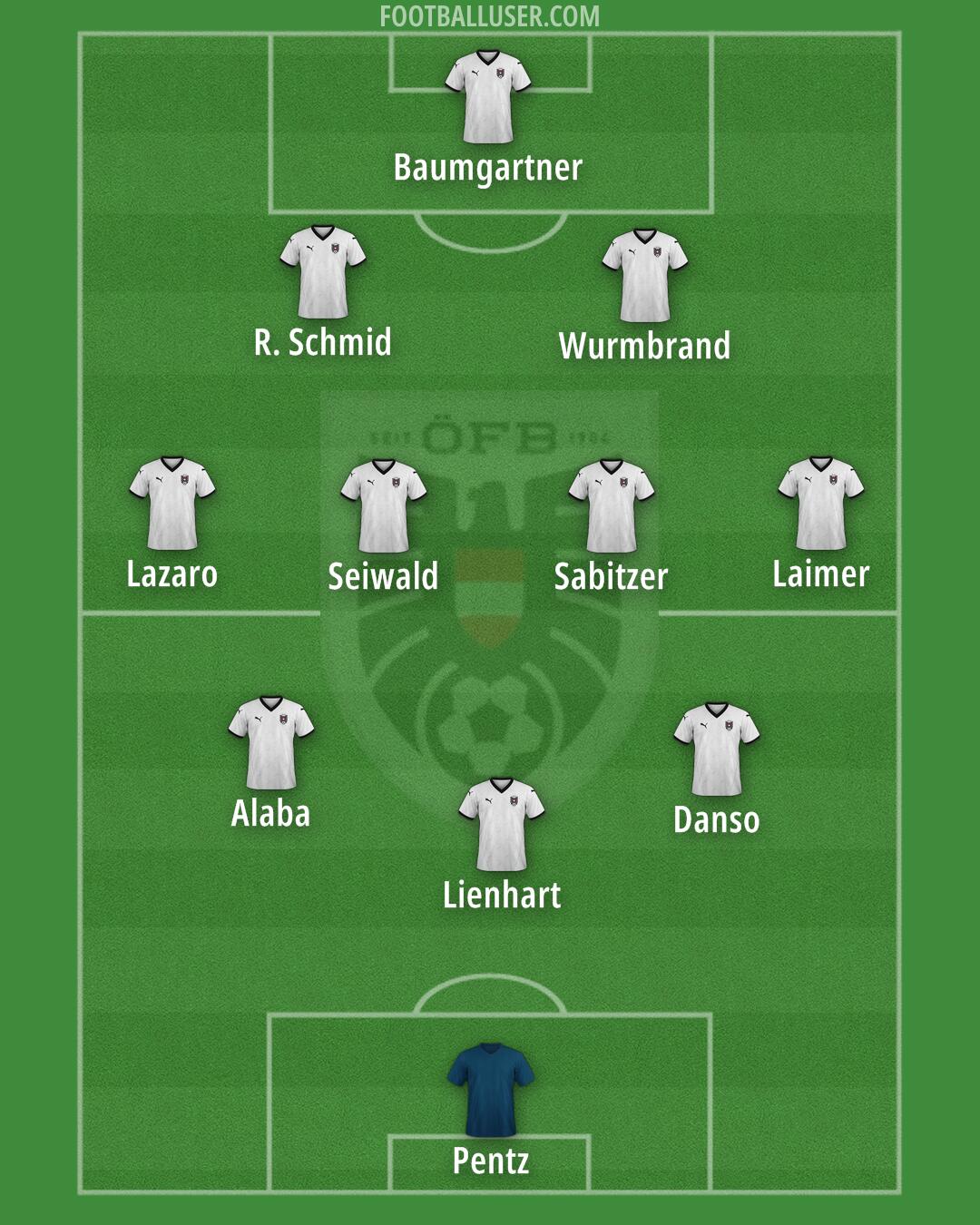

Austria National Football Team Formation
 November 21, 2025


Starting Lineup
Lazaro · Laimer · Seiwald · Baumgartner · R. Schmid · Wurmbrand · Sabitzer · Danso · Lienhart · Alaba · PentzAustria plays with a heavy high press and rapid verticality using a 3-4-3 formation. This lineup seeks to win the ball high up the pitch to catch opponents out of position through quick transitions. The goal for the Austrian national team is to use intensity and directness to overwhelm the opposition before they can settle into their defensive block.
Pentz guards the goal as the last line of defense. Ahead of him, a back three provides stability with Lienhart acting as a ball playing defender to start attacks. Danso uses his aerial strength and physical presence to defend the right side, while Alaba covers the left. The defenders are expected to step up to compress the space in the middle of the pitch, forcing opponents to play wide or risk losing possession in dangerous areas.
The midfield operates with two central players and two wide midfielders to control the tempo. Seiwald works to shield the defense and intercept passes, while Sabitzer uses his passing range to break the line and drive the team forward. Lazaro and Laimer act as wing backs, providing the width for the team. They must track back to support the back three but also push high to overlap the wingers and create crossing opportunities from the flanks.
In the final third, the attack relies on three players to stretch the opposing backline. Baumgartner leads the line as the lone striker, tasked to hold up the ball and make runs into the channels. Wurmbrand and R. Schmid operate as wide attackers, with R. Schmid looking to cut inside to create space for Lazaro. These three forwards must press in coordinated waves to prevent the opposition from building play from the back.
This formation offers significant advantages through its ability to press high in coordinated waves. Austria can also create wide overloads when Laimer or Lazaro push up to support the wingers, forcing defenders into difficult one on one situations. The compactness of the midfield and the three central defenders makes it difficult for opponents to find space between the lines when the team sits deep or shifts side to side.
The 3-4-3 formation provides a high intensity identity built on pressing and quick vertical movements. It is best suited for matches against teams that struggle to play out from the back or those that lack the speed to handle rapid transitions.