Leeds Football Formation
 November 24, 2025


Starting Lineup
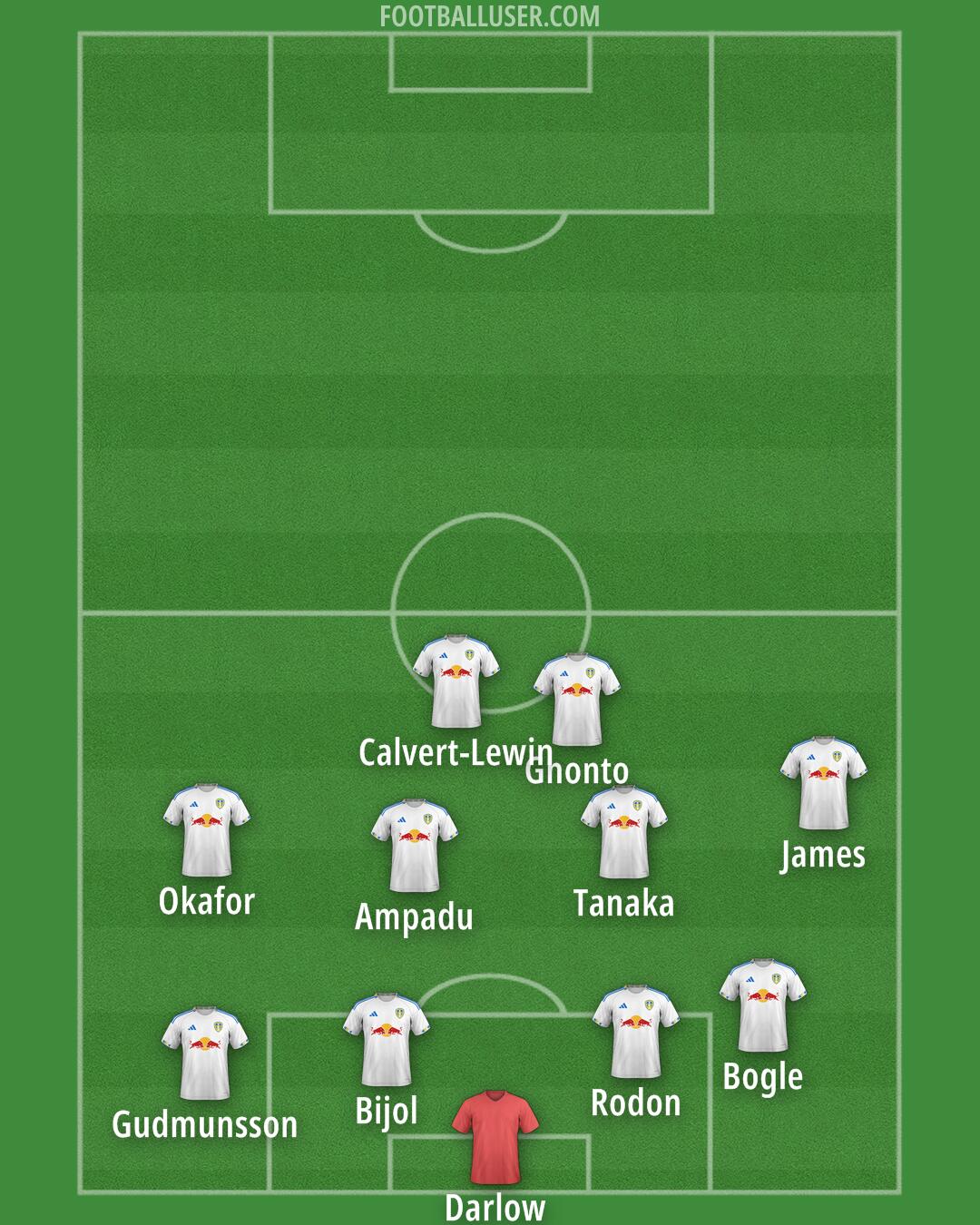
Darlow · Bogle · Rodon · Bijol · Gudmunsson · James · Tanaka · Ampadu · Okafor · Gnonto · Calvert-LewinLeeds focuses on a direct and high pressing style of play using a 4-4-2 formation. This lineup is built to win the ball back quickly and transition into vertical attacks that punish opponents. The team aims to control territory through physical presence and aggressive ball recovery in the middle third.
Darlow stays between the posts to manage the defense from the back. A flat back four consists of Bogle on the right and Gudmunsson on the left to provide width and cover the flanks. In the center, Bijol and Rodon act as the main defensive unit, where Bijol provides aerial strength and Rodon focuses on covering the space behind the line. These players must step up to intercept passes or drop deep to protect the goal when the team sits deep.
The midfield functions as a double pivot and two wide midfielders to maintain balance. Ampadu and Tanaka control the center, with Ampadu acting as the shield to protect the back four while Tanaka works to break the line with his movement. On the flanks, Okafor and James provide the engine, with James using his pace to push forward and Okafor helping to track back. This midfield group works to connect the defense to the front two by winning second balls and switching play quickly.
Leeds utilizes two forwards to lead the line in a high press. Calvert-Lewin acts as the lone striker who can hold up the ball and use his aerial strength, while Gnonto plays as a second striker to hunt for loose balls and run into the channels. The width comes from the wide midfielders, but the forwards often cut inside to create central presence. Their main job is to press the opposing defenders and force mistakes that lead to direct scoring opportunities.
A major strength of this Leeds formation is the ability to press high in coordinated waves. By having two strikers and two central midfielders close to the opposition, the team can suffocate the opponent in their own half. Another advantage is the speed of transition, as James and Gnonto can exploit space the moment the ball is recovered. The compactness of the two lines makes it hard for opponents to find gaps between the units.
This 4-4-2 formation relies on intensity and physical duels to dominate the pitch. It is best suited for games against teams that struggle to play out from the back under pressure.