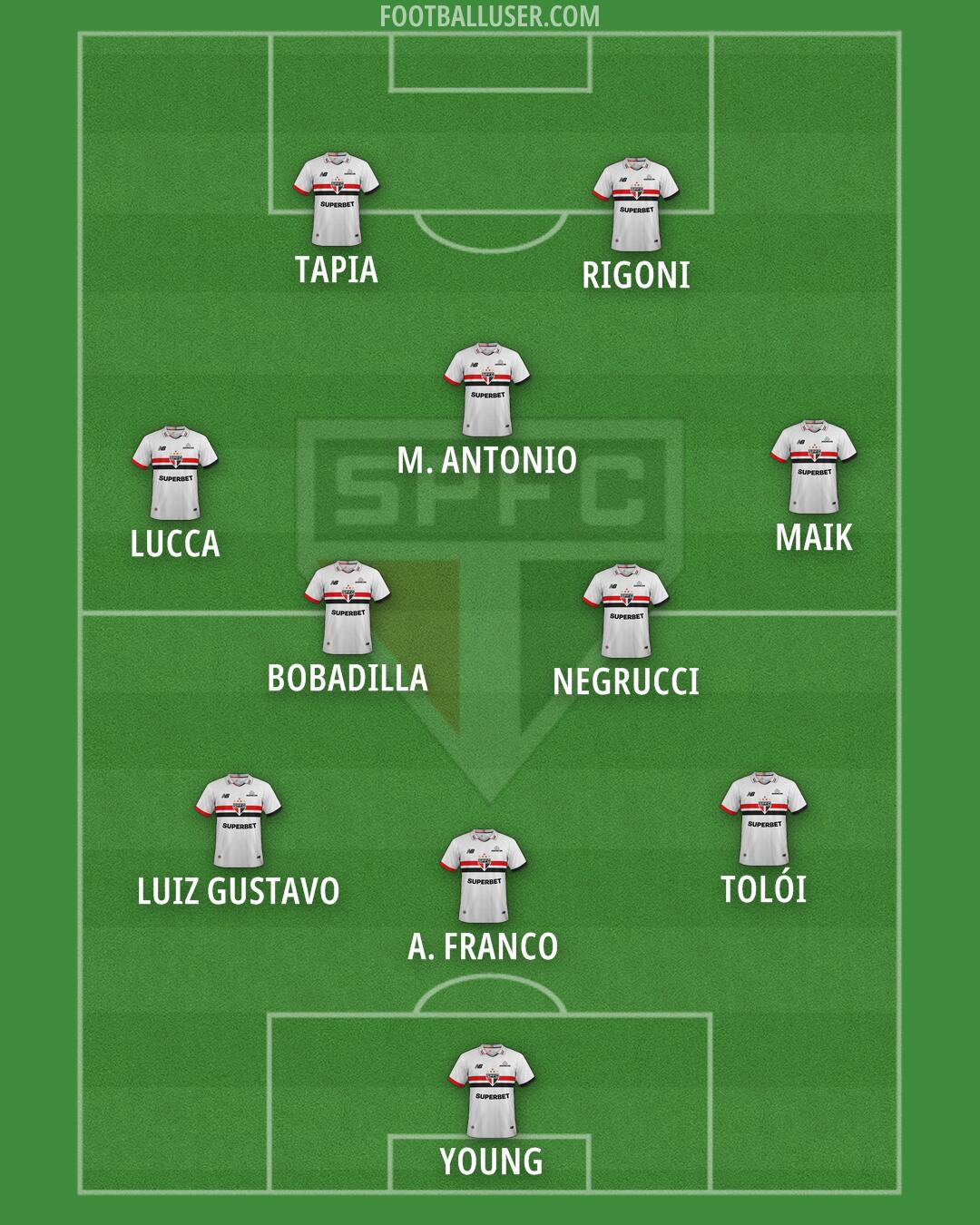

São Paulo Football Formation
 November 27, 2025


Starting Lineup
YOUNG · TOLÓI · A. FRANCO · LUIZ GUSTAVO · MAIK · NEGRUCCI · BOBADILLA · LUCCA · M. ANTONIO · TAPIA · RIGONISeeking to control games through central density and verticality, São Paulo utilizes a 3-5-2 formation. This lineup is built to dominate the middle of the pitch and use a compact block to win the ball back quickly. The team relies on high pressing and rapid transitions to catch the opposition out of position.
In the defensive phase, YOUNG guards the goal as the last man. The back line operates as a three man unit with Luiz Gustavo acting as the left central defender and Tolói covering the right side. A. Franco sits in the middle to direct the line. These defenders are expected to step up to intercept passes and cover the space left when the wingers push high. The back three must remain tight to prevent any direct runs through the center.
The midfield is the heart of this São Paulo system, operating with a heavy central presence. Bobadilla and Negrucci form a double pivot to shield the back three and hold the position when under pressure. In front of them, Lucca and Maik operate as two central midfielders who drive forward to support the attack. M. Antonio plays as an attacking ten, occupying the pockets of space between the opposition midfield and defense to connect the lines and create chances.
The attacking unit features two forwards, Rigoni and Tapia, who work in tandem to stretch the defense. Rigoni often looks to cut inside from the right to create shooting opportunities, while Tapia plays as a focal point to hold up the ball. They press the opposition defenders high up the pitch to force mistakes. This movement creates space for the midfielders to run into the final third.
This formation offers significant tactical advantages, particularly through numerical superiority in the center of the pitch. By crowding the midfield, the team can intercept many passes and control the tempo of the game. The presence of M. Antonio allows the team to break the line with quick vertical passes. Furthermore, the central density makes it very hard for opponents to play through the middle, forcing them to use wide areas where the team can shift and block crossing lanes.
This 3-5-2 formation focuses on central dominance and high pressing intensity. It is best suited for matches against teams that prefer to play through the middle or struggle to handle high-pressure environments.