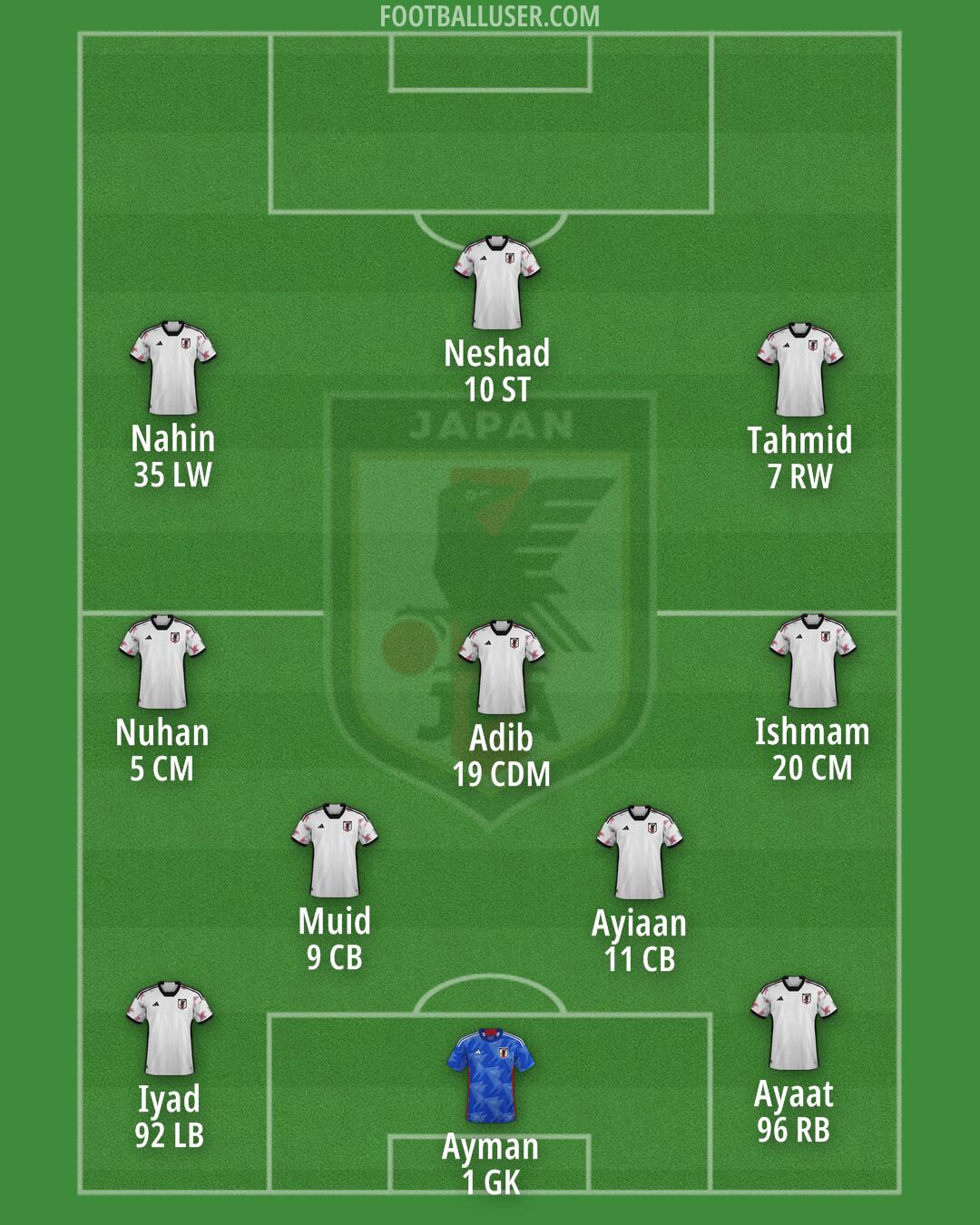

Japan National Football Team Formation
 November 30, 2025
 Ayiaan


Starting Lineup
Ayman (1 GK) · Iyad (92 LB) · Ayiaan (11 CB) · Tahmid (7 RW) · Ishmam (20 CM) · Nuhan (5 CM) · Adib (19 CDM) · Nahin (35 LW) · Neshad (10 ST) · Ayaat (96 RB) · Muid (9 CB)Japan looks to control games through high pressing and quick transitions in a 4-3-3. This lineup is built to dominate the ball and push opponents back into their own half. The team aims to use the width of the pitch to stretch the opposition defense while keeping a compact block when they lose possession.
Ayman sits between the posts to organize the defensive line. The back four functions with Muid and Ayiaan as the central pairing, where they look to block crosses and win aerial duels. Iyad operates as the left back to provide width, while Ayaat works on the right side to cover the flank. This defensive unit tries to stay high to keep the distances between players short.
A trio of midfielders controls the center of the pitch through a single pivot system. Adib sits deeper to shield the back line and break the lines with his passing. Nuhan and Ishmam operate ahead of him, with Nuhan acting as a link between the defense and the front three. Ishmam helps to drive forward during attacks, while both players work hard to press and intercept passes in the middle third.
The attacking front three provides the main goal threat for Japan. Neshad plays as a lone striker, tasked to hold up the ball and bring his teammates into the game. On the flanks, Nahin and Tahmid act as wide wingers who look to cut inside or drive toward the touchline. These attackers push high to pin the opposition defenders back and create space for the midfielders to run into.
This formation offers significant advantages in terms of pressing and wide play. The team can press high in coordinated waves with Nahin, Tahmid, and Neshad leading the charge. By using Iyad and Ayaat to overlap, the team can create wide overloads that isolate defenders in one on one situations. This helps the team to break down deep blocks and find openings in the final third.
The 4-3-3 allows Japan to maintain a high level of intensity through both ball retention and defensive pressure. This lineup is best suited for matches against teams that sit deep and struggle to handle rapid transitions.