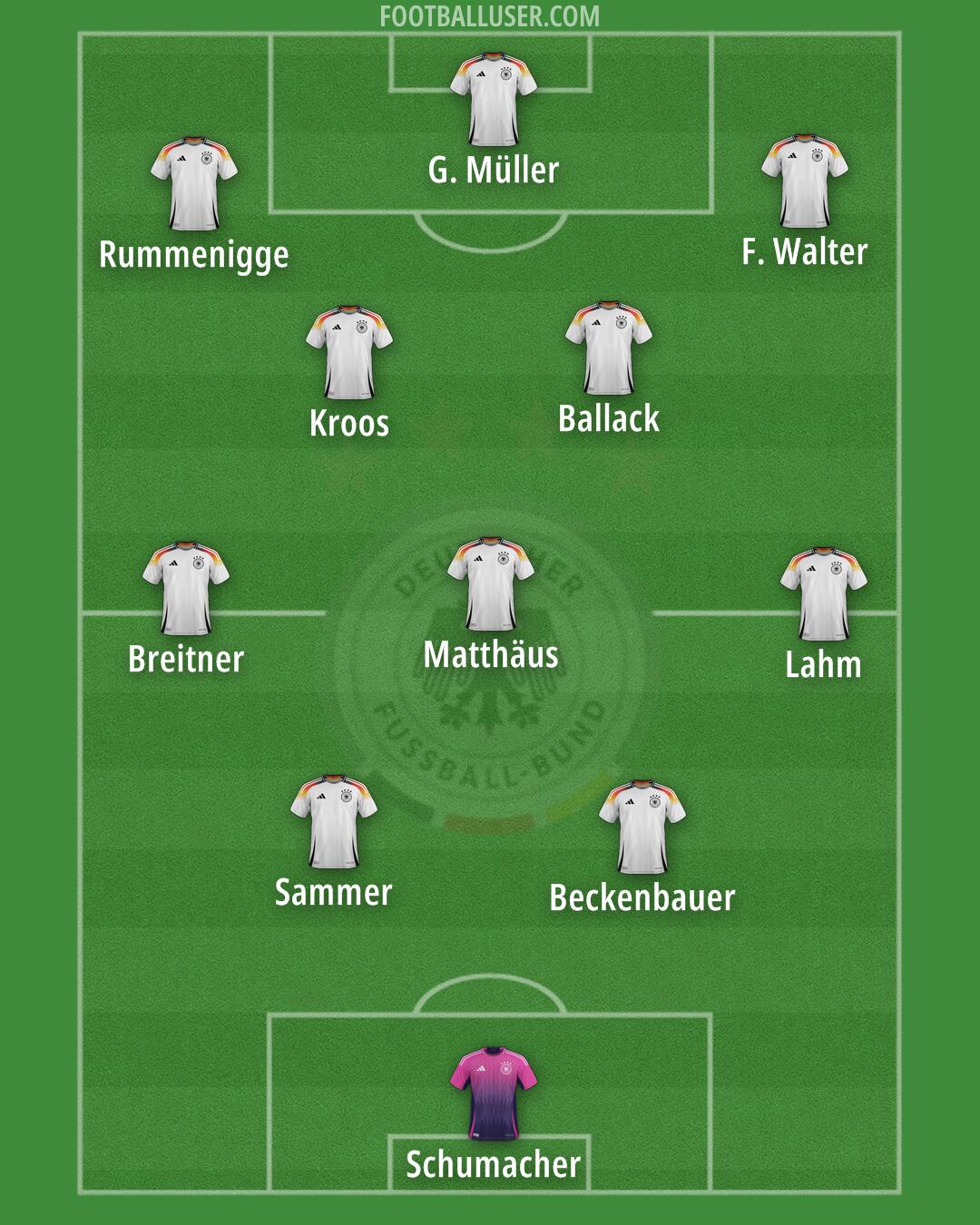

Germany National Football Team Formation
 December 2, 2025


Starting Lineup
G. Müller · Rummenigge · F. Walter · Ballack · Kroos · Matthäus · Lahm · Sammer · Beckenbauer · Breitner · SchumacherFocusing on verticality and high intensity, Germany utilize a 5-2-3 formation to dominate the pitch. This lineup is built to press high and quickly transition from defense to attack through central passing and wide runs. The team aims to control the tempo while remaining very difficult to break down through the middle.
Schumacher guards the goal while the defensive unit stays compact. A back three consists of Matthäus, Beckenbauer, and Sammer. Matthäus acts as the central anchor to sweep up danger, while Beckenbauer operates as a ball playing defender with his high technical ability to start attacks from the back. Sammer provides cover and aerial strength in the left channel. On the flanks, Lahm and Breitner act as wing backs who push high up the pitch to provide width. They are expected to track back quickly to form a five man line when the opposition has the ball.
The midfield operates with a double pivot. Kroos sits in the left channel to dictate the play with his immense passing range and ability to break the line. He connects the defenders to the attackers. Beside him, Ballack works to drive forward and uses his physical presence to win second balls. This pair must cover a lot of ground to ensure the team does not get overrun in the center. They serve as the engine that allows the front three to stay high.
The attacking line is composed of three direct players. G. Müller occupies the central role as a striker, using his predatory movement in the box to finish chances. On the wings, Rummenigge and F. Walter provide constant threat. Rummenigge cuts inside from the left to find scoring positions, while F. Walter stretches the play from the right. These attackers lead the first line of the press to force errors from the opposition defense.
Germany possesses significant tactical advantages with this setup. The presence of Beckenbauer and Kroos allows for total control over the ball and the ability to switch play rapidly. There is also a high capacity for wide overloads because Lahm and Breitner can overlap the wingers effectively. This creates numerical superiority in the final third and forces opponents to sit deep.
This formation creates a powerful balance between defensive solidity and attacking speed. It is best suited for matches where Germany can exploit spaces behind a high defensive line through rapid transitions.