Custom Team Football Formation
 December 3, 2025


Starting Lineup
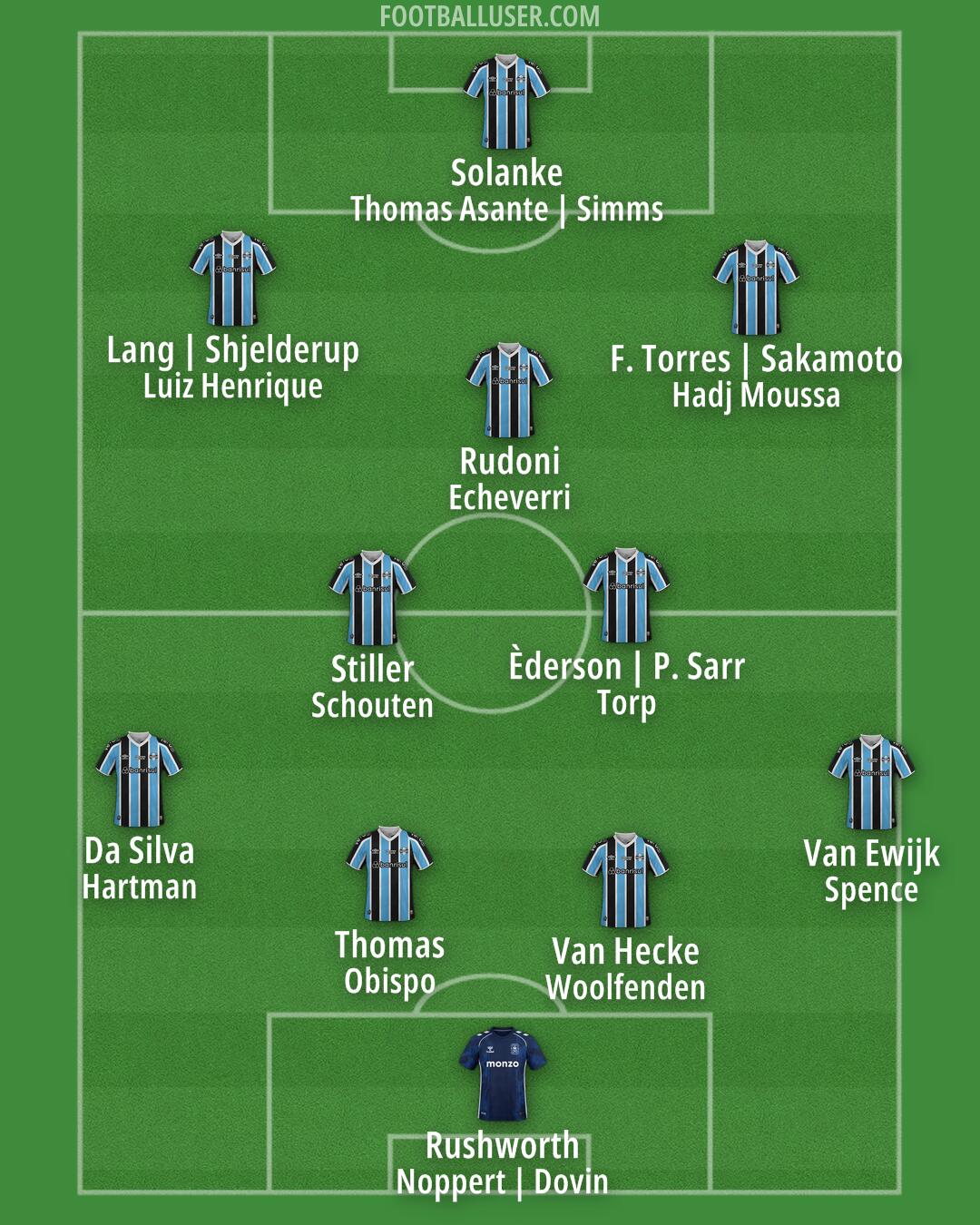
Thomas (Obispo) (Grêmio) · Van Hecke (Woolfenden) (Grêmio) · Van Ewijk (Spence) (Grêmio) · Da Silva (Hartman) (Grêmio) · Stiller (Schouten) (Grêmio) · Èderson | P. Sarr (Torp) (Grêmio) · Rudoni (Echeverri) (Grêmio) · F. Torres | Sakamoto (Hadj Moussa) (Grêmio) · Lang | Shjelderup (Luiz Henrique) (Grêmio) · Solanke (Thomas Asante | Simms) (Grêmio) · Rushworth (Noppert | Dovin) (Coventry)Searching for control through high pressing and quick transitions, this team operates with a 4-3-3 formation. The lineup aims to win it back high up the pitch to catch opponents out of position. By using a vertical style, the team looks to break the line quickly once possession is regained.
Rushworth starts between the posts to organize the back line. The defensive unit functions as a flat back four that can step up to squeeze the space. Van Hecke and Thomas act as the central pairing, with Van Hecke often playing as a ball playing defender to initiate attacks. Da Silva and Van Ewijk provide width as overlapping full backs, pushing high to support the wings. This allows the central defenders to hold the line and cover the space left behind when the wide defenders push forward.
The midfield is built around a three man midfield with a carrier. Stiller plays as the deep lying playmaker, dropping between the centre backs to receive the ball and recycle possession. Èderson | P. Sarr operates as an inverted eight, driving forward with the ball to connect the defensive and attacking lines. Rudoni plays as an attacking ten behind the striker, looking to find the feet of the striker or arrive late into the box. This trio works to compress the midfield and prevent the opposition from playing through the thirds.
In the final third, the team uses three attackers across the front. Solanke acts as a pressing centre forward, working to pin the last defender and hold up the ball for others. Lang | Shjelderup and F. Torres | Sakamoto operate as inverted wingers who cut inside to create central presence. These wide players look to isolate a one on one or find space to play a one two with the midfielders. The goal is to create runs in behind through quick combinations or to pull wide to stretch the defence.
This formation offers clear tactical advantages including the ability to press high in coordinated waves. By having the full backs push up, the team can create wide overloads to bypass the midfield. The central trio also ensures numerical superiority in midfield when they squeeze the space against a double pivot.
This 4-3-3 lineup relies on high intensity and quick ball movement to disrupt opposition banks. It is best suited for games where the opponent plays a high line and can be caught on the transition.