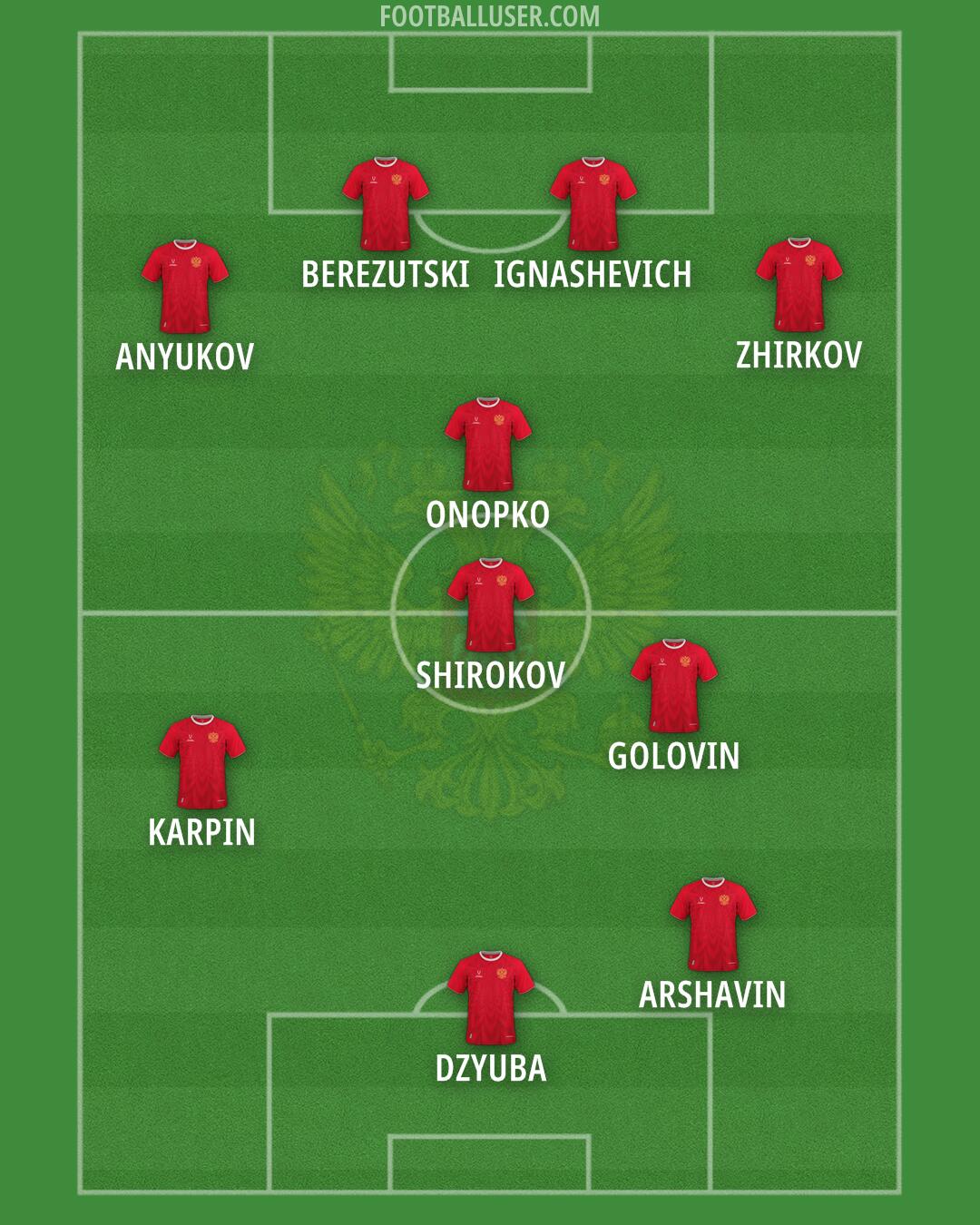

Russia National Football Team Formation
 December 4, 2025


Starting Lineup
AKINFEEV · IGNASHEVICH · BEREZUTSKI · ANYUKOV · ZHIRKOV · ONOPKO · KARPIN · ARSHAVIN · DZYUBA · SHIROKOV · GOLOVINFocusing on defensive solidity and rapid breaks, Russia operates in a 5-3-2 formation. This lineup is built to sit deep and absorb pressure before hitting opponents with direct vertical passes. The tactical identity relies on a compact block that forces the opposition wide and uses quick transitions to catch them out of position.
Akinfeev stands between the posts to command the area and organize the back line. The defensive unit uses a back three consisting of Onopko, Ignashevich, and Berezutski, who provide massive aerial strength and physical presence. Anyukov and Zhirkov act as wing backs, tasked with covering the entire flank to provide width in attack and tracking back to defend. This heavy defensive core allows the team to stay compact and difficult to break down in low block situations.
The midfield works as a central trio designed to control the tempo and shield the back three. Shirokov sits in the single pivot role to intercept passes and break up opposition play. Golovin operates in the middle to connect the defense to the attack with his passing range, while Karpin pushes higher to operate as an attacking midfielder. This midfield unit must work hard to cover large spaces when the wing backs push up the pitch.
In the attacking phase, Russia utilizes two forwards to lead the line. Arshavin plays as a second striker, often cutting inside from the left to create chances and find space between the lines. Dzyuba acts as the lone target man, using his size to hold up the ball and bring others into play. The attack relies on the movement of Arshavin to complement the physical presence of Dzyuba, creating a mix of technical skill and power.
One major advantage of this formation is the ability to create wide overloads when Anyukov and Zhirkov overlap. Another strength lies in the speed of transition, where the team can move from a deep defensive block to a forward attacking position in seconds. The presence of three central defenders also provides a numerical superiority in the box when defending crosses or set pieces.
Russia relies on a compact defensive base and clinical counter attacks. This formation is best suited for facing teams that dominate possession and leave space behind their high defensive line.