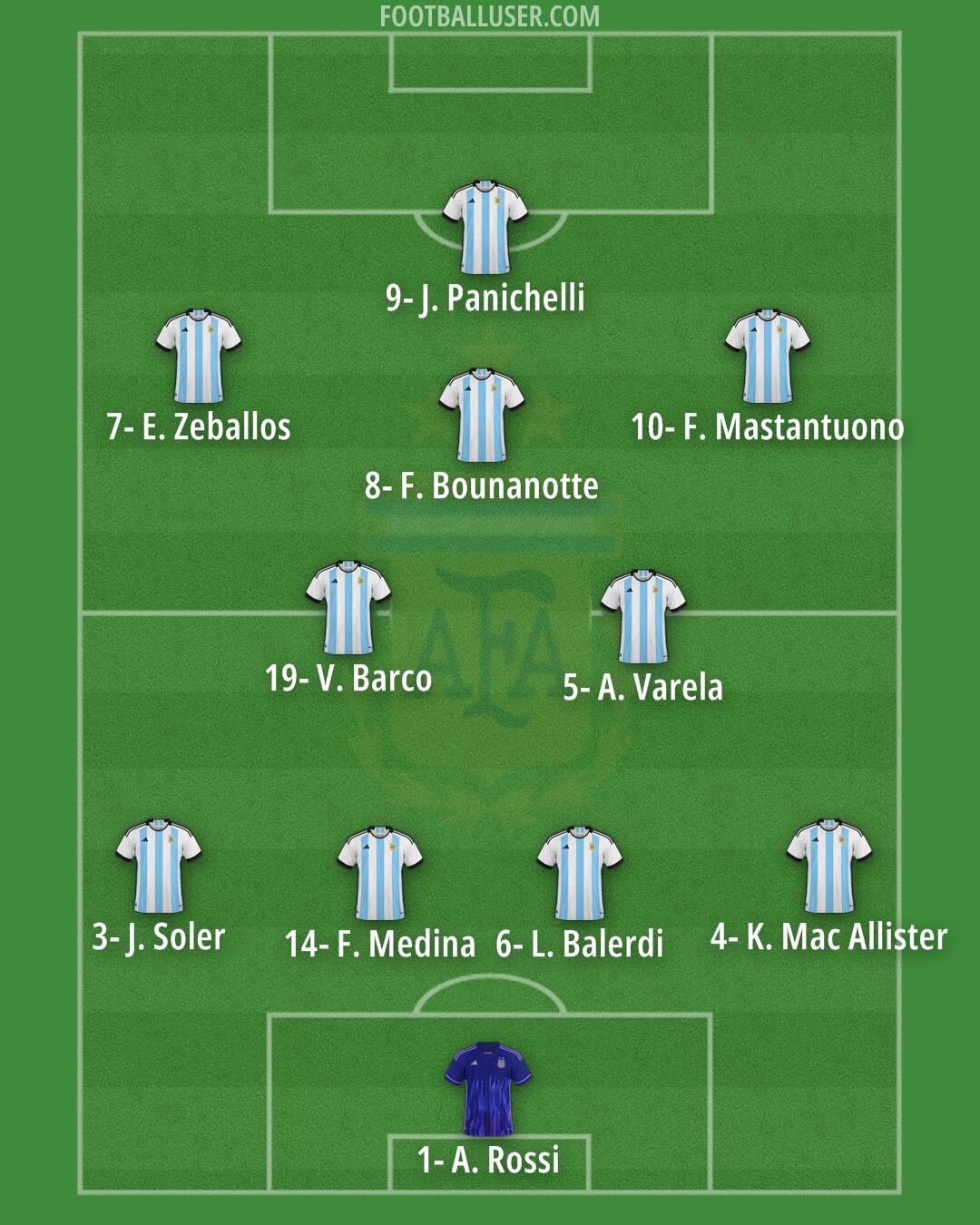

Argentina National Football Team Formation
 December 7, 2025


Starting Lineup
1- A. Rossi4- K. Mac Allister
6- L. Balerdi
14- F. Medina
3- J. Soler
5- A. Varela
19- V. Barco
10- F. Mastantuono
9- J. Panichelli
7- E. Zeballos
8- F. Bounanotte
Argentina aims to overwhelm opponents through constant attacking pressure and high intensity. This team uses a 4-2-4 formation to flood the final third and force errors. The lineup is built to play a very vertical game that targets the opposition box through quick transitions.
A. Rossi stays between the posts to manage the defensive line. L. Balerdi and F. Medina form the central pair, where Balerdi acts as a ball playing defender to start play from the back. Medina works to cover space and win duels in the air. On the flanks, K. Mac Allister and J. Soler act as wide defenders. K. Mac Allister often pushes up to overlap, while J. Soler must balance his runs with the need to track back and cover the wide areas.
The midfield works as a double pivot to maintain control. A. Varela and V. Barco hold the center of the pitch. Varela focuses on shielding the back four and intercepting passes to stop breaks. V. Barco is the link that connects the defense to the attack, often stepping up to drive the ball forward into the half spaces. This duo must work hard to press when the ball is lost.
A heavy front four drives the attack. E. Zeballos operates as a wide winger on the left, while F. Mastantuono works from the right with a tendency to cut inside. F. Bounanotte and J. Panichelli play as two central forwards to pin the opposition defenders. They use the width of the pitch to stretch the defense before the forwards make runs into the box. These players press high to win the ball back immediately.
This formation provides several tactical advantages for Argentina. The most obvious is the numerical superiority in the final third, which can isolate defenders in one on one situations. The team can also create wide overloads through the movement of the full backs combined with the wingers. Furthermore, the ability to press high in coordinated waves makes it very difficult for an opponent to play out from the back. The speed of transition allows the team to punish teams that sit too deep.
The 4-2-4 is a high intensity lineup designed to dominate through sheer numbers in the attacking zone. It is best suited for matches against teams that struggle with high pressing or lack the pace to defend large amounts of space behind them.