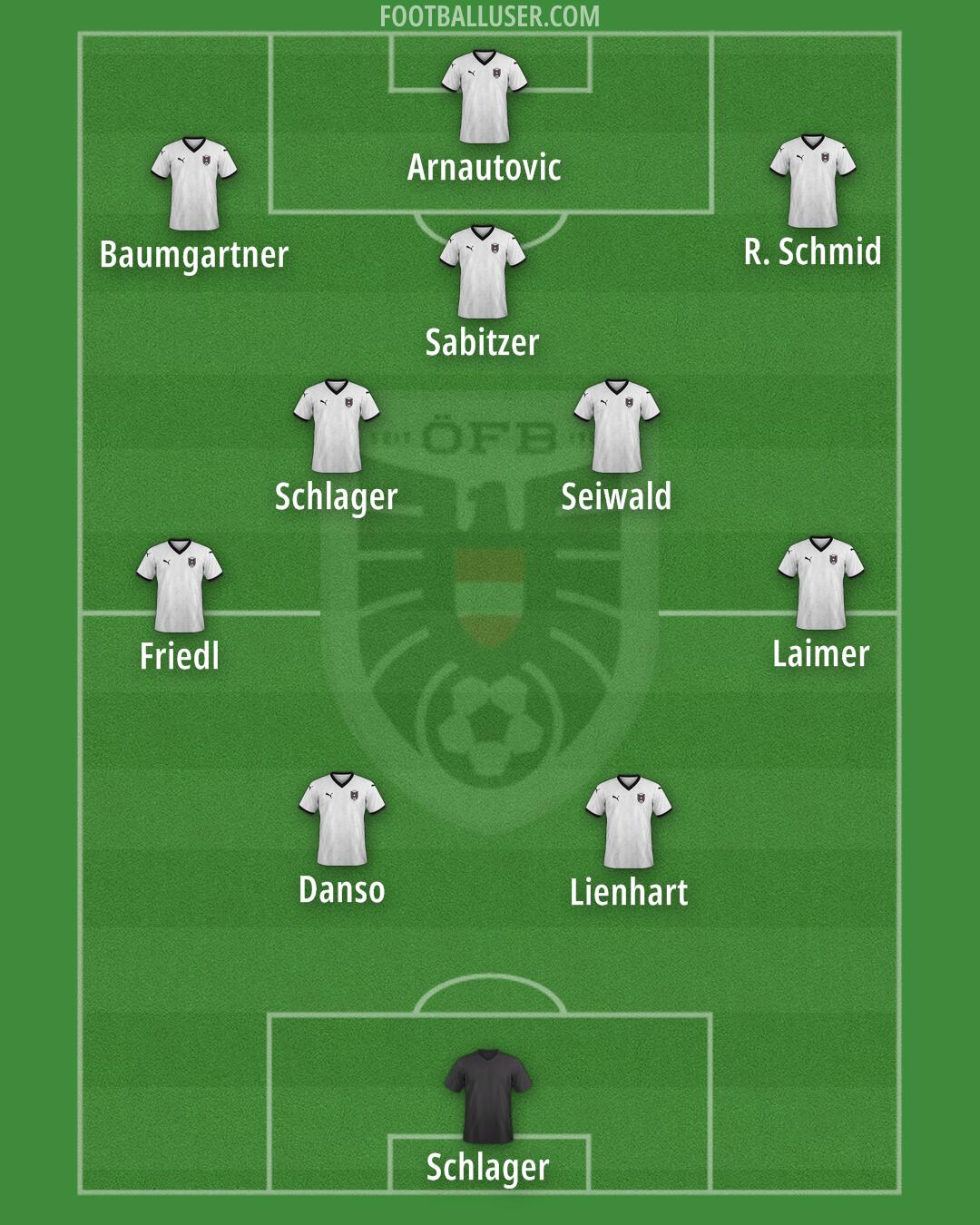

Austria National Football Team Formation
 December 8, 2025


Starting Lineup
Arnautovic · Baumgartner · Sabitzer · R. Schmid · Schlager · Seiwald · Friedl · Laimer · Danso · Lienhart · SchlagerAustria aims to dominate the central areas of the pitch and press high to win the ball back quickly. This intent is reflected in their aggressive 2-5-3 formation. The lineup is designed to suffocate opponents in their own half and use a heavy central presence to control the tempo of the game.
Schlager stays between the posts to organize the defensive unit. In front of him, Lienhart and Danso operate as a central pair in a narrow back two. Both players must be ready to step up into space or drop deep to cover long balls. Because there are no wide defenders in this specific lineup, the two central defenders must remain compact and use their physical presence to intercept passes and block crosses.
The midfield is the engine room for the Austrian national team, working in a dense block of five. Friedl and Laimer form a double pivot to shield the back two and track runners. Beside them, Schlager and Seiwald occupy the central channels to win second balls and push the line forward. Sabitzer operates as the attacking ten, looking to break the line with vertical passes or driving runs into the box. This heavy midfield concentration allows the team to dominate possession and recycle play through the center.
In the final third, the team employs three dedicated attackers to stretch the opposition. Arnautovic leads the line as a lone striker, using his strength to hold up the ball and bring others into play. On the flanks, Baumgartner and R. Schmid provide the width needed to pull defenders out of position. Baumgartner looks to cut inside and create chances, while R. Schmid stays wide to deliver crosses. These three forwards lead the high press to force turnovers high up the pitch.
One major advantage of this formation is the massive numerical superiority in the middle of the park. By crowding the center, Austria can easily intercept passes and control the rhythm. Another strength is the ability to press in coordinated waves, with the front three and the five midfielders working together to trap opponents. This creates significant pressure in the opposition half and allows for quick transitions once the ball is recovered.
This aggressive formation relies on high intensity and control of the central zones. It is best suited for games where Austria can dictate the tempo against teams that sit deep.