
Brazil National Football Team Formation
 December 8, 2025


Starting Lineup
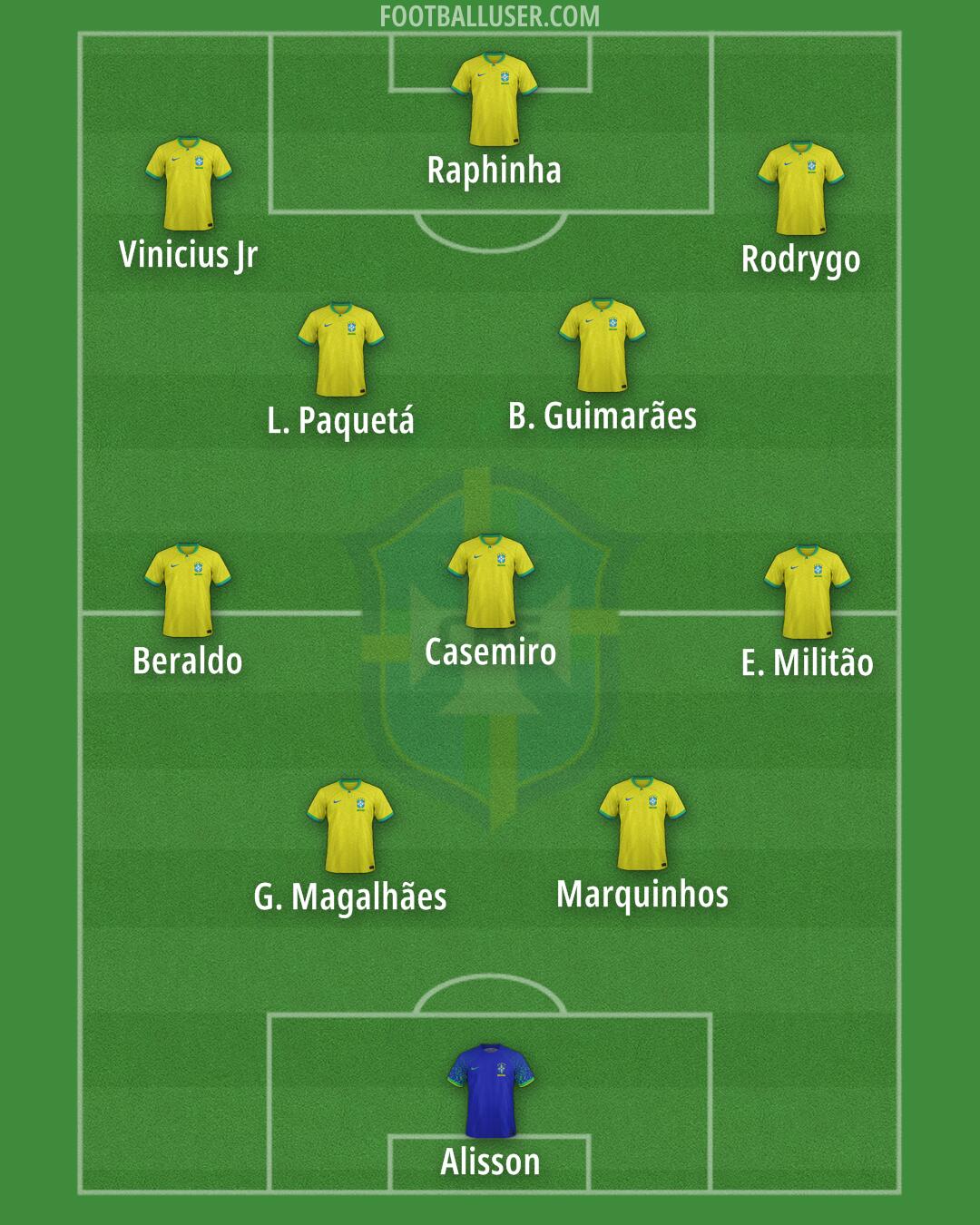
Raphinha · Vinicius Jr · Rodrygo · Casemiro · L. Paquetá · B. Guimarães · E. Militão · Beraldo · G. Magalhães · Marquinhos · AlissonFocusing on rapid transitions and high pressing defines how Brazil plays in this 5-2-3 formation. The lineup aims to control large areas of the pitch through intense running and directness when moving forward. This formation relies on wide players to stretch the opposition while the center stays compact to defend against breaks.
Alisson acts as the last line of defense, utilizing his sweeping ability and strong distribution to start attacks. The defensive unit operates with a back three consisting of G. Magalhães, Marquinhos, and Casemiro. Marquinhos provides aerial strength and composure, while G. Magalhães stays deep to cover space. E. Militão plays as the right wing back to push high up the pitch and provide width, whereas Beraldo works as the left wing back to overlap and deliver crosses. This block can sit deep or step up to compress the space between the lines.
The midfield functions as a double pivot to bridge the gap between the defense and the front three. L. Paquetá and B. Guimarães occupy the central spaces, with one player often dropping to help the defenders while the other moves to support the attack. L. Paquetá uses his passing range to break the lines, and B. Guimarães helps to intercept passes and shield the back three. They must track back quickly to prevent opponents from finding space between the midfield and the defensive line.
In the final third, Brazil utilizes three attackers to pin the opposition back. Raphinha leads the line as the lone striker, holding up the ball and pressing the defenders to force mistakes. On the wings, Vinicius Jr and Rodrygo operate as wide attackers who love to cut inside and drive at the defense. Vinicius Jr uses his explosive dribbling and pace to beat markers, while Rodrygo looks to create space for himself or others. The movement of these three players forces the opposing defense to stretch thin.
This formation offers significant advantages through its ability to create wide overloads when the wing backs join the attackers. The defensive solidity of the three central defenders provides security, allowing the midfielders to push forward with more confidence. Brazil can also use the speed of transition to catch opponents off balance, moving from a low block to an attacking stance in seconds. The presence of multiple ball playing defenders makes it easier to build play from the back.
This 5-2-3 lineup is a potent tool for teams looking to combine defensive stability with lethal counter attacks. It is best suited for matches against teams that play with high defensive lines or those who struggle to cope with wide numerical superiority.