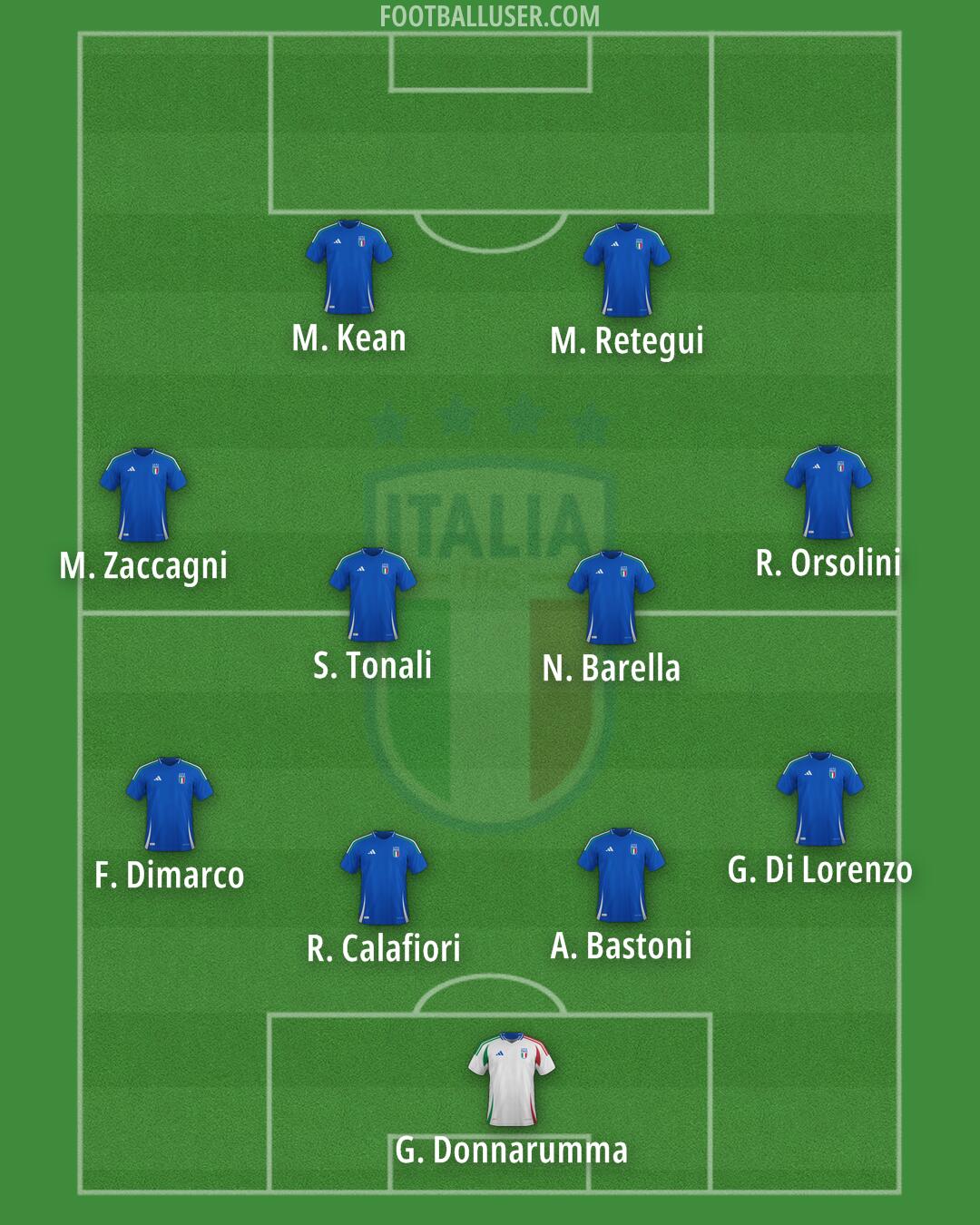

Italy National Football Team Formation
 December 8, 2025


Starting Lineup
G. Donnarumma · G. Di Lorenzo · A. Bastoni · R. Calafiori · M. Zaccagni · R. Orsolini · F. Dimarco · N. Barella · S. Tonali · M. Kean · M. ReteguiItaly aims to play a direct and hard pressing game through a 4-4-2 formation. This lineup focuses on verticality and quick transitions to catch opponents out of position. The team seeks to use the width of the pitch while maintaining a compact block when they do not have the ball.
G. Donnarumma acts as the last line of defense, using his massive frame to command the area. In front of him, a flat back four provides a solid base. A. Bastoni acts as a ball playing defender with a long passing range, while R. Calafiori covers the space alongside him. The wide defenders are key to the width, as F. Dimarco looks to push high and deliver crosses from the left, while G. Di Lorenzo tracks back to support the defense and overlaps when needed.
The midfield operates in two banks of two to keep the team compact. S. Tonali sits deeper to shield the defense and break the line with his passing, while N. Barella drives forward to link the play. On the flanks, M. Zaccagni and R. Orsolini provide the engine in the wide areas. They must track back to help the full backs and then immediately push up to support the attack. This midfield unit works to intercept passes and force the opposition into mistakes.
In the attacking phase, Italy uses two forwards to stretch the opposition defense. M. Kean and M. Retegui play as a strike partnership, often looking to run behind the line. M. Kean uses his physical presence to hold up the ball, allowing the midfielders to join the play. The wide players, M. Zaccagni and R. Orsolini, cut inside to create space for the full backs or to shoot. This movement creates constant pressure in the final third.
One major advantage for Italy is the ability to press high in coordinated waves using the two strikers and wide midfielders. Another strength lies in the wide overloads created when F. Dimarco and M. Zaccagni push forward together. The team can also switch play quickly to find isolated players in one on one situations on the wings. These tactical elements make the formation difficult to break down during defensive transitions.
This 4-4-2 formation relies on work rate and rapid vertical movements to succeed. It is best suited for matches against teams that play a high line or struggle to handle intense physical pressure.