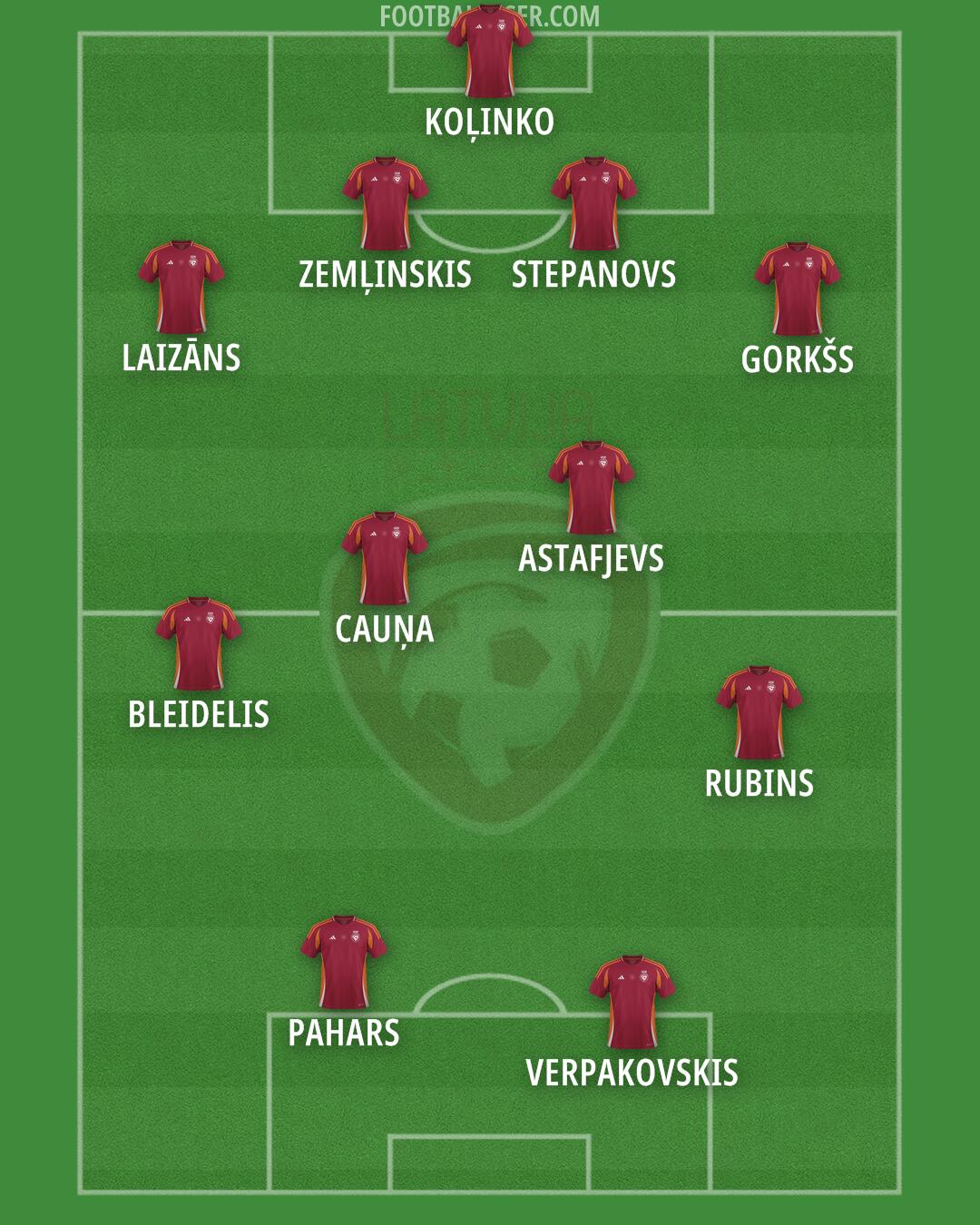

Latvia National Football Team Formation
 December 10, 2025


Starting Lineup
KOĻINKO · ZEMĻINSKIS · STEPANOVS · LAIZĀNS · GORKŠS · ASTAFJEVS · CAUŅA · BLEIDELIS · RUBINS · PAHARS · VERPAKOVSKISLatvia prefers to sit deep and play a direct, counter attacking game using a 4-4-2. This formation is built to absorb pressure and strike quickly when the opposition leaves space behind. The lineup relies on compactness to frustrate opponents and uses the verticality of the two strikers to transition from defense to attack in a matter of seconds.
KOĻINKO acts as the last line of defense in goal. The back four consists of a flat defensive line where ZEMĻINSKIS and STEPANOVS act as the central duo to block crosses and win headers. LAIZĀNS and GORKŠS operate as full backs, tasked with tracking back to mark wide players and preventing crosses into the box. The unit must remain close together to prevent gaps from opening between the defenders.
The midfield works in two banks of four to cover the width of the pitch. ASTAFJEVS sits in front of the defense as a single pivot to shield the back line and intercept passes. To his sides, CAUŅA and BLEIDELIS provide the engine, with CAUŅA working to break the line with passes and BLEIDELIS helping to cover ground. RUBINS pushes forward from the central area to act as an attacking ten, connecting the midfield to the two forwards.
In the final third, Latvia utilizes two forwards to stretch the opposition. VERPAKOVSKIS and PAHARS work as a strike duo, often playing on the shoulder of the last defender to exploit long balls. The wingers in the 4-4-2 system are expected to push wide to provide crosses, while the two strikers hold up the ball to allow the midfield to push up. This attacking setup forces the opposition defenders to stay deep.
One major advantage for Latvia is the ability to create compactness when defending in a low block. By keeping the distance between the midfield and the defensive line small, they make it difficult for opponents to pass through the middle. Another strength is the speed of transition, as the team can move the ball quickly from ASTAFJEVS to the forwards. This allows them to isolate wide players in one on one situations during a quick break.
This 4-4-2 formation is designed to be defensively solid and efficient on the break. It is best suited for matches against technically superior teams where Latvia can sit deep and wait for the right moment to strike.