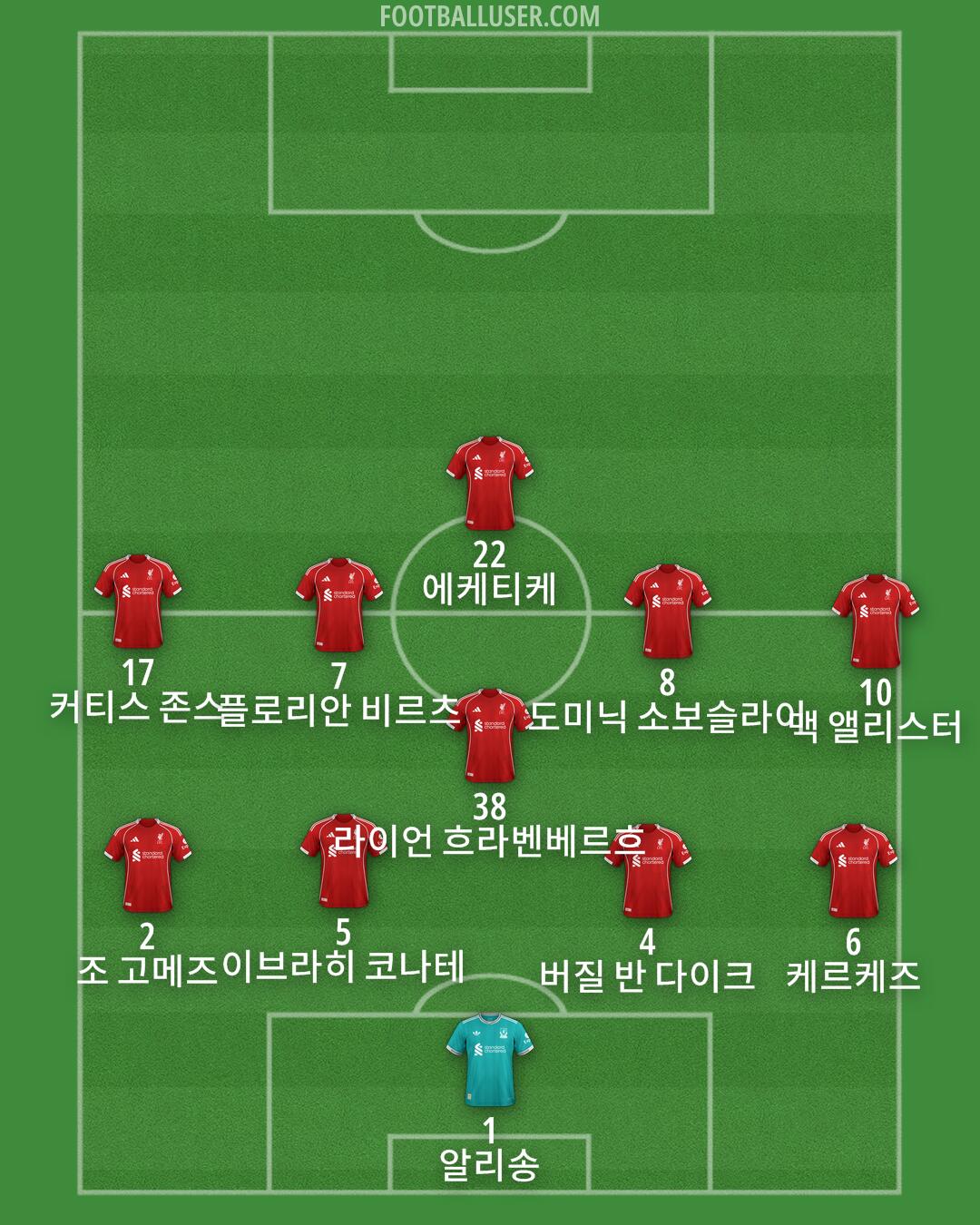
Liverpool Football Formation
 December 13, 2025


Starting Lineup
1 (알리송)2 (조 고메즈)
5 (이브라히 코나테)
4 (버질 반 다이크)
6 (케르케즈)
38 (라이언 흐라벤베르흐)
17 (커티스 존스)
7 (플로리안 비르츠)
8 (도미닉 소보슬라이)
10 (맥 앨리스터)
22 (에케티케)
Liverpool aims to play a high press and fast transition game using a 4-5-1 formation. This lineup focuses on winning the ball back quickly in the opponent half to launch direct attacks. The team relies on intense running and closing down spaces to force mistakes from the opposition.
The goalkeeper 1 sits behind a flat back four that maintains a high line to keep the team compact. Central defenders 5 and 4 work together to cover space and win aerial duels, with 5 acting as the primary cover. On the flanks, 2 and 6 act as full backs who must track back to defend wide areas while also preparing to push up. This defensive unit works to keep the distance between the line and the midfield very small.
In the middle of the pitch, the midfield is built around a single pivot with 38 sitting deep to shield the defense. Around 38, three central midfielders including 8, 7, and the central roles create a crowded zone to intercept passes and disrupt the opposition. The wide midfielders 10 and 17 provide much of the width, helping to link the defense to the attack by stretching the play. This group works to press in waves to prevent the opponent from building from the back.
The attacking plan revolves around a lone striker 22 who must hold up the ball and fight against central defenders. Because there is only one striker, the wide players 10 and 17 are vital to cut inside and provide support in the final third. The goal is to use the movement of 22 to pull defenders out of position, creating gaps for the midfielders to run into. This setup forces the opposition to defend a large area of the pitch.
One major advantage for Liverpool is the ability to press high in coordinated waves, making it difficult for opponents to find passing lanes. The presence of 38 allows the other midfielders to push higher without leaving the center completely exposed. Additionally, the width provided by 10 and 17 allows for quick switches of play to exploit isolated defenders on the flanks.
This 4-5-1 formation is built to dominate through heavy pressing and rapid verticality. It is most effective against teams that try to build play slowly from the back.