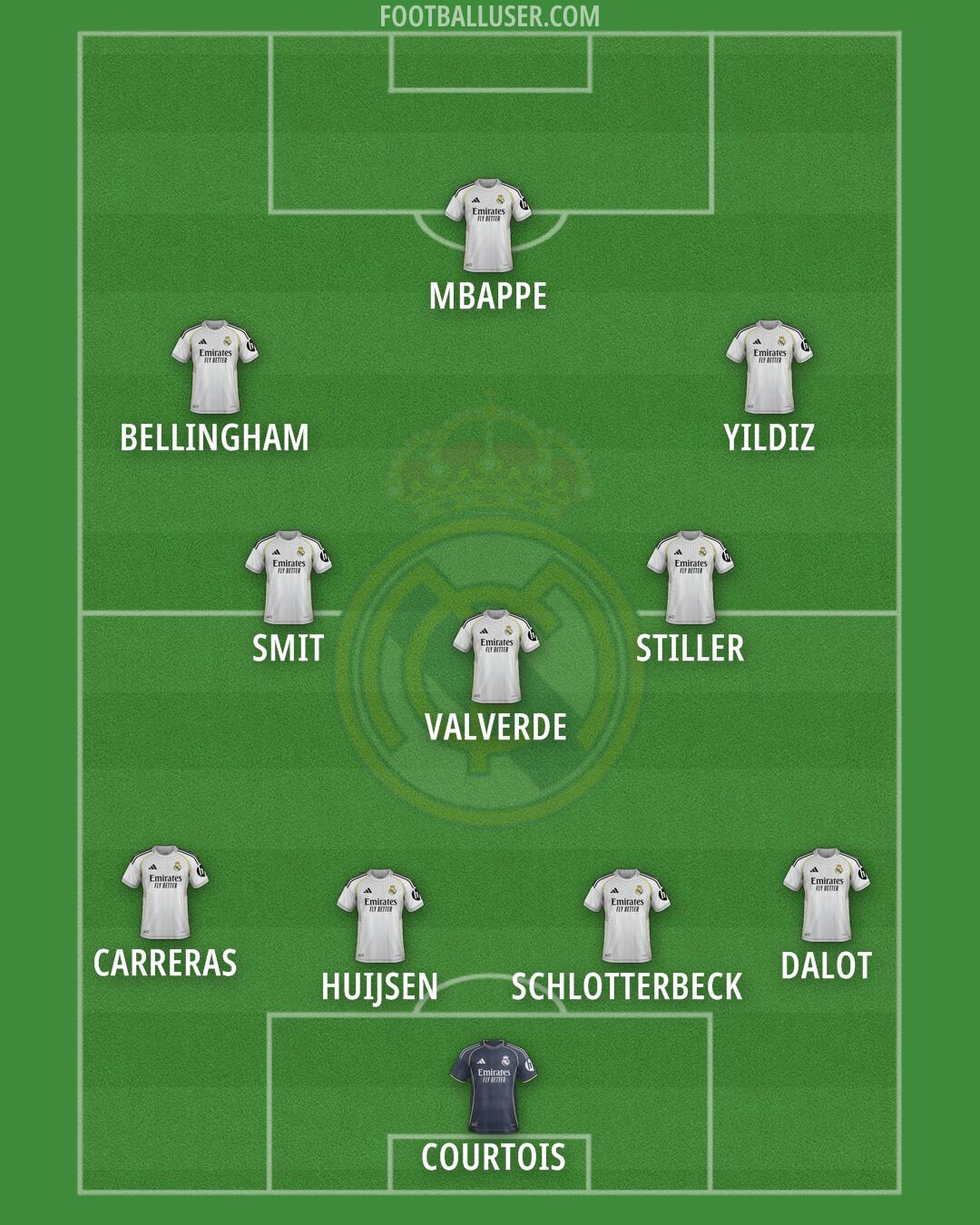

Real Madrid Football Formation
 December 14, 2025


Starting Lineup
COURTOIS · SMIT · STILLER · HUIJSEN · SCHLOTTERBECK · MBAPPE · VALVERDE · BELLINGHAM · DALOT · CARRERAS · YILDIZReal Madrid aims to control the tempo through a high press and rapid transitions using a 4-3-3. This formation is built to dominate the ball and squeeze the opponent in their own half. By pushing the lines forward, the team seeks to win the ball back quickly to exploit spaces before the opposition can settle.
Thibaut Courtois acts as the last line of defense for Real Madrid. The back line operates with a high line, where Schlotterbeck and Huijsen act as the central pair. Schlotterbeck provides aerial strength and physical presence to win headers, while Huijsen covers the space behind during transitions. On the flanks, Dalot and Carreras provide width by pushing up to overlap the midfield, which helps move the defensive block higher up the pitch.
The midfield functions as a single pivot system with Valverde acting as the defensive screen. Valverde uses his high pressing intensity and immense engine to track runners and break up play in the center. Ahead of him, Smit and Stiller work to connect the defense to the attack. Smit drives forward to penetrate the lines, while Stiller uses his passing range to switch play and control the rhythm of the game.
In the final third, the team uses three attackers to pin the opposition back. Mbappe leads the line as a lone striker, using his explosive pace to run behind defenders and occupy the central channels. Bellingham plays as an inverted winger on the left, often cutting inside to join the midfield, while Yildiz operates on the right to provide width and direct runs. This front line presses in unison to force mistakes high up the field.
This lineup offers significant advantages through its ability to press high in coordinated waves. The presence of Valverde in the pivot allows the team to maintain compactness when defending against counter attacks. Furthermore, the team creates wide overloads when Dalot or Carreras push up to support the wingers, forcing the opposition to shift their defensive block constantly.
The 4-3-3 formation focuses on high intensity and rapid verticality. It is best suited for games where the team needs to break down a low block or dominate possession against mid-table sides.