
Austria National Football Team Formation
 December 17, 2025


Starting Lineup
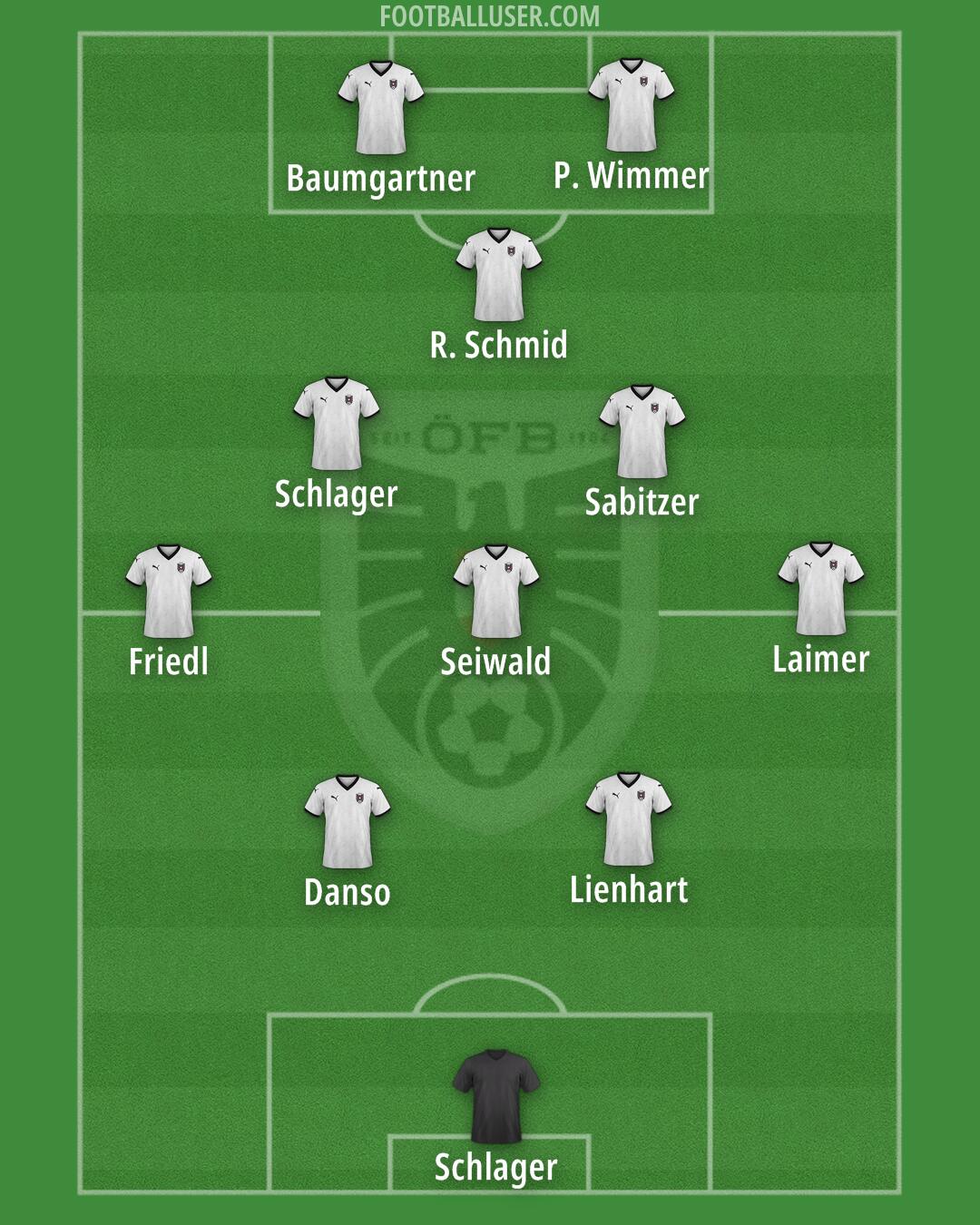
Baumgartner · P. Wimmer · R. Schmid · Seiwald · Schlager · Sabitzer · Laimer · Friedl · Danso · Lienhart · SchlagerA heavy focus on midfield dominance and central control defines the way Austria plays in a 2-6-2 formation. This lineup looks to overwhelm the middle of the pitch to control the tempo and squeeze the opposition into their own half. By packing the center, the team builds a platform to dominate possession and force turnovers high up the pitch.
Schlager stays between the posts to organize the defensive unit. Ahead of him, Danso and Lienhart act as a pair of central defenders in a very narrow back two. These two must remain disciplined to cover the massive space behind them, often sitting deep to prevent long balls from breaking the line. They rely on quick interceptions and physical strength to stop direct attacks before they reach the goal.
The midfield is a massive block consisting of six players working to control every zone. Friedl and Seiwald operate as the deepest part of this unit to shield the two defenders and protect the middle. Laimer works to drive forward and connect the play, while Sabitzer uses his passing range to break lines and find teammates in advanced positions. Schlager and R. Schmid push even higher into the attacking third to support the strikers and maintain pressure.
In the final third, the team utilizes two forwards to stretch the opposition. Baumgartner plays as the left striker, while P. Wimmer operates on the right. These two attackers are tasked with pressing the opposing defenders and making runs into the channels to create space. They must hold up the ball or move quickly to allow the six midfielders to join the attack and create numerical superiority in the box.
This formation offers massive numerical superiority in the center of the park, making it very difficult for opponents to play through the middle. Austria can use this density to press high in coordinated waves, suffocating the opponent in their own defensive third. The ability to quickly switch play from one side of this large midfield block to the other allows the team to catch defenses out of position.
The 2-6-2 formation is designed to dominate the ball through sheer central mass. It is best suited for matches against teams that sit deep and struggle to compete in the middle of the pitch.