
São Paulo Football Formation
 December 18, 2025
 RPLemos


Starting Lineup
24 Young30 Rodriguinho
27 Lucca
29 Tapia
31 Isac
26 Wendell
28 Negrucci
32 Maik
33 Sabino
19 Brenner
25 Danielzinho
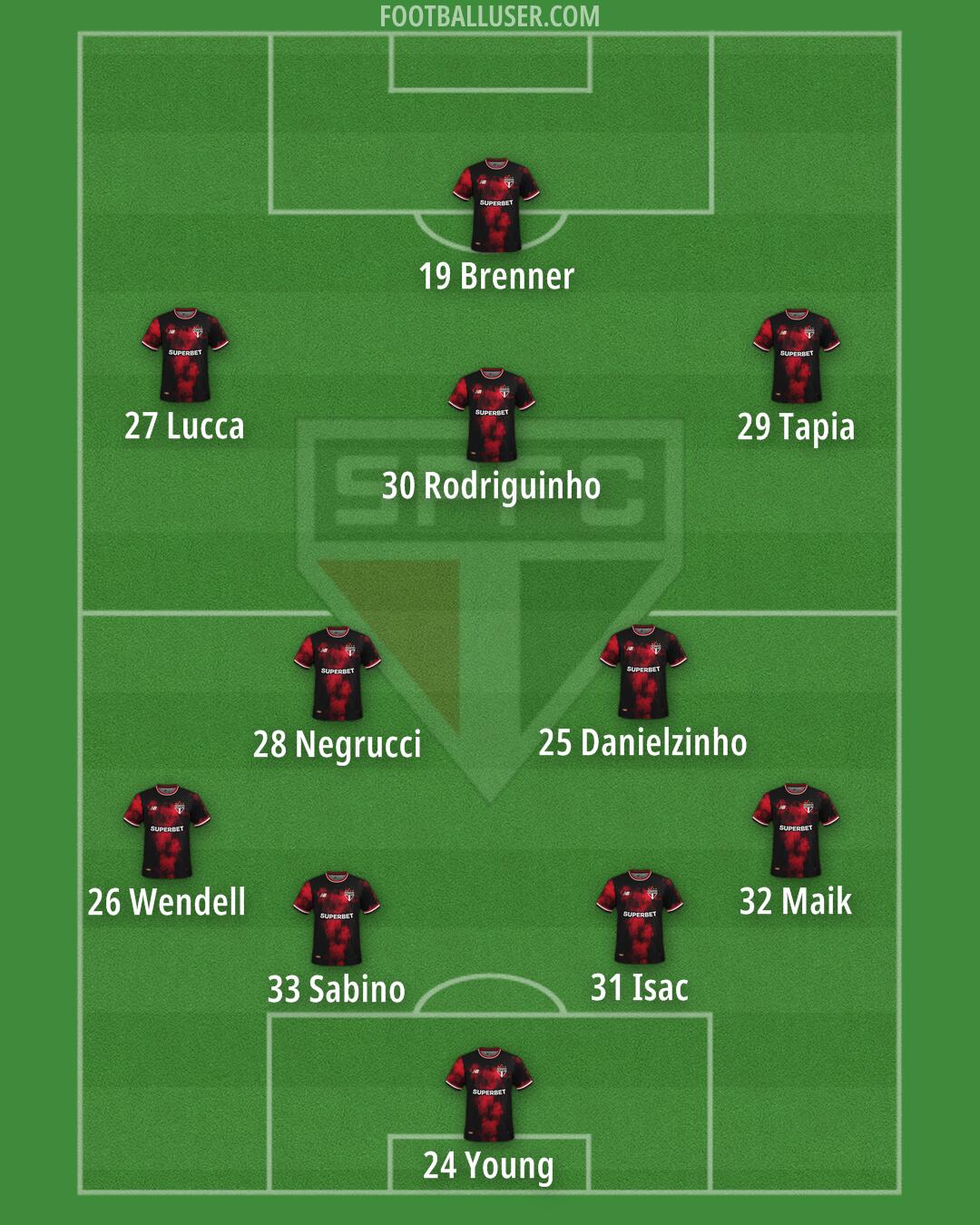
Aiming to overwhelm opponents with verticality and high numbers in the final third, São Paulo operates in a 4-2-4 formation. This lineup focuses on aggressive attacking transitions and rapid forward movements to catch the opposition off guard. By committing many players forward, the team seeks to dominate the attacking phase through sheer numbers and direct play.
The defensive unit begins with Young in goal to manage the back line. A flat back four consists of Maik at right back and Wendell at left back, while Isac and Sabino act as the two central defenders. Maik and Wendell are expected to push up the flanks to provide width, though they must track back quickly to prevent being caught out. Isac and Sabino need to hold their position and stay compact to cover the space left behind by the advancing full backs.
A double pivot in midfield provides the necessary link between the defense and the attack. Negrucci and Danielzinho occupy the central roles, tasked with sitting deep to shield the back four. Their main job is to win the ball and immediately pass into the front line. They must work hard to cover the gaps when the team loses possession, ensuring the central area does not become too exposed against counter attacks.
The attack is built around four players designed to stretch the opposition defense. Lucca and Tapia operate as wide wingers, looking to cut inside or deliver crosses into the box. In the center, Rodriguinho and Brenner act as two forwards, with one often dropping slightly deeper to link play while the other pushes against the defenders. This front four is designed to press high and force mistakes from the opposing center backs.
One major advantage of this São Paulo lineup is the ability to create immediate numerical superiority in the penalty area. Having two central strikers paired with wide players allows the team to overload the box during crosses. Another strength is the speed of transition, as the team can move from a defensive block to a full attacking wave in seconds. This creates high pressure on the opponent and makes it difficult for them to settle into a rhythm.
This 4-2-4 formation is a high risk, high reward system that relies on intense pressing and quick direct passes. It is most effective when playing against teams that struggle to deal with constant pressure and deep defensive lines.