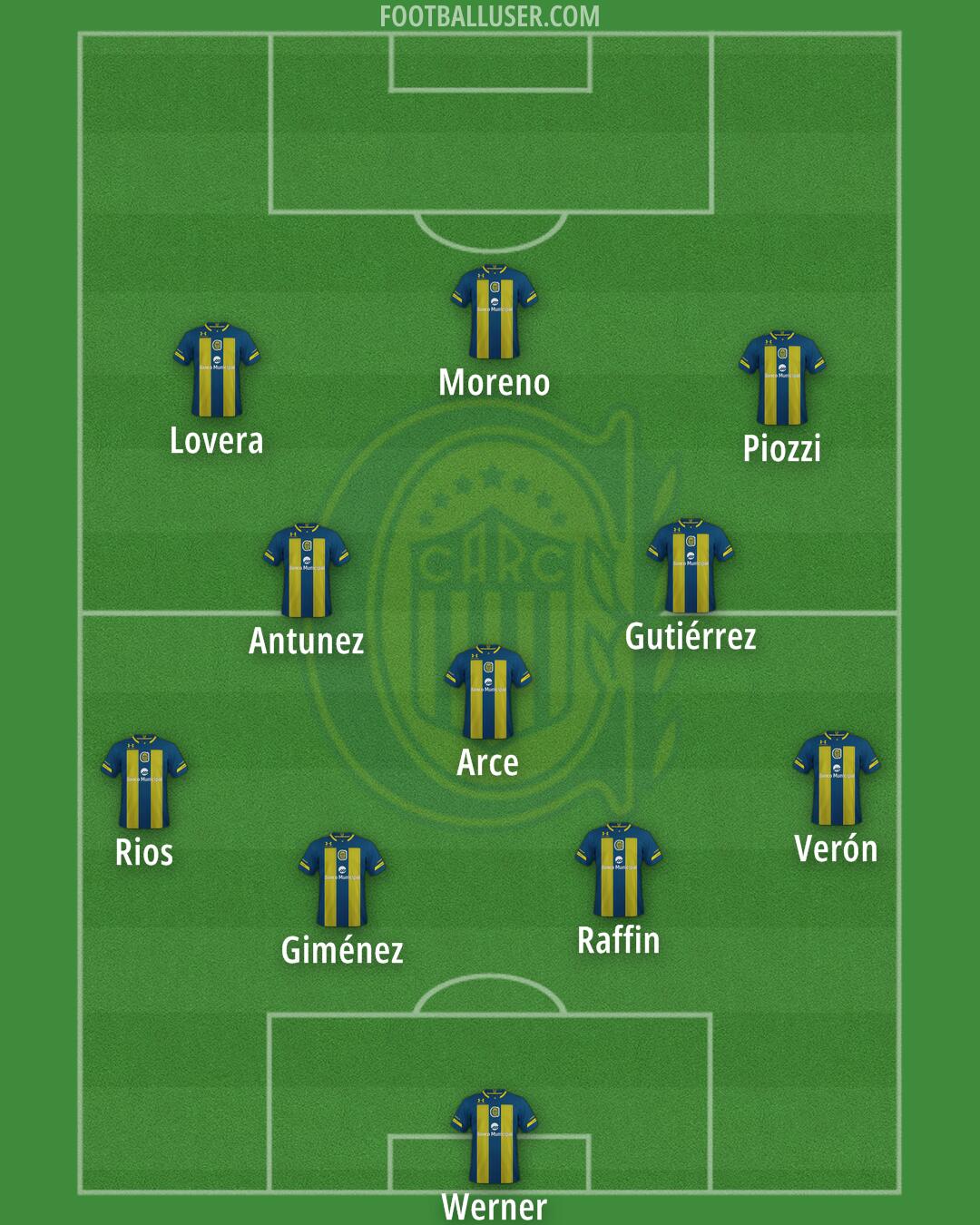

Rosario Central Football Formation
 December 18, 2025


Starting Lineup
Werner · Giménez · Verón · Arce · Gutiérrez · Raffin · Rios · Moreno · Piozzi · Antunez · LoveraRosario Central aims to control space through a compact defensive block and quick verticality, playing in a 5-2-3 formation. This lineup focuses on absorbing pressure before hitting opponents with rapid transitions. The team relies on deep defensive layers to minimize gaps between lines, making them very hard to break down in central areas.
Werner stays between the posts to command his area. The back five features Arce at the center of the defense, acting as the main organizer. Giménez and Raffin sit on either side of Arce to provide strength and cover. Verón and Rios act as the wing backs, pushing high up the pitch to provide width when the team has the ball, while also tracking back to defend the flanks. This group can drop deep to form a low block or step up to compress the pitch.
The midfield operates with a double pivot to protect the back line. Antunez and Gutiérrez occupy the central spaces to control the tempo. Antunez works to break the line with forward passes, while Gutiérrez helps to intercept play and shield the defenders. These two midfielders act as the link, recycling possession to the wing backs or finding the attackers quickly once the ball is won.
Rosario Central utilizes three attackers to stretch the opposition. Moreno plays as the lone striker to hold up the ball and fight against central defenders. Lovera and Piozzi act as wide attackers, often cutting inside to create goal scoring chances or finding space in the channels. The front three press high to force mistakes, creating passing lanes for the midfielders to exploit during the transition.
One major advantage for Rosario Central is the numerical superiority they create in the defensive third, making it difficult for opponents to find space in the box. The team also gains wide overloads when Verón and Rios push forward to support the wingers. This allows the side to shift between a deep defensive block and a wide attacking threat very quickly.
This formation provides a solid foundation for teams that want to remain defensively sound while exploiting space on the break. It is best suited for matches against opponents who dominate possession but leave gaps behind their midfield.