
Germany National Football Team Formation
 December 19, 2025


Starting Lineup
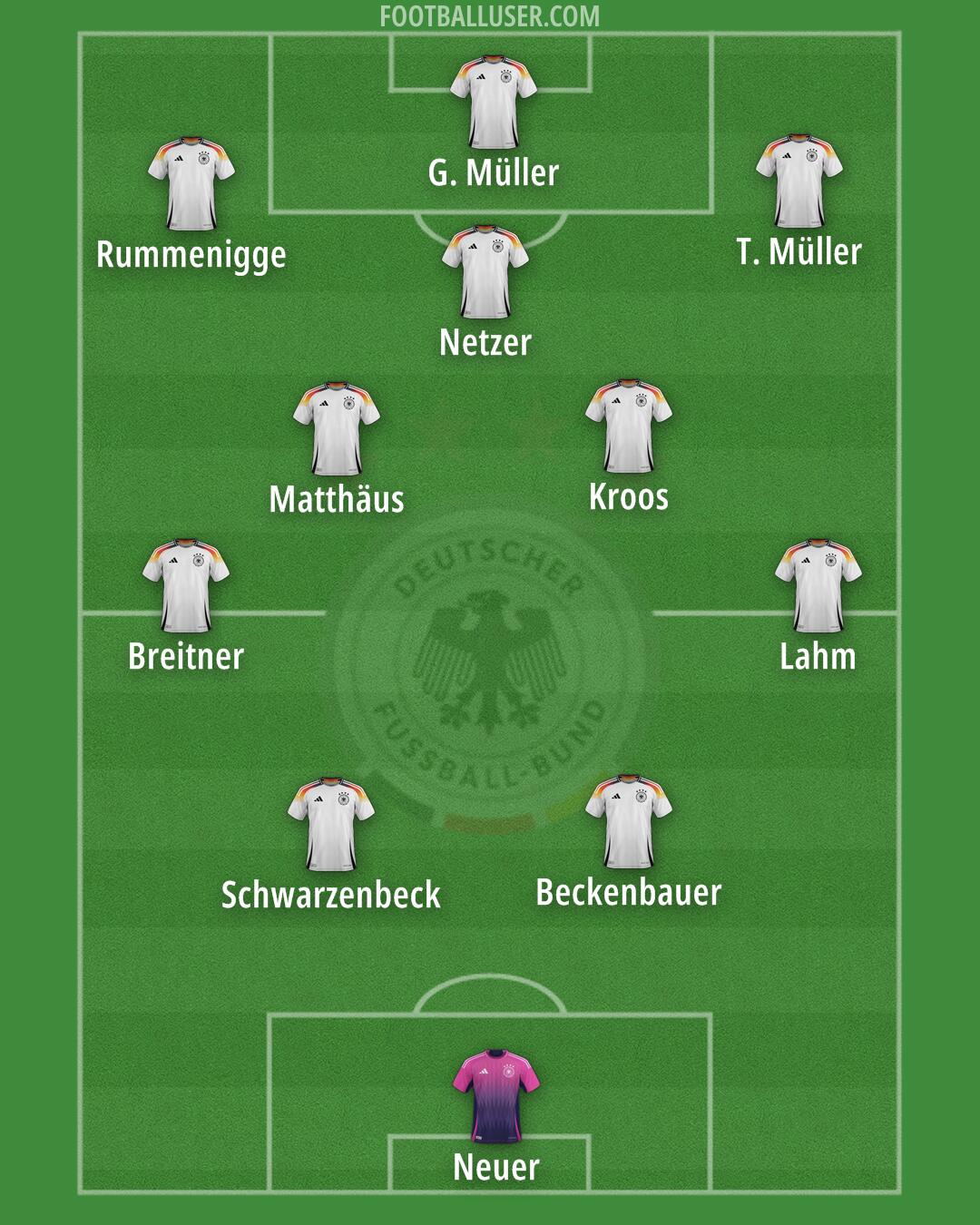
G. Müller · Rummenigge · Netzer · T. Müller · Matthäus · Kroos · Breitner · Lahm · Schwarzenbeck · Beckenbauer · NeuerControl of the ball and aggressive verticality define the way Germany plays in a 2-5-3. This lineup relies on high pressing and quick transitions to overwhelm the opposition in their own half. The team pushes forward with great intensity to ensure the ball stays in the attacking third as much as possible.
Manuel Neuer acts as a sweeper keeper to manage the space behind the defenders. The defensive unit consists of a back two featuring Schwarzenbeck and Beckenbauer. Beckenbauer is known for his passing range and ability to step up into midfield, while Schwarzenbeck provides cover and strength. Because there are only two central defenders, they must maintain a high line to compress the pitch and intercept long balls early.
A dense midfield block forms the engine of the German team. Breitner and Lahm operate as deep pivots to shield the back line and recycle possession. Matthäus works alongside Kroos in the central areas to break the line with vertical passes and drive the play forward. Kroos uses his exceptional passing range to switch play quickly, while Matthäus provides high pressing intensity and energy. Netzer operates as the attacking midfielder to connect the midfield to the front three and create chances.
The attack utilizes three distinct players to stretch the defense. Rummenigge plays as a wide forward on the left to cut inside and run at defenders. T. Müller operates on the right, using his intelligent movement and spatial awareness to find gaps in the defense. G. Müller leads the line as a striker, acting as the central focal point to finish moves. This front line stays high to ensure the team can transition into attack immediately after winning the ball.
Germany creates several tactical advantages with this formation. The heavy presence of five midfielders allows for massive numerical superiority in the center of the pitch, making it difficult for opponents to hold the ball. The wide positioning of Rummenigge and T. Müller creates wide overloads when combined with the passing of the midfielders. Additionally, the high positioning of the entire team allows them to press high in coordinated waves to force turnovers.
This formation is built for dominance and heavy ball possession. It is best suited for games where Germany can dictate the tempo against a team that sits deep in a low block.