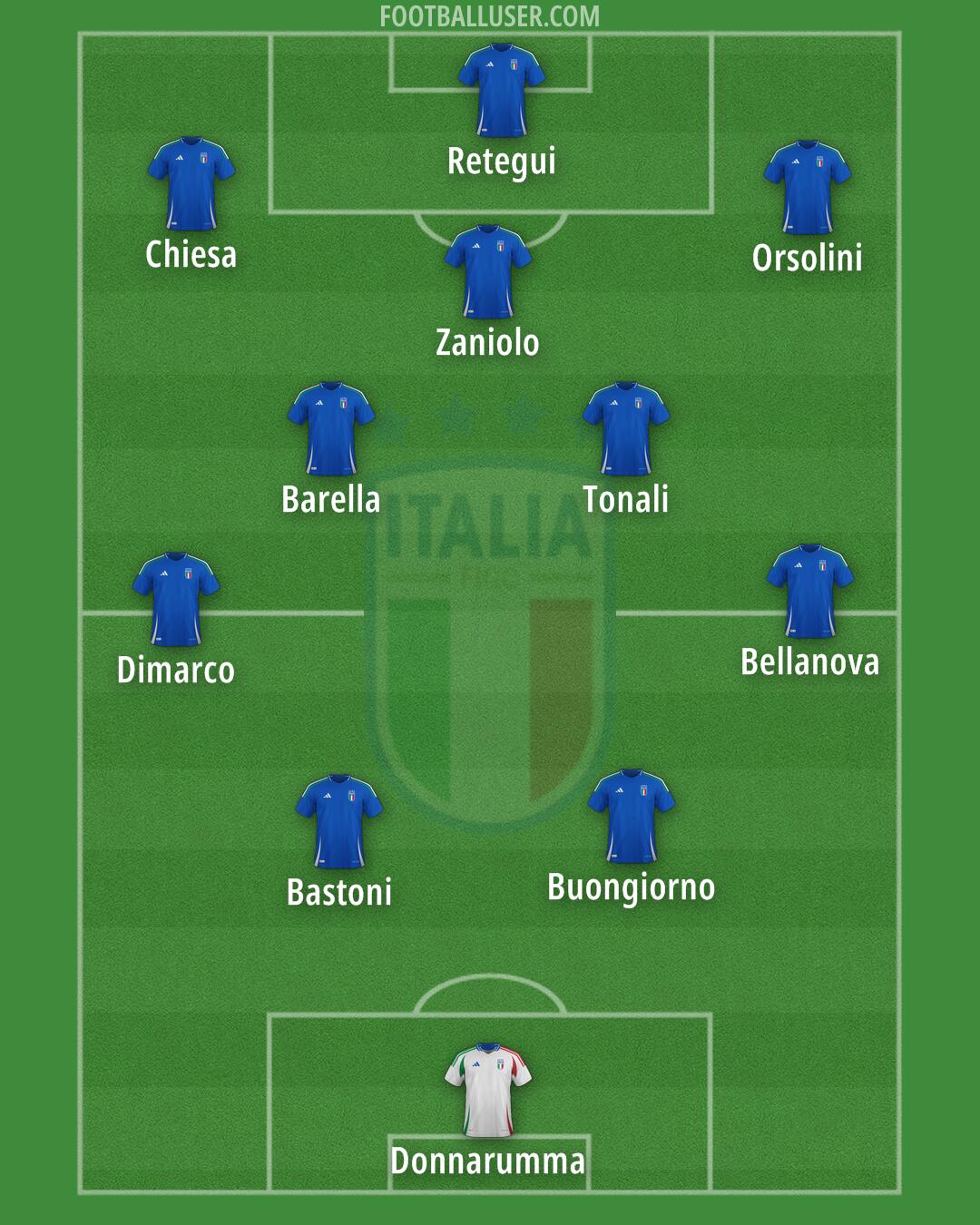

Italy National Football Team Formation
 December 19, 2025


Starting Lineup
Dimarco · Bellanova · Bastoni · Buongiorno · Retegui · Zaniolo · Barella · Tonali · Chiesa · Orsolini · DonnarummaFocusing on rapid transitions and high intensity, Italy utilizes a 2-5-3 formation. This lineup aims to overwhelm opponents in the final third by using aggressive numbers forward. The team looks to regain the ball quickly in the opponent half and move the ball vertically to catch defenses out of position.
Donnarumma acts as the last line of defense, utilizing his massive frame and shot-stopping ability to command the box. Behind him, the defensive unit consists of only two central defenders, Bastoni and Buongiorno. Bastoni serves as a ball playing defender with a high passing range, while Buongiorno provides aerial strength and covers the space behind the midfield. This high line requires the defenders to step up constantly to intercept long balls.
The midfield functions as a five man block that controls the center of the pitch. Dimarco and Bellanova operate as wide midfielders who can push high to provide width or drop back to help the defense. In the central areas, Barella and Tonali work to break the line with their passing and pressing intensity. Zaniolo operates as an attacking ten, playing between the lines to connect the midfield to the front three.
The attacking front line uses three players to stretch the opposition. Retegui acts as the lone striker, working to hold up the ball and make runs into the channels. On the wings, Orsolini and Chiesa provide directness, with Chiesa often looking to cut inside to use his dribbling style. This trio keeps the opposition backline pinned back and forces them to defend in much deeper areas.
Italy gains a significant advantage through numerical superiority in the central midfield zones. The presence of Barella and Tonali allows the team to dominate the middle and force turnovers. Furthermore, the wide players Dimarco and Bellanova create overloads on the flanks, which isolates Orsolini and Chiesa in one on one situations against full backs. This makes the formation very difficult to track during quick transitions.
This high risk formation is built for aggressive teams that want to dominate possession and press high. It is best suited for matches where the opponent sits deep and can be broken down by sheer numbers in the attacking third.