
Germany National Football Team Formation
 December 19, 2025


Starting Lineup
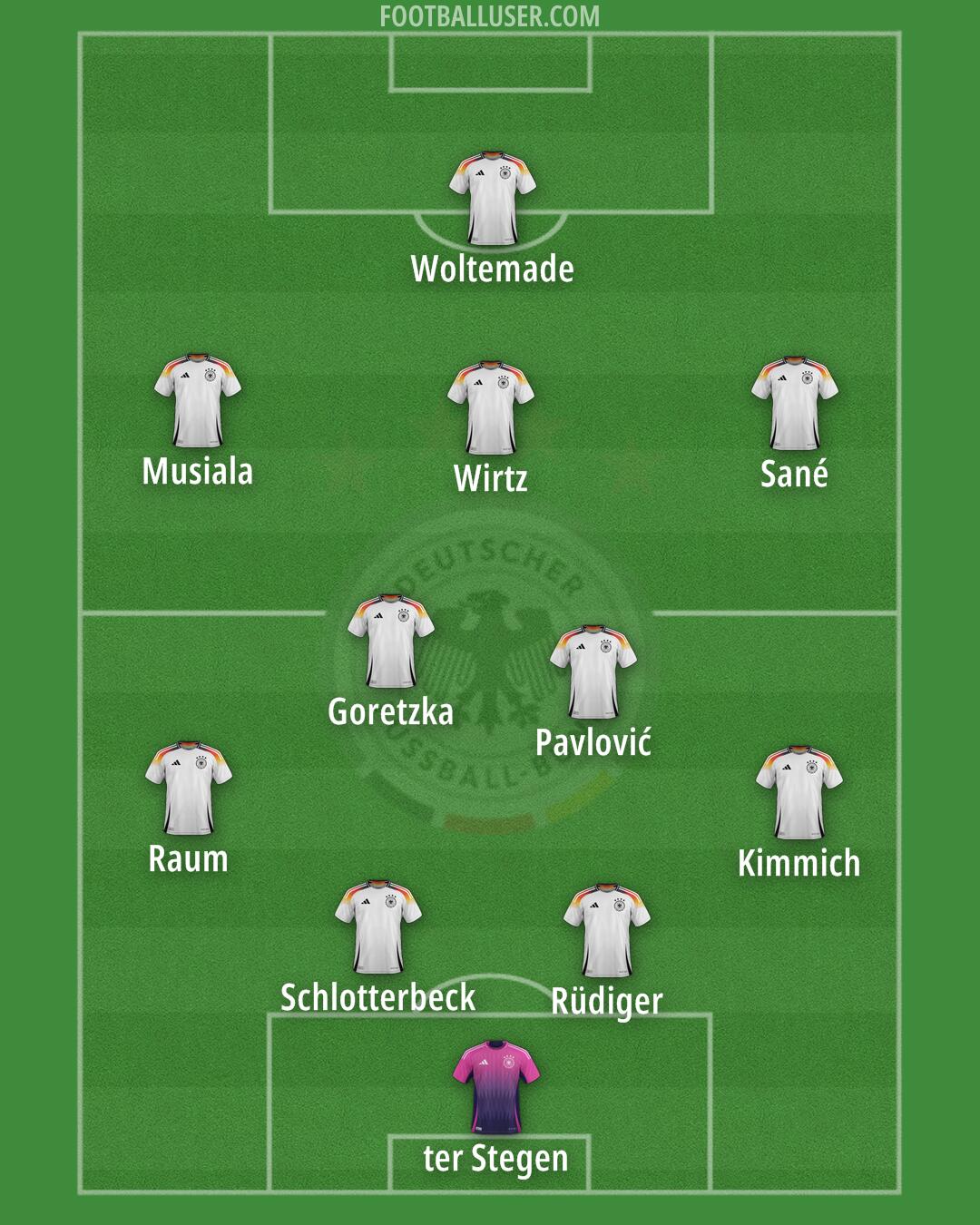
Rüdiger · Kimmich · Schlotterbeck · Raum · Sané · Woltemade · Wirtz · Musiala · Pavlović · Goretzka · ter StegenGermany relies on a heavy high press and aggressive verticality through a 2-4-4 formation. This lineup seeks to overwhelm opponents in the final third by pushing almost the entire team into the attacking half. By playing with such a narrow defensive base, the team aims to win the ball back quickly and strike before the opposition can settle.
Ter Stegen acts as the lone man between the posts, often playing a high line to sweep up long balls behind the defense. The back line consists of only two central defenders, Rüdiger and Schlotterbeck, who must stay compact and cover vast amounts of space. Rüdiger uses his physical presence and aerial strength to win duels, while Schlotterbeck must step up to intercept passes. Because there are no full backs, these two must be ready to track runners in wide areas or push up to support the midfield block.
The midfield functions as a central block designed to control the rhythm and press relentlessly. Pavlović holds the position to shield the two defenders, acting as a pivot to collect the ball from the back. Kimmich operates on the right side of this unit, using his passing range to switch play and break lines with direct balls. On the left, Raum provides energy to cover the wide zone, while Goretzka pushes forward into the attacking ten role to link the midfield to the front four.
The attack is built around four players positioned to harass the opposition defense. Wirtz and Woltemade play as the central duo, where Wirtz uses his dribbling style and vision to create chances in tight spaces. Sané occupies the right wing to cut inside and take on defenders, while Musiala operates on the left flank. Musiala uses his close control to navigate through compact blocks, helping to pull defenders out of position to create gaps for the central attackers.
One major advantage of this Germany lineup is the ability to press high in coordinated waves, making it difficult for opponents to play out from the back. The concentration of talent around Wirtz and Musiala creates numerical superiority in the half spaces, allowing the team to overload the middle. Additionally, the speed of transition when Pavlović or Kimmich win the ball allows the front four to exploit disorganized defensive lines immediately.
This high risk formation is designed to dominate possession and suffocate opponents in their own half. It is best suited for matches where Germany needs to break down a low block or chase a result through sheer offensive volume.