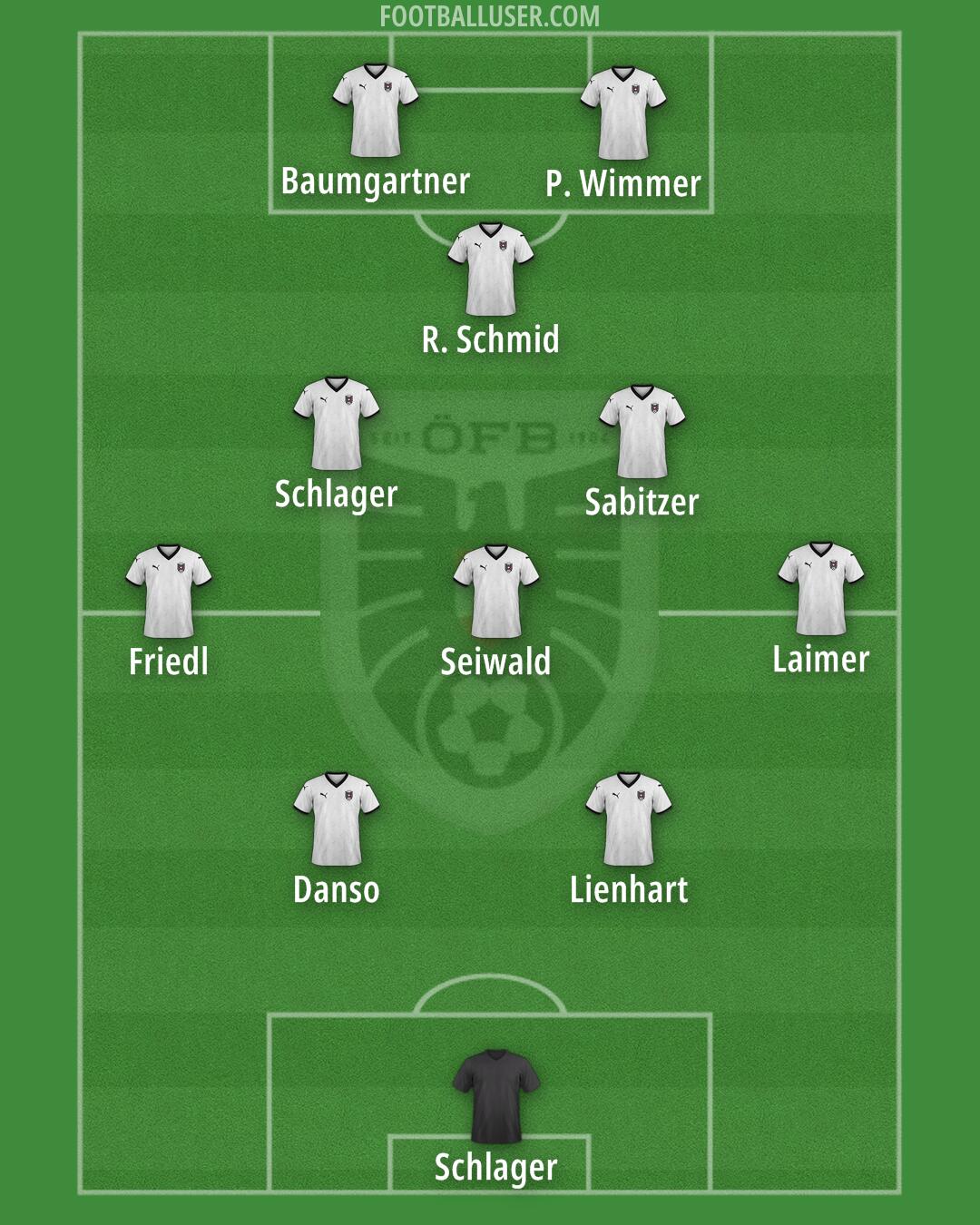

Austria National Football Team Formation
 December 19, 2025


Starting Lineup
Baumgartner · P. Wimmer · R. Schmid · Seiwald · Schlager · Sabitzer · Laimer · Friedl · Danso · Lienhart · SchlagerFocusing on heavy ball retention and central density, Austria operates in a 2-6-2 formation. This lineup is built to dominate the middle of the pitch and overwhelm opponents through sheer numbers in the center. The goal is to control the tempo of the game by constantly passing through congested areas and using a massive midfield block to squeeze the space available to the other team.
Schlager acts as the last line of defense, sitting behind a very narrow back two. Lienhart and Danso form the central defensive pairing, tasked with being dominant in the air and covering large amounts of space behind the high midfield line. Because there are no full backs, these two must be ready to step up and intercept long balls, while the rest of the unit must sit deep or press high to prevent the opposition from finding wide channels.
The midfield is a massive engine room consisting of six players designed to control every passing lane. Friedl and Seiwald work as a deep double pivot to shield the defense and break the line with vertical passes. Laimer provides energy to drive forward, while Sabitzer uses his wide passing range to switch play and connect the various layers. Schlager and R. Schmid operate in more advanced roles to create chances, making the midfield a dense wall that is difficult to penetrate.
In the final third, the team utilizes two forwards to keep the opposition defenders occupied. Baumgartner leads the line from the left side, while P. Wimmer operates from the right. These two attackers are expected to press high and hold up the ball to allow the six midfielders to join the attack. The movement of the forwards is designed to create gaps in the middle for the advancing midfielders to run into.
Austria possesses significant tactical advantages due to this concentrated numbers game. The primary strength is the numerical superiority in midfield, which allows the team to keep possession and choke the opposition's ability to build play. Additionally, the coordinated waves of players from the midfield can create sudden overloads in central areas. This density makes it very hard for opponents to find passing lanes, forcing them to play wide and away from the danger.
This formation relies on total control of the central zones to starve the opponent of the ball. It is best suited for games against teams that play a narrow style or struggle to handle intense central pressure.