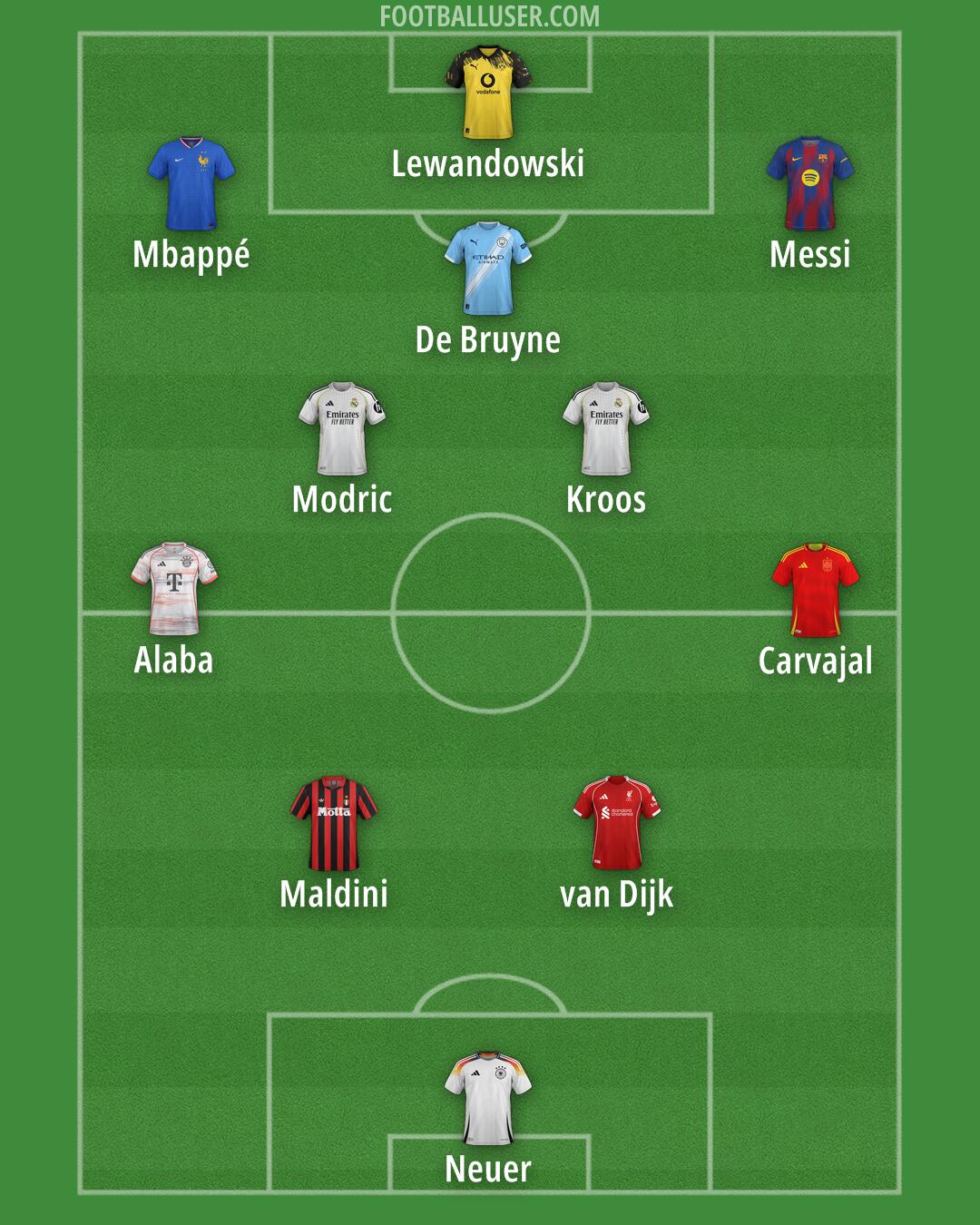
Custom Team Football Formation
 December 21, 2025


Starting Lineup
Mbappé (France) · Lewandowski (Borussia Dortmund) · Messi (Barcelona) · De Bruyne (Man City) · Modric (Real Madrid) · Kroos (Real Madrid) · Carvajal (Spain) · Alaba (FC Bayern) · van Dijk (Liverpool) · Maldini (Milan) · Neuer (Germany)A heavy focus on dominating the ball and controlling the center of the pitch defines this lineup, which operates in a 2-5-3 formation. This team aims to pin the opposition back through heavy possession and constant central pressure. By overcrowding the middle of the field, the team seeks to dictate the tempo of every match and starve the opponent of any rhythm.
Neuer sits between the posts to act as a sweeping goalkeeper, often pushing up to help play out from the back. The defensive unit relies on a very high line consisting of just two central defenders, van Dijk and Maldini. van Dijk uses his aerial strength and physical presence to win the second ball, while Maldini provides elite positioning to cover the space behind. Because there are no full backs, these two must be ready to step up and intercept long balls to prevent being hit in behind on the transition.
The midfield is a massive engine consisting of five players designed to compress the midfield and control every passing lane. Carvajal and Alaba form a double pivot to shield the defense, with Alaba acting to intercept play while Carvajal looks to carry the ball forward. Modric and Kroos operate in the half spaces, where Kroos uses his immense passing range to switch play and Modric connects the defensive and attacking lines with his ability to receive on the half-turn. De Bruyne plays as an attacking ten behind the striker, looking to find the feet of the striker or arrive late into the box to strike from distance.
In the final third, the team utilizes three attackers to stretch the defense. Lewandowski acts as the central target man, holding up the ball to allow others to join the attack. On the flanks, Mbappé acts as an inverted winger who wants to cut inside to use his blistering speed, while Messi occupies the right wing to drift inward and create chances. This attacking trio works to pin the last defender and create combinations in tight spaces. The frontline is designed to press from the front to win it back high up the pitch.
This formation offers significant tactical advantages through numerical superiority in midfield. By having five players against a standard three man unit, the team can easily recycle possession and find pockets of space. Another strength is the ability to create wide overloads when the attackers pull wide, forcing the opposition to stretch their defensive block. This setup makes it very difficult for opponents to defend through the middle without leaving gaps elsewhere.
The team relies on total control of the ball and central dominance to break down opponents. This lineup is best suited for matches against teams that sit deep and lack the speed to exploit the space behind the two central defenders.