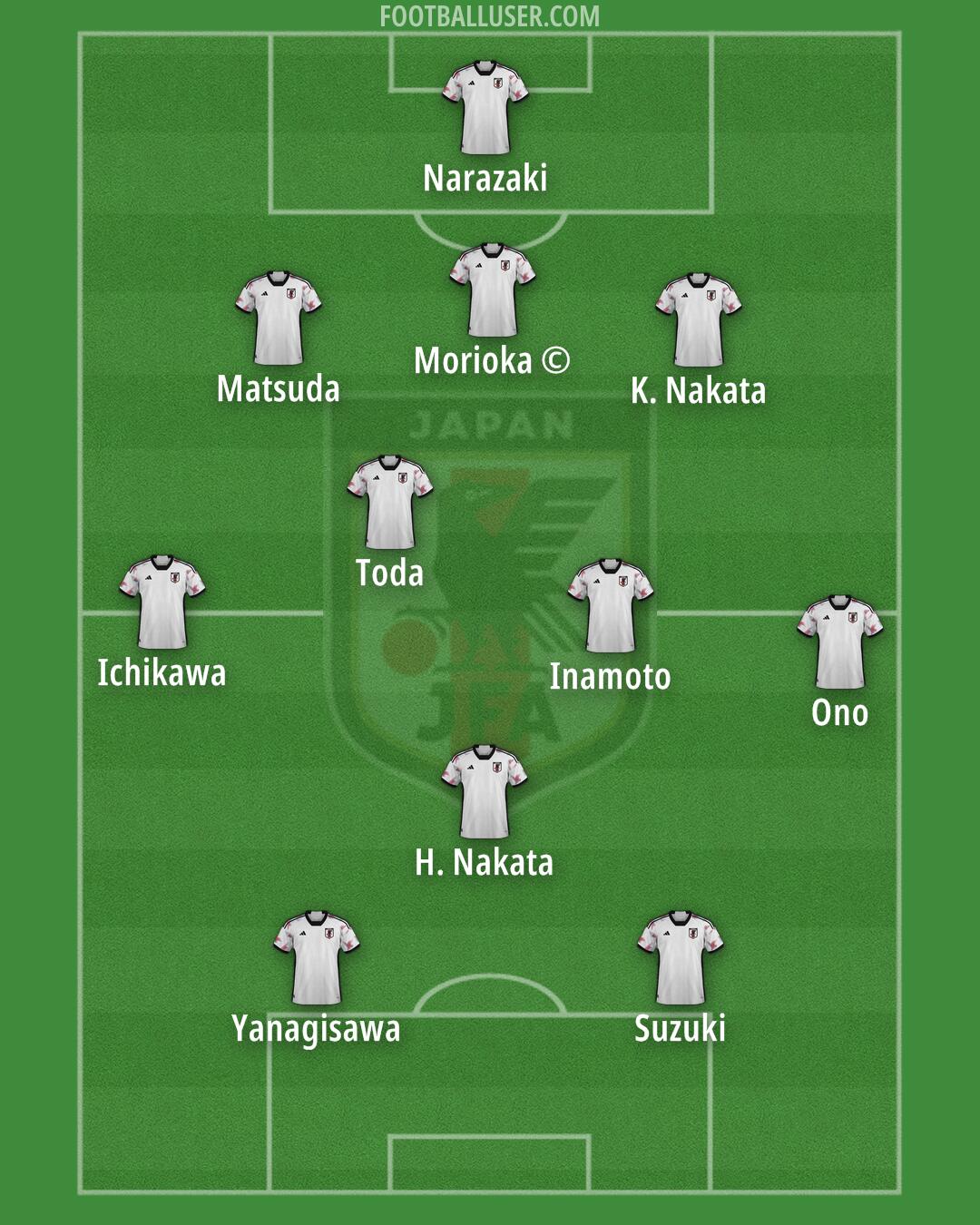

Japan National Football Team Formation
 December 22, 2025


Starting Lineup
Narazaki · Morioka © · Matsuda · K. Nakata · Toda · Inamoto · Ono · Ichikawa · H. Nakata · Suzuki · YanagisawaA focus on heavy verticality and rapid attacking transitions defines this Japan lineup in a 2-4-4. The formation is built to overload the final third and press opponents high up the pitch to win the ball back quickly. This lineup relies on high energy to sustain pressure in the opponent half and force turnovers through constant movement.
Suzuki acts as the lone man behind the back line. The defensive unit relies on a central pair consisting of Yanagisawa and H. Nakata. Since there are no wide defenders, these two must stay compact and step up to intercept passes or track runs into the channels. They must be ready to cover large amounts of space if the ball is switched, acting as a mobile block to protect the goal.
The midfield functions as a dense central engine to control the center of the pitch. Inamoto holds his position to shield the defense and break up play, while Ono operates in the right central role to drive forward. Ichikawa connects the play from the left side, and Toda plays as an attacking midfielder to push between the lines. This group works to win the ball and quickly find the front four to break the opponent line.
The attack utilizes a powerful front four to overwhelm the opposition. Morioka, who is the captain, leads the line alongside Narazaki as two central forwards. They hold up the ball and fight for aerial duels to bring others into play. On the flanks, Matsuda stays wide on the left while K. Nakata cuts inside from the right wing. This setup creates constant movement in the box and forces defenders into difficult decisions.
Japan offers significant tactical advantages through their ability to press high in coordinated waves. The density in the middle with Inamoto, Ono, Ichikawa, and Toda makes it hard for opponents to play through the center. Furthermore, the heavy presence of four attackers allows for wide overloads and creates high pressure when the ball is lost. This setup aims to isolate defenders in one on one situations once the midfield breaks the first line of the press.
This formation creates a relentless attacking force that prioritizes speed of transition. It is best suited for games where Japan needs to overwhelm a deep sitting defense or catch an opponent out on the break.