
Italy National Football Team Formation
 December 22, 2025


Starting Lineup
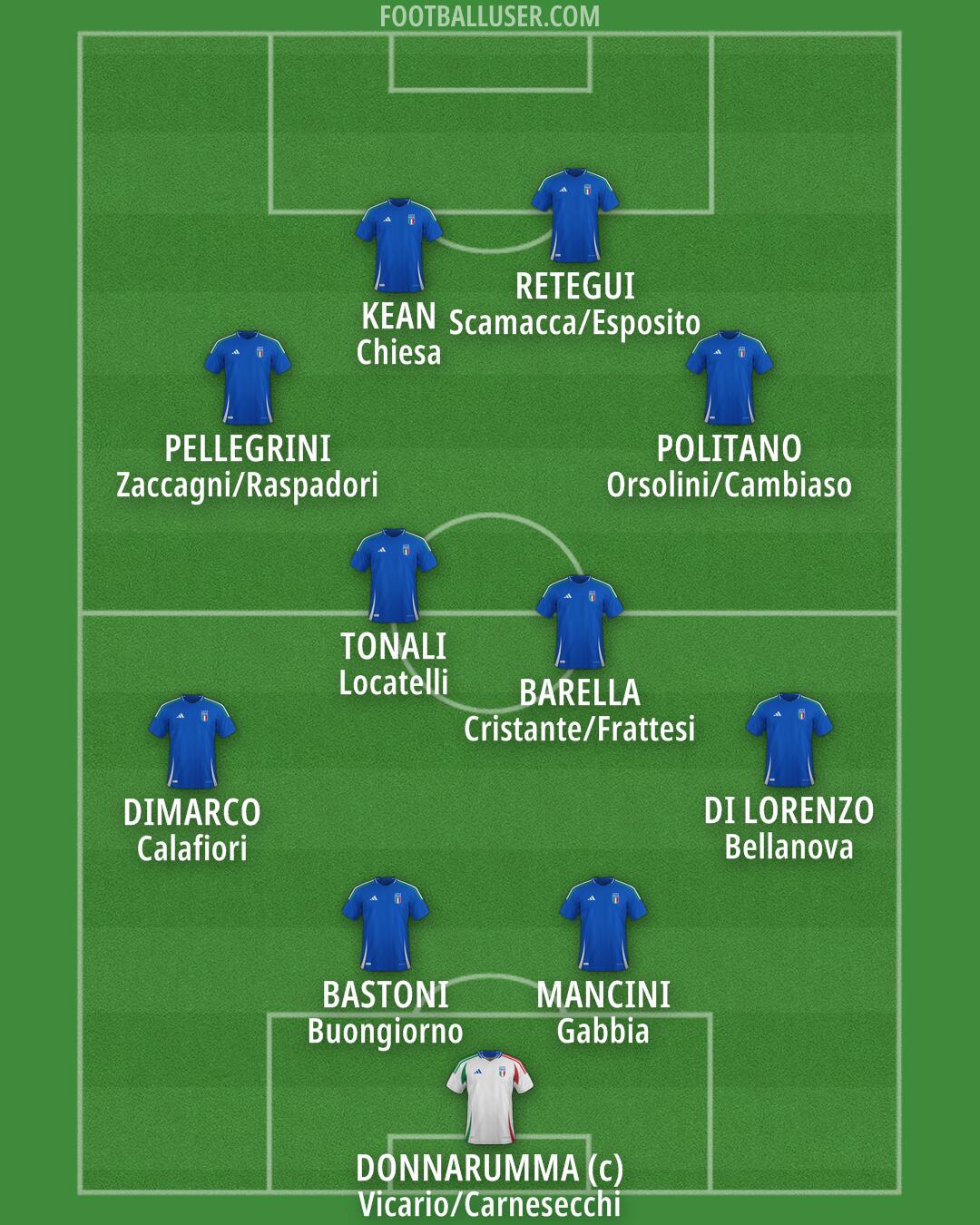
DONNARUMMA (c) (Vicario/Carnesecchi) · MANCINI (Gabbia) · BASTONI (Buongiorno) · DI LORENZO (Bellanova) · DIMARCO (Calafiori) · BARELLA (Cristante/Frattesi) · TONALI (Locatelli) · POLITANO (Orsolini/Cambiaso) · PELLEGRINI (Zaccagni/Raspadori) · KEAN (Chiesa) · RETEGUI (Scamacca/Esposito)A heavy focus on verticality and high pressing defines the tactical identity of Italy as they utilize a 2-4-4 formation. This lineup is built to overwhelm opponents in the final third by flooding the attacking zones and forcing mistakes high up the pitch. The team seeks to play with high intensity to win the ball back quickly and launch rapid attacks before the opposition can settle.
Gianluigi Donnarumma (c) acts as the foundation in goal, using his massive frame and reach to command the area. In front of him, the defensive unit consists of a central pairing with Mancini and Bastoni. Mancini provides strength and aerial dominance while Bastoni acts as a ball playing defender to start attacks from the back. Because the formation lacks traditional full backs, these two central defenders must step up into space and cover the wide areas when the midfielders push forward.
The midfield works in a central block to control the tempo and link the defense to the front line. Barella and Tonali operate in the heart of the pitch, where Barella uses his high energy to press and cover ground while Tonali acts as the link to push the ball forward. Di Lorenzo and Dimarco occupy the central midfield roles but act almost like wide players to provide the necessary width. This group must remain compact to prevent the opposition from playing through the center of the pitch.
The attacking force is split into two lines to create constant movement and pressure. Kean and Retegui operate as a strike partnership, with one player often looking to hold up the ball while the other makes runs behind the defense. On the flanks, Pellegrini and Politano provide width and ability to cut inside into the half spaces. This front four aims to press the opposition backline aggressively, forcing them to hit long balls that the central defenders can easily intercept.
Italy possesses several tactical advantages with this aggressive lineup. The team can create massive overloads in the attacking half, often catching opponents in two on one situations in wide areas. By using two strikers alongside two wide attackers, the formation makes it difficult for a back four to mark everyone effectively. The ability to press in coordinated waves allows the team to win the ball in dangerous positions and transition into a goal scoring threat instantly.
This formation is designed for a high risk high reward style of football that prioritizes offensive pressure. It is best suited for games where Italy needs to break down a deep sitting opponent through sheer numbers in the final third.