
SV Ried Football Formation
 December 22, 2025


Starting Lineup
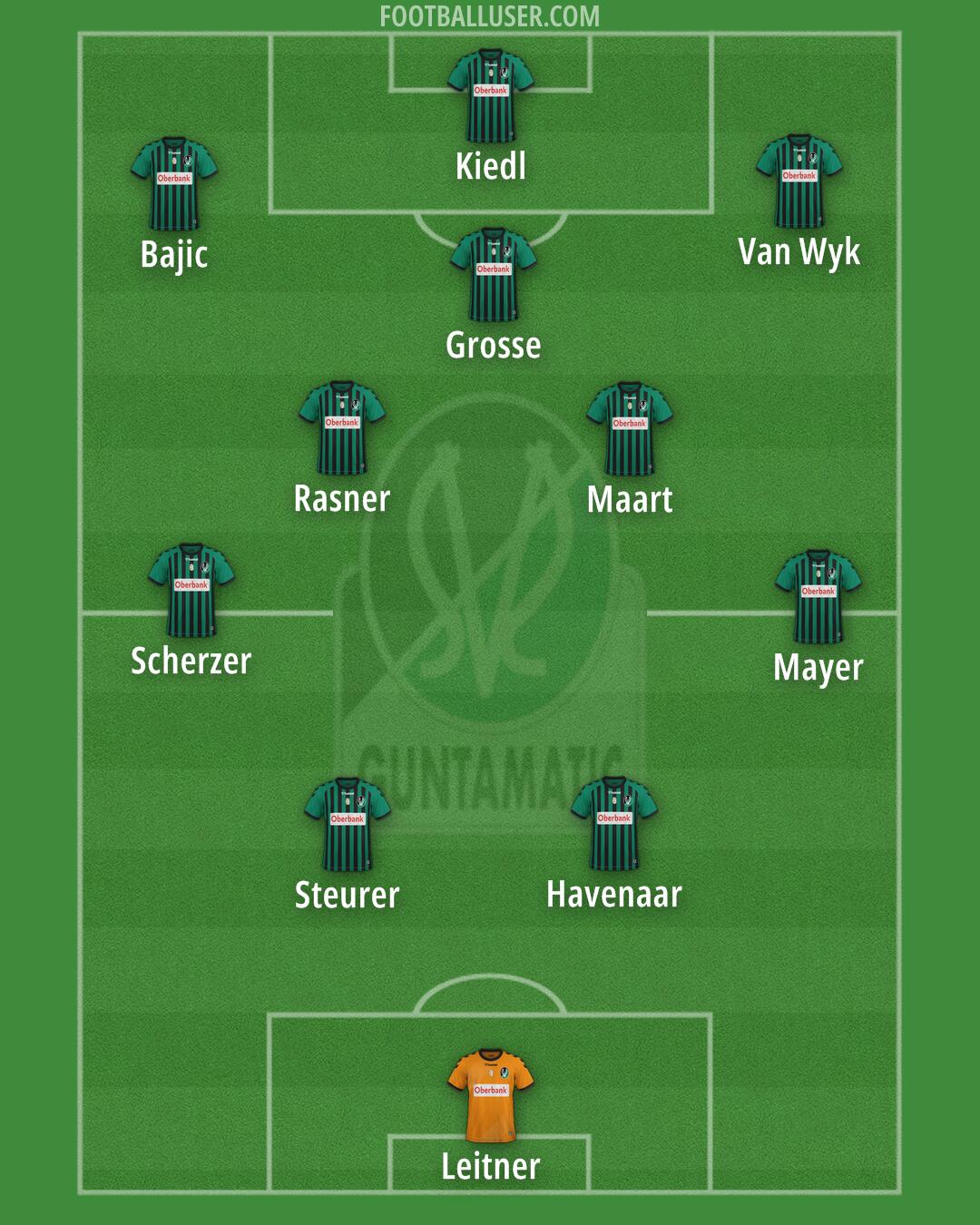
Kiedl · Van Wyk · Bajic · Rasner · Grosse · Maart · Steurer · Havenaar · Scherzer · Mayer · LeitnerFocusing on verticality and quick transitions, SV Ried utilizes a 2-5-3 formation to catch opponents off guard. This lineup seeks to dominate the central areas and use rapid forward movements to break lines. By packing the middle of the pitch, the team aims to control the tempo and force turnovers in dangerous areas.
Leitner stays between the posts to organize the back line during defensive phases. The defense consists of a pair of central defenders, Steurer and Havenaar, who must act as a mobile unit. They often step up to intercept passes or drop deep to cover space behind them. Because there are only two players in the back, they rely on the midfield to block passing lanes and prevent direct runs.
A massive five-man midfield unit provides the engine for SV Ried. Mayer and Scherzer form a double pivot to shield the two center backs and win second balls. Moving ahead of them, Maart and Rasner operate as central midfielders who drive forward to support the attack and track back to help the defense. Grosse plays as an attacking ten, looking to find pockets of space between the lines and deliver final passes to the front three.
The attacking line features three players tasked with stretching the opposition. Bajic and Van Wyk occupy the wide positions as wingers, looking to cut inside or provide width to cross the ball. Kiedl leads the line as a lone striker, tasked with holding up the ball and making runs to pull defenders out of position. This front three works together to press the opposition backline immediately upon losing possession.
One clear advantage for SV Ried is the numerical superiority they create in the center of the pitch. Having five midfielders allows them to overwhelm opponents who play with standard three-man midfields. Another strength is the ability to isolate Bajic and Van Wyk in one on one situations when they receive the ball in wide areas. The compact midfield also makes it difficult for teams to play through the middle, forcing them to play wide.
This formation relies on high intensity to prevent being bypassed by long balls. It is best suited for games where the opponent struggles to control the center of the pitch.