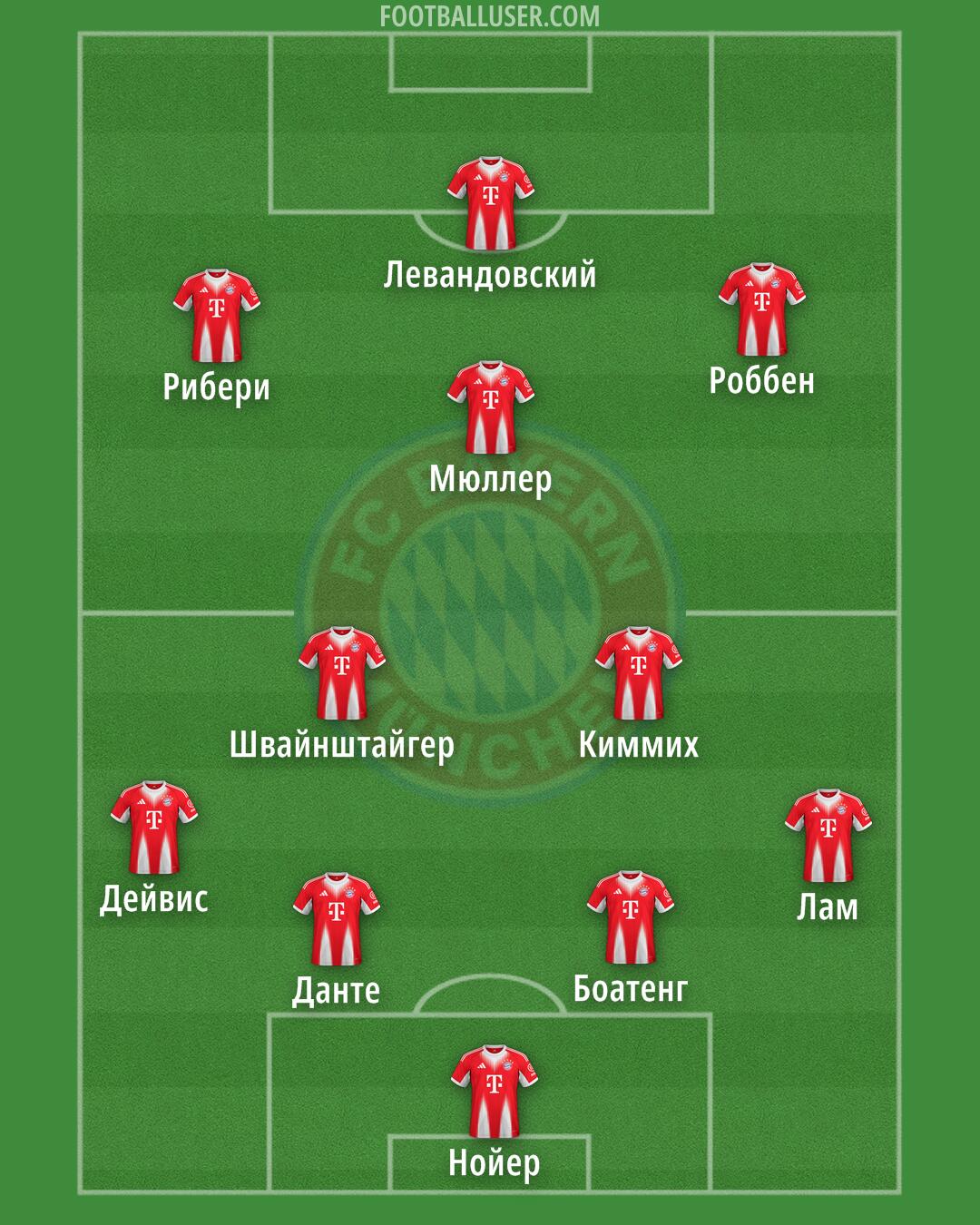

FC Bayern Football Formation
 December 23, 2025


Starting Lineup
Нойер · Лам · Боатенг · Данте · Дейвис · Швайнштайгер · Киммих · Роббен · Рибери · Мюллер · ЛевандовскийSeeking to control the tempo through heavy possession and high pressing, FC Bayern utilizes a 4-3-3. This lineup is built to dominate the ball and push the opposition back into their own half. The goal is to use aggressive movement to suffocate opponents and create scoring chances through quick combinations.
Manuel Neuer acts as the foundation in goal, often playing a high line to sweep up long balls behind the defense. In front of him, a back four consists of Dante and Boateng as the central pair, while Philipp Lahm and Alphonso Davies occupy the flanks. Dante and Boateng provide aerial strength and physical presence to block crosses and intercept passes. Lahm operates as an attacking full back who can overlap to support the wings, whereas Davies uses his pace to push up the left side. The entire defensive unit stays compact to prevent breakthroughs.
The midfield functions as a three man engine room that connects the defense to the attack. Bastian Schweinsteiger acts as the anchor, shielding the back line and looking to break the line with his passing range. Joshua Kimmich works alongside him to drive forward and maintain the rhythm of the game. Thomas Müller operates in the advanced space as an attacking ten, finding pockets between the lines to create chances. This midfield group works to win the ball back quickly and shift play to whichever side offers the most space.
In the final third, FC Bayern employs a potent trio of attackers. Robert Lewandowski leads the line as a lone striker, tasked to hold up the ball and finish clinical chances. On the wings, Franck Ribery and Arjen Robben act as inverted wingers who frequently cut inside to challenge the defense. Their movement forces the opposition to sit deep, creating room for the midfielders to push into the box. The forwards press intensely the moment possession is lost to keep the ball in the attacking third.
One major tactical advantage of this formation is the ability to create wide overloads when the full backs join the wingers. Another strength lies in the high press, where the players move in coordinated waves to trap opponents. This pressure often forces turnovers in dangerous areas, allowing the team to exploit disorganized defenses. The presence of goal scoring threats in the midfield and attack means the opposition can never truly relax.
The 4-3-3 is a dominant formation designed for teams that want to control every phase of the match. It is best suited for facing opponents who struggle with high physical intensity and rapid transitions.