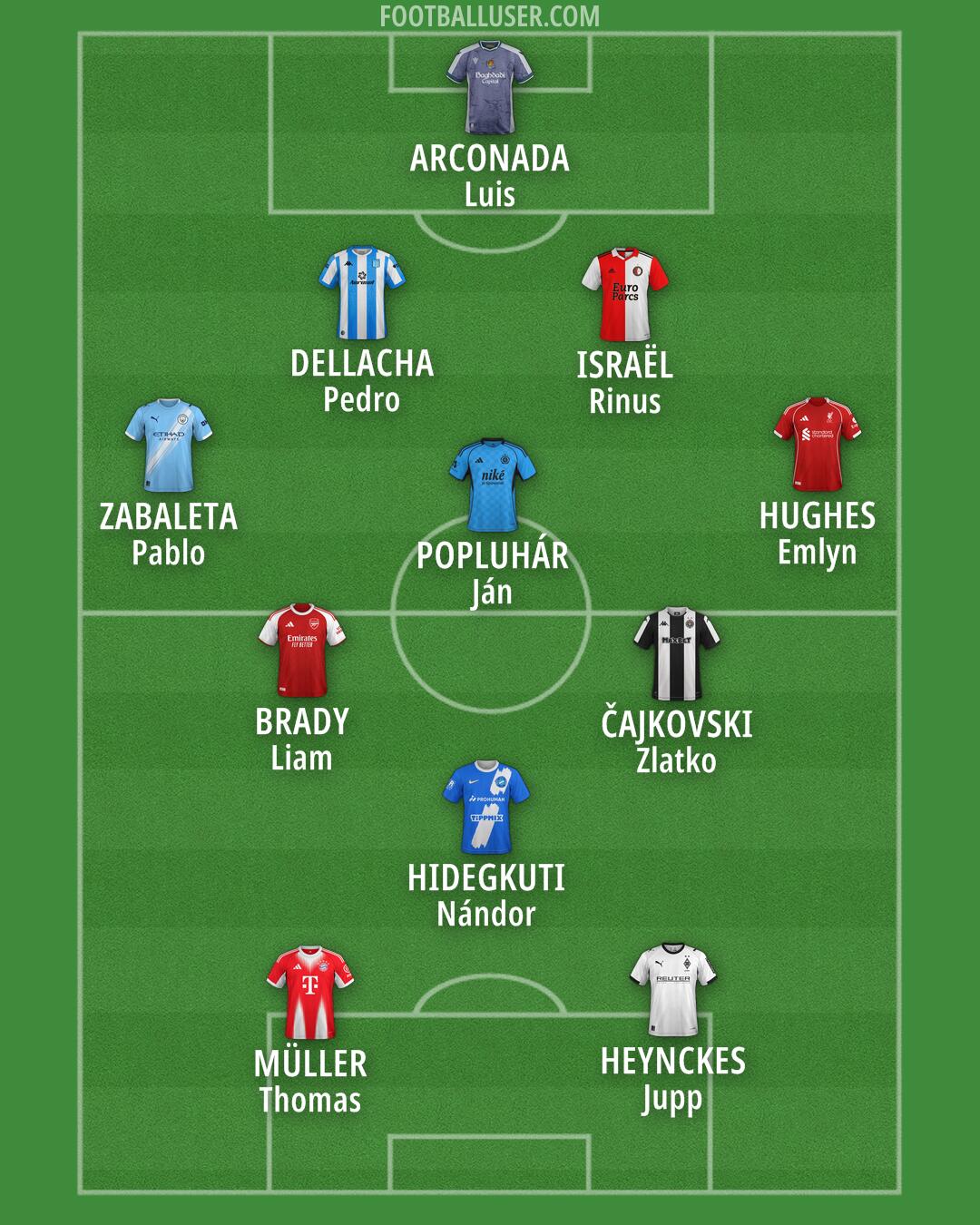
Custom Team Football Formation
 December 31, 2025


Starting Lineup
ARCONADA (Luis) (Real Sociedad) · DELLACHA (Pedro) (Racing Club) · ISRAËL (Rinus) (Feyenoord) · ZABALETA (Pablo) (Man City) · HUGHES (Emlyn) (Liverpool) · POPLUHÁR (Ján) (Slovan Bratislava) · ČAJKOVSKI (Zlatko) (Partizan) · BRADY (Liam) (Arsenal) · HIDEGKUTI (Nándor) (MTK) · MÜLLER (Thomas) (FC Bayern) · HEYNCKES (Jupp) (Borussia M'gladbach)A focus on defensive solidity and rapid counter attacking defines this lineup. The team relies on a 5-3-2 formation to sit deep and soak up pressure before hitting the opposition on the transition. This setup is built to maintain a compact block and exploit space behind the opposing full backs.
ARCONADA starts in goal to command the area. The defensive unit operates as a back five, with POPLUHÁR acting as the central defender to anchor the line. DELLACHA and ISRAËL sit on either side of him to defend zonally and win the second ball. ZABALETA and HUGHES act as attacking wing backs, tasked with providing width and pushing high up the pitch to support the attack. This means the central three must be ready to cover wide areas if the wing backs are caught high.
The midfield operates as a three man midfield with a carrier and an attacking ten. ČAJKOVSKI and BRADY sit in the middle to shield the defence and recycle possession. HIDEGKUTI plays in the hole as an attacking ten, looking to connect the midfield to the front two. These players must work to compress the midfield and prevent the opposition from playing through the lines. When the team wins the ball, the midfielders look to find the forwards quickly to start a break.
In the final third, the team uses two forwards in a partnership. HEYNCKES and MÜLLER operate as the main threats up front. MÜLLER works as a pressing centre forward to force a long ball from the opposition, while HEYNCKES looks to hold up the ball and find the feet of the oncoming runners. The attack relies on the wing backs to provide width, allowing the two strikers to stay central and pin the last defender. This movement creates runs in behind for the forwards to exploit during a quick break.
This formation offers great compactness when defending a deep block. It also allows for wide overloads from ZABALETA and HUGHES when they overlap the midfield. The team can shift quickly from a narrow defensive block to a wide attacking presence, making them very difficult to break down in a low block.
This 5-3-2 system is built for teams that want to remain hard to beat and strike on the break. It is best suited for games against heavy possession teams that leave space behind their defensive line.