West Ham Football Formation
 January 1, 2026


Starting Lineup
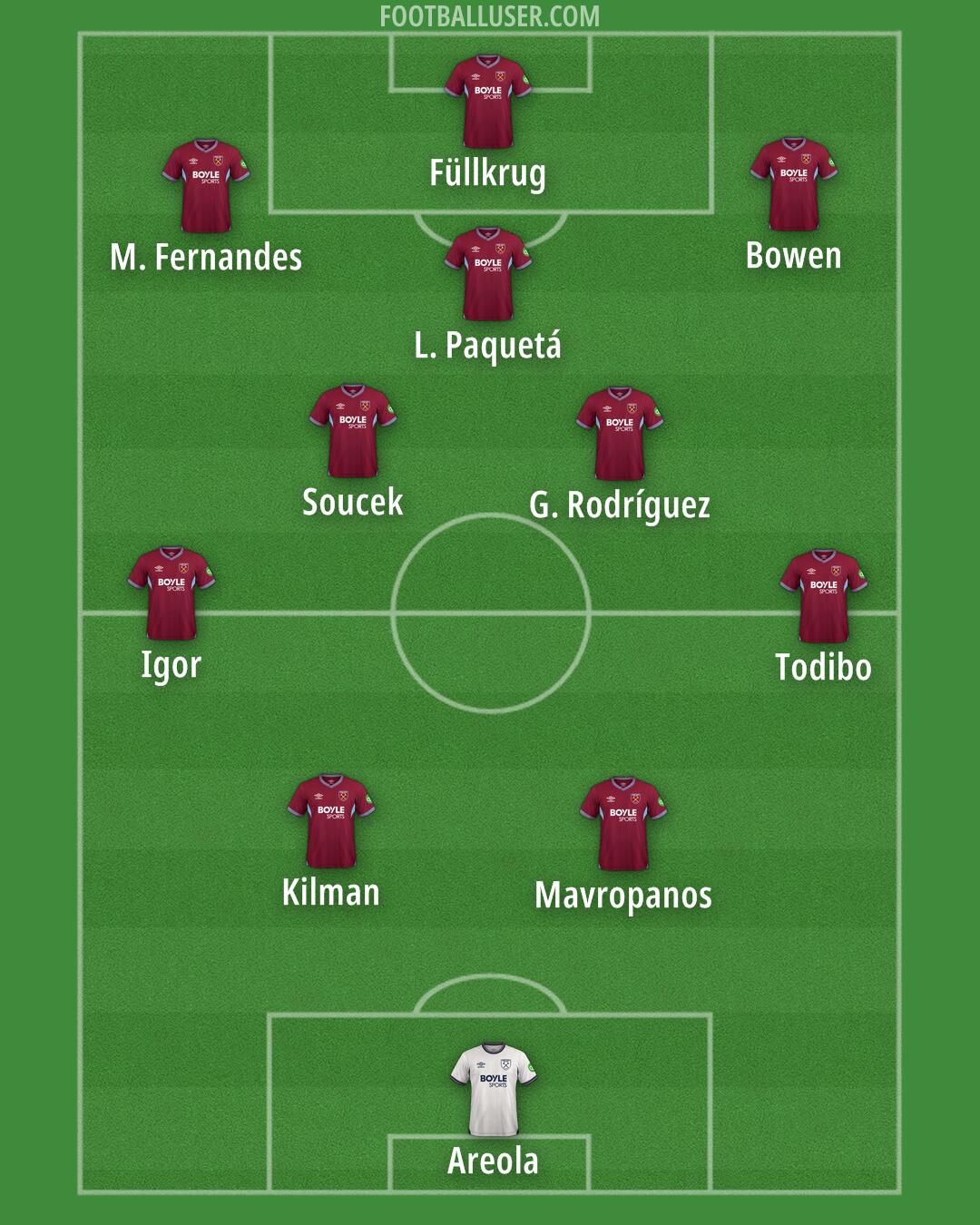
Igor · Todibo · Kilman · Mavropanos · Soucek · G. Rodríguez · Füllkrug · Bowen · L. Paquetá · M. Fernandes · AreolaWest Ham aims to dominate the center of the pitch through a high volume of passing and aggressive pressing in a 2-5-3 formation. This lineup focuses on controlling the middle third and using a dense midfield to suffocate the opposition. The team looks to win the ball back quickly and use the central numbers to drive the play forward into the final third.
Areola acts as the last line of defense, acting as a sweeper when the team pushes high. Behind the central block, Mavropanos and Kilman form a narrow pair of central defenders. Mavropanos uses his aerial strength to defend crosses, while Kilman works to cover the space behind the midfield. These two must stay compact to prevent runners from breaking the line through the middle.
The midfield functions as a heavy engine room built around a single pivot and a box style arrangement. Todibo and Igor sit deep to shield the two central defenders and intercept passes. G. Rodríguez provides the link between the defensive and attacking units, using his passing range to switch play. Soucek works to win second balls and push the press forward, while L. Paquetá operates as the creative hub to find gaps in the defense.
The attacking unit relies on three players to stretch the opposition and provide a focal point. Füllkrug acts as a lone striker to hold up the ball and battle against defenders. Bowen stays wide on the right to deliver crosses, while M. Fernandes cuts inside from the left to create chances. This three man front line presses intensely to force mistakes near the opponent's goal.
One major advantage for West Ham is the numerical superiority in the middle of the park. The five midfielders can easily overload opponents who play with a standard three man lineup. Another strength is the ability to use the wide players to isolate defenders in one on one situations during transitions. The compactness of the midfield makes it very difficult for teams to play through the center.
This formation relies on a heavy central presence to control the tempo of the match. It is best suited for games where the team needs to dominate possession against a side that sits deep.