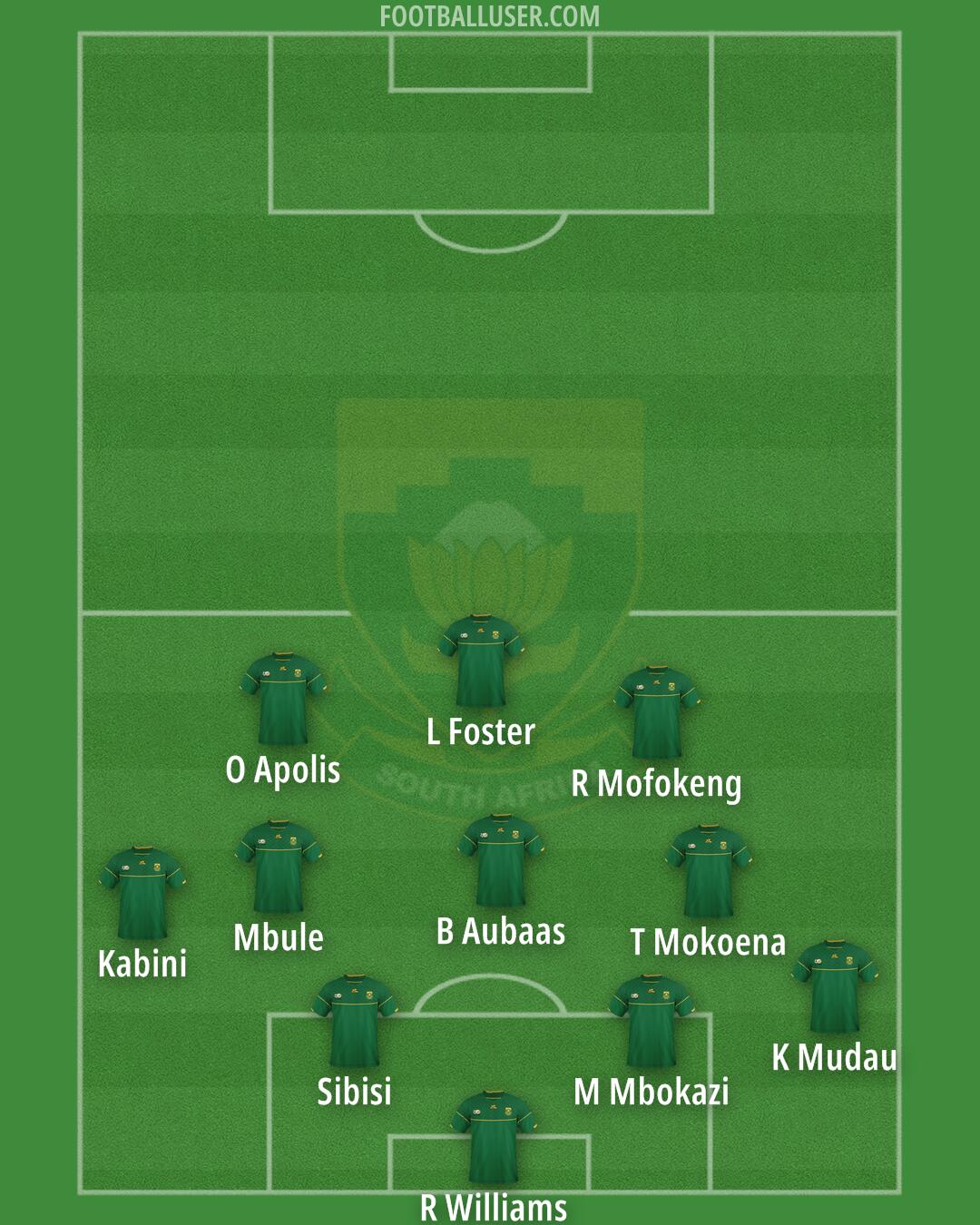

South Africa National Soccer Team Formation
 January 1, 2026


Starting Lineup
R Williams · Kabini · Sibisi · M Mbokazi · K Mudau · T Mokoena · B Aubaas · Mbule · R Mofokeng · L Foster · O ApolisSouth Africa focuses on high pressing and rapid transitions using a 3-4-3 formation. This lineup is built to play vertical football that forces opponents into mistakes in their own half. By spreading players across the pitch, the team aims to stretch the opposition and create space for quick movements.
R Williams guards the goal while a back three provides the foundation for the defense. Sibisi sits as the left central defender to cover wide areas, while K Mudau acts as the right central defender to handle physical battles. M Mbokazi stays central to command the area and organize the line. The wide midfielders, Kabini and T Mokoena, act as wing backs to provide width and track back when the team loses possession.
The midfield works as a central block to control the tempo and protect the back line. B Aubaas and Mbule form a double pivot in the center to shield the defenders and break the lines with forward passes. They connect the defensive unit to the attackers by recycling possession or driving into space. Kabini and T Mokoena shift inward to help the central pair when the game becomes congested, ensuring South Africa maintains control in the middle.
An aggressive front line drives the pressure from the front. L Foster acts as a lone striker to hold up the ball and pin the opposition center backs. O Apolis operates from the left wing to cut inside and create shooting chances, while R Mofokeng stays wide on the right to stretch the defense. These three forwards press in coordinated waves to force turnovers high up the pitch.
A major advantage for South Africa is the ability to create wide overloads. When Kabini and T Mokoena overlap, they provide extra passing lanes that isolate R Mofokeng and O Apolis in one on one situations. The formation also offers compactness when defending a low block, as the midfield and back three can sit deep to deny space. This allows the team to quickly switch play to the flanks during transitions.
This 3-4-3 formation is designed for a high intensity game that relies on pressing. It is best suited for matches against teams that struggle to play out from the back under pressure.