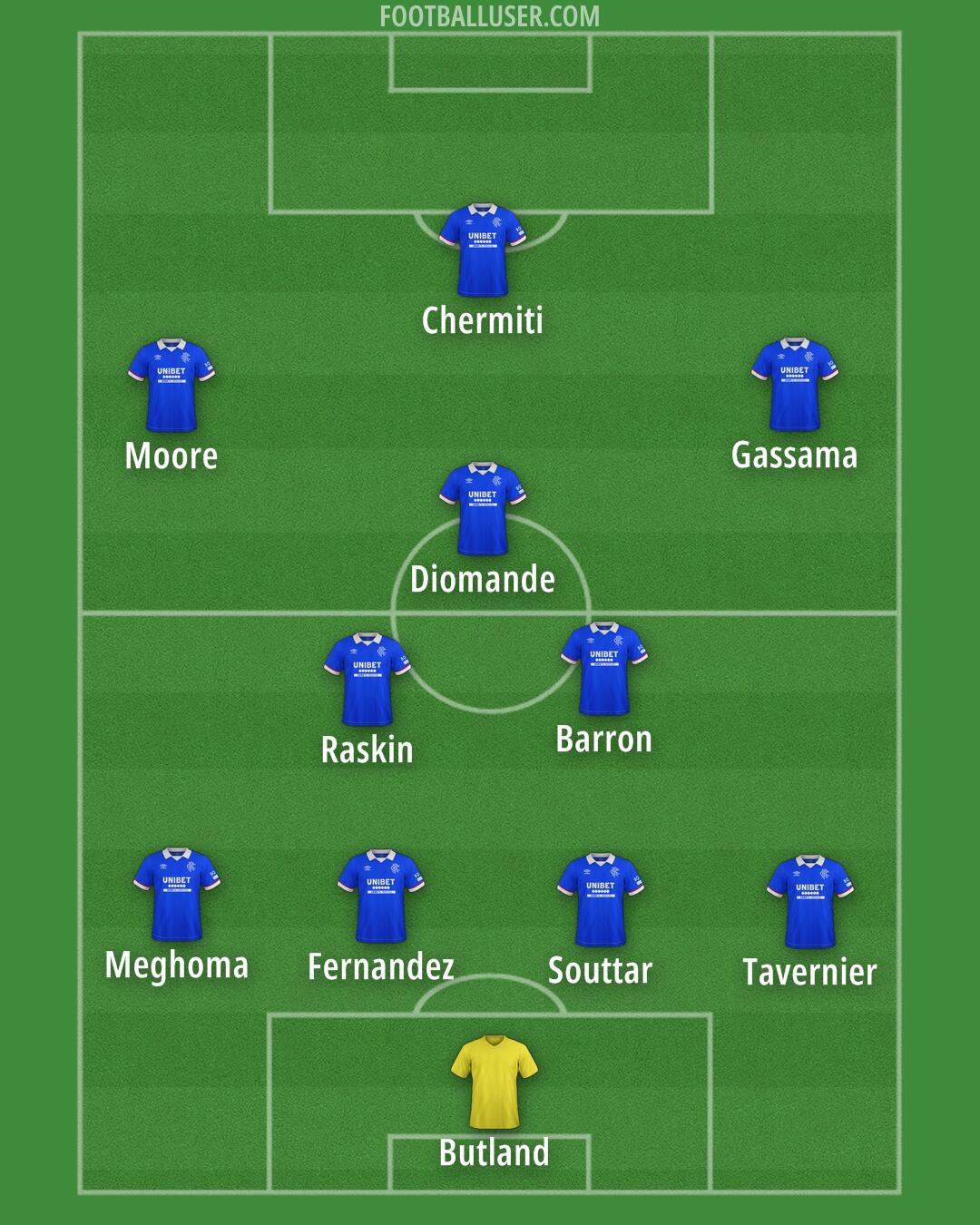
Rangers Football Formation
 January 2, 2026


Starting Lineup
Butland · Meghoma · Fernandez · Souttar · Tavernier · Barron · Raskin · Diomande · Gassama · Moore · ChermitiRangers look to control games through high pressing and quick vertical transitions in a 4-3-3. This formation allows the team to hunt for the ball high up the pitch and move it quickly toward the final third. By using this lineup, the squad aims to dominate territory and use width to stretch the opposition.
Butland acts as the last line of defense behind a back four that can sit deep or step up. Souttar provides aerial strength and presence in the middle of the defense, while Fernandez covers the space next to him. Tavernier plays as an attacking right back, looking to overlap and send crosses into the box, whereas Meghoma holds the left side to maintain balance. This unit works to block passing lanes and intercept balls before the opponent can enter the penalty area.
The midfield functions with a mix of roles to connect the defense to the attack. Raskin works to break the line with his passing and movement, while Barron provides the engine to track back and cover ground. Diomande operates as the attacking midfielder, looking to find pockets of space between the opponent lines to create chances. This trio must shift together to maintain compactness and ensure the middle of the pitch is not exploited.
In the final third, Rangers use three attackers to pressure the opposition backline. Chermiti leads the line as a lone striker, tasked to hold up the ball and lead the press. Moore cuts inside from the left to create goalscoring opportunities, while Gassama provides width and pace from the right wing. This attacking group moves in relation to one another to pull defenders out of position and create space in the central areas.
One major strength of this Rangers formation is the ability to create wide overloads when Tavernier pushes high up the pitch. Another advantage is the ability to press high in coordinated waves, using the front three and Diomande to force mistakes in the opponent half. The setup also allows for quick transitions, moving the ball from Butland through the midfield to the wingers in seconds.
This 4-3-3 is built for teams that want to dictate the tempo through aggressive pressing and wide play. It is particularly effective against opponents that struggle to play out from the back under heavy pressure.