
Spartak Moscow Football Formation
 January 5, 2026


Starting Lineup
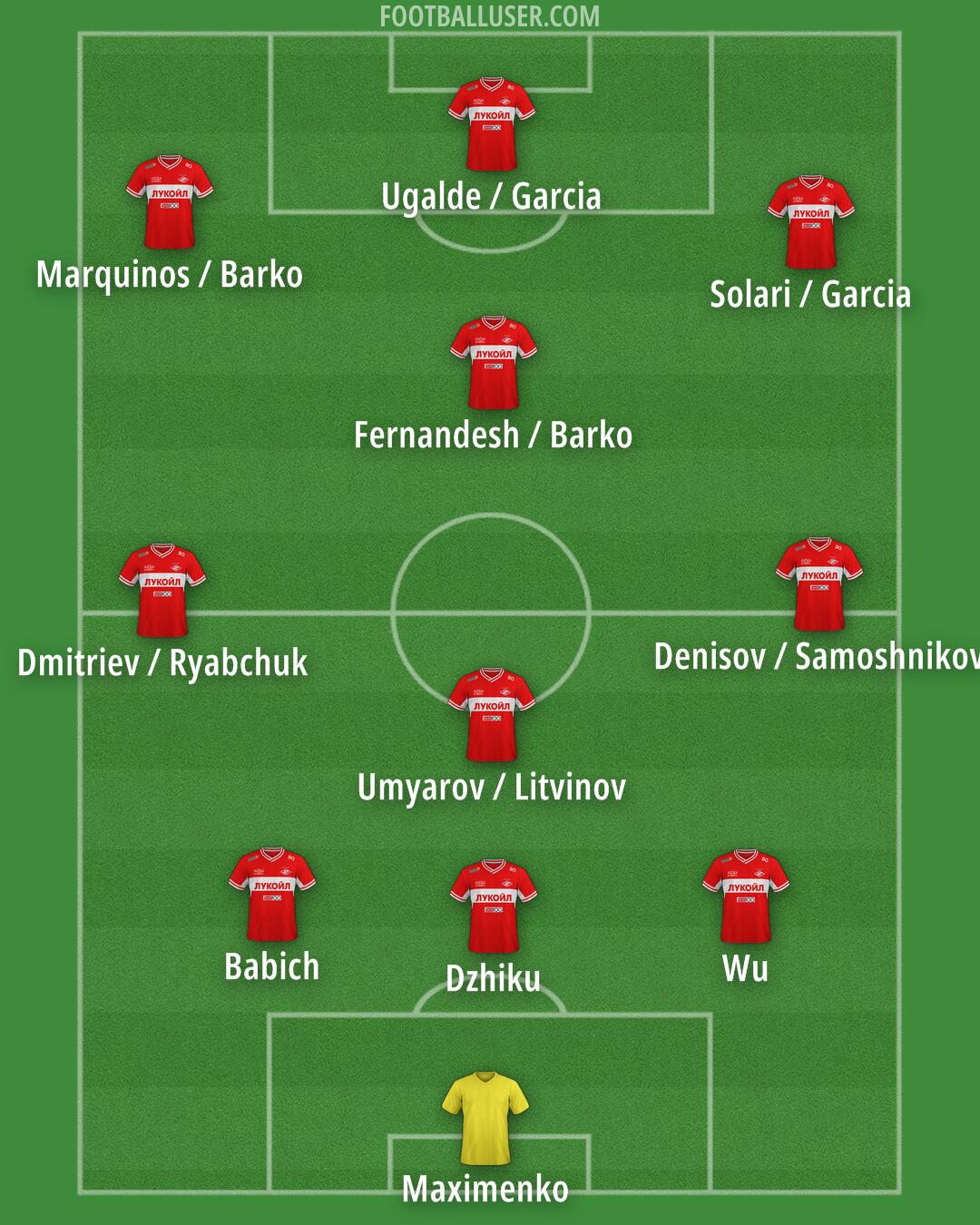
Babich · Dzhiku · Wu · Dmitriev / Ryabchuk · Denisov / Samoshnikov · Umyarov / Litvinov · Fernandesh / Barko · Marquinos / Barko · Solari / Garcia · Ugalde / Garcia · MaximenkoSpartak Moscow seeks to dominate through high pressing and verticality using a 3-4-3 formation. This lineup focuses on controlling the pitch by pushing players high up the field to win the ball back quickly. The goal is to transition from defense to attack with speed, using heavy pressure to force errors in the opponent's half.
Maximenko sits between the posts to organize the back line. The defensive unit relies on a back three consisting of Dzhiku, Wu, and Babich. Dzhiku leads the group as a dominant force in the air and provides physical presence. Wu and Babich cover the wide areas of the three, stepping up to intercept passes or sliding across to support the central zone. This unit can sit deep in a low block or push up to maintain a high line depending on how the midfield holds its position.
The midfield operates as a central engine to connect the defense to the front line. Umyarov or Litvinov acts as the single pivot to shield the three defenders and break up play. Ahead of them, Dmitriev or Ryabchuk and Denisov or Samoshnikov occupy the central roles to drive forward and occupy space. Fernandesh or Barko plays as an attacking ten to create chances and find pockets of space between the lines. This setup allows the team to control the center of the pitch and move the ball quickly from back to front.
The attack is built to overwhelm opponents with width and central movement. Solari or Garcia on the right and Marquinos or Barko on the left act as wide attackers who can cut inside to create shooting lanes. Ugalde or Garcia plays as a lone striker to hold up the ball and bring others into play. These three forwards press high in coordinated waves to prevent the opposition from building from the back.
Spartak Moscow gains a massive advantage through numerical superiority in the central zones when the attacking ten joins the midfield. The ability to press high in waves makes it difficult for opponents to play out from their own half. This formation also allows the wide attackers to isolate defenders in one on one situations once they receive the ball in space.
This 3-4-3 formation is built for aggressive, high intensity football that relies on rapid transitions. It is best suited for games against teams that struggle to play under pressure or leave space behind their midfield.