Man City Football Formation
 January 6, 2026


Starting Lineup
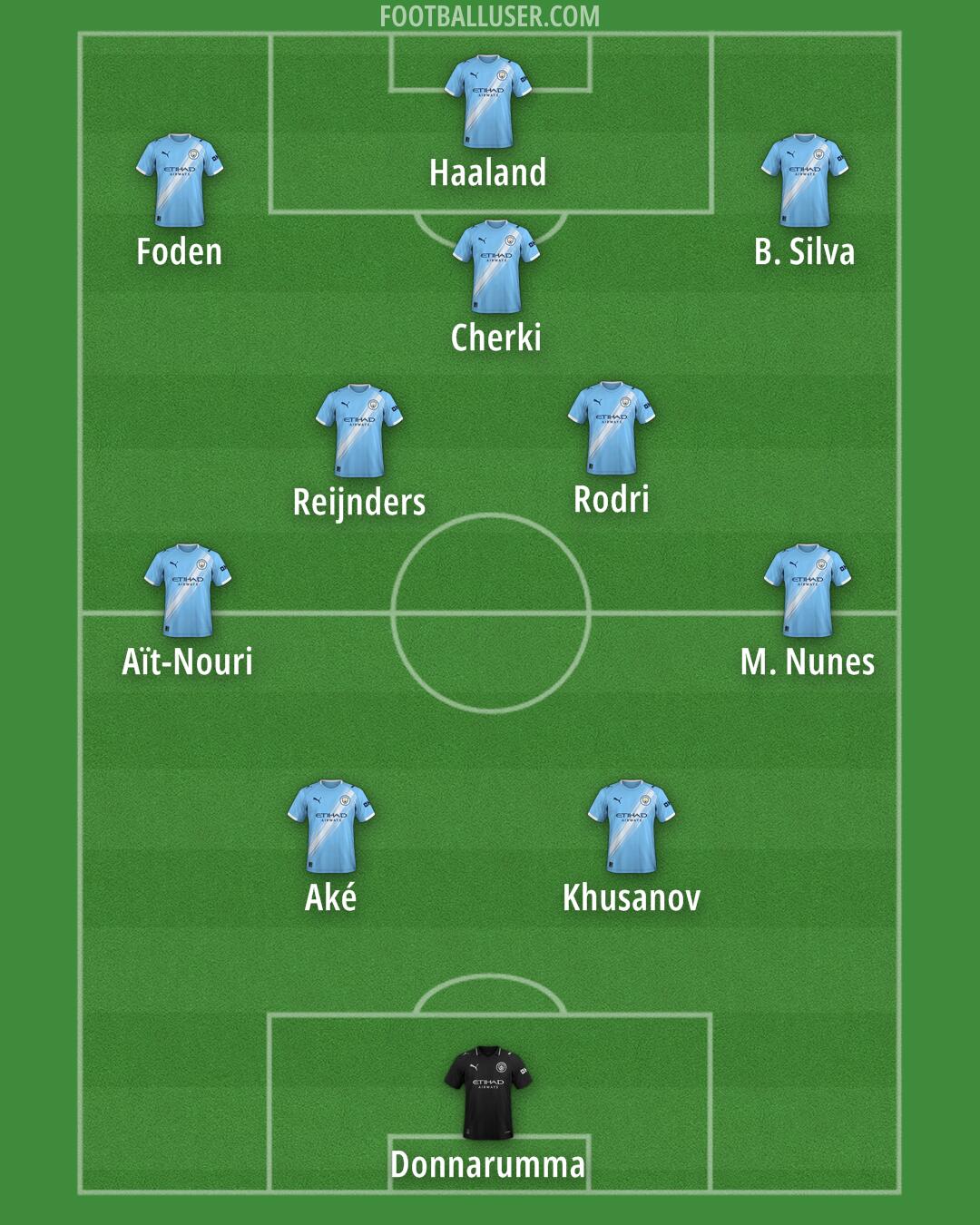
Aït-Nouri · M. Nunes · Aké · Khusanov · Haaland · Cherki · Reijnders · Foden · B. Silva · Rodri · DonnarummaMan City focus on heavy ball possession and suffocating the opponent in their own half using a 2-5-3. This lineup builds play through a heavy central presence to control the tempo of the game. The team seeks to dominate every area of the pitch by keeping the ball and moving the opponent around until a gap appears.
Donnarumma acts as the last line of defense in goal. Ahead of him, Aké and Khusanov form a narrow pair of central defenders who must step up high to compress the playing area. This two man back line requires both players to be comfortable in space to cover for the aggressive midfield. Aké often uses his ability to read the game to intercept passes, while Khusanov provides physical presence.
The midfield functions as a powerful five man unit designed to control the center of the pitch. Rodri acts as the anchor, sitting deep to shield the defense and break the lines with his passing range. Next to him, M. Nunes and Aït-Nouri occupy the wider central roles to provide energy and help with ball recovery. Reijnders works to connect the defense to the attack by driving forward into space, while Cherki operates as the attacking ten to find pockets of space between the lines.
The attacking trio is built to create constant pressure on the opposition box. Haaland sits as the lone striker to hold up the ball and use his aerial strength to target crosses. On the flanks, Foden and B. Silva act as inverted wingers who cut inside to create shooting opportunities or central overloads. This movement draws defenders out of position, allowing Haaland to find space in the middle.
One major advantage of this Man City formation is the massive numerical superiority in the center of the pitch. By packing the middle with five players, the team can easily outnumber most opponents and keep the ball under pressure. The setup also allows for quick transitions where the wingers can immediately exploit space behind the opposition full backs once the ball is won.
This formation relies on high pressing and intense control to dictate the rhythm of the match. It is most effective against teams that try to play out from the back or those that lack the strength to fight for second balls in the middle.