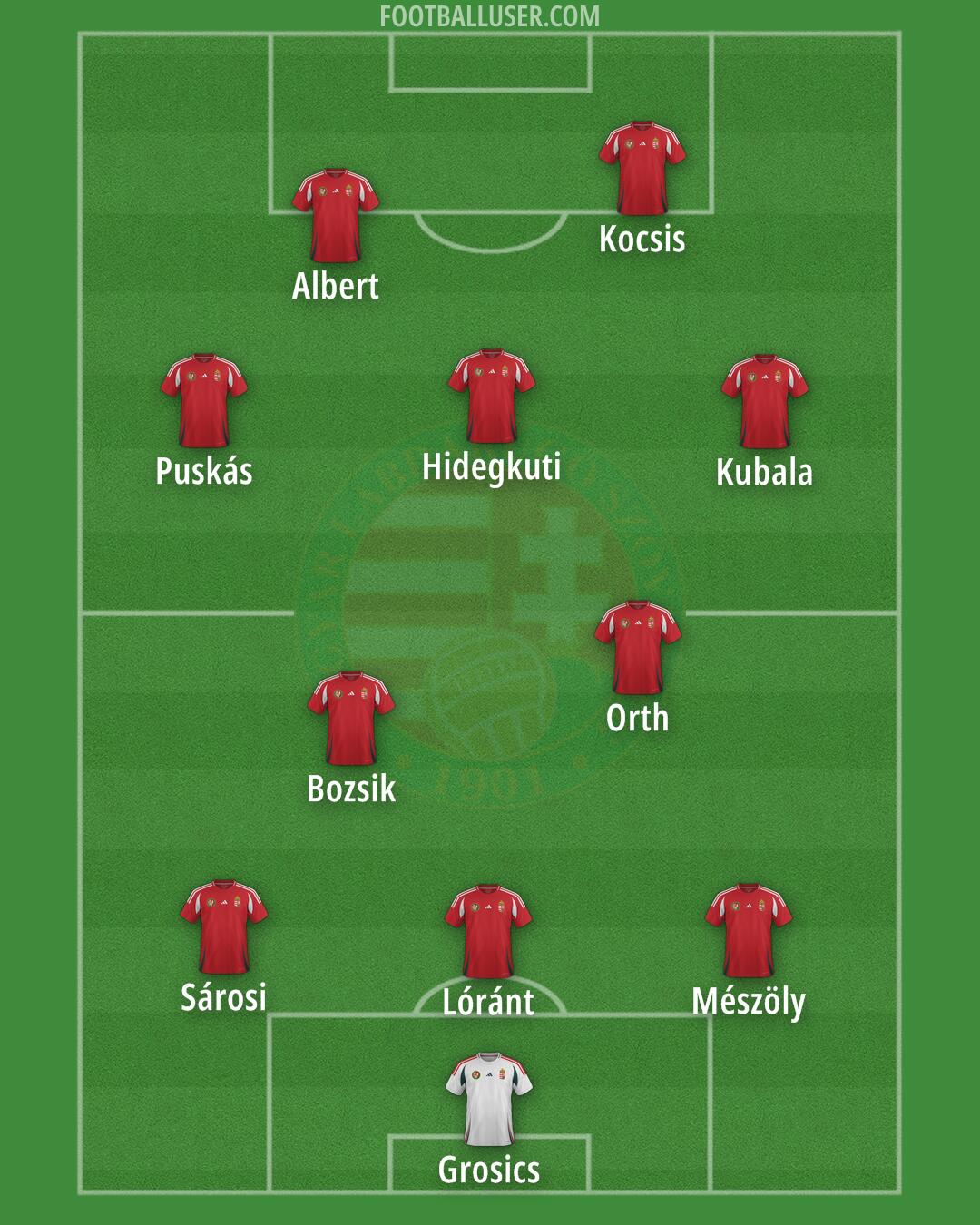

Hungary National Football Team Formation
 January 6, 2026


Starting Lineup
Grosics · Lóránt · Mészöly · Sárosi · Bozsik · Orth · Hidegkuti · Puskás · Kubala · Albert · KocsisHungry aims to control games through high pressing and quick verticality using a 5-3-2. This formation relies on a solid foundation to win the ball back and strike rapidly through a powerful attacking duo. The Hungarian team uses this lineup to squeeze opponents in their own half and dominate central areas.
Grosics sits between the posts to command the defensive unit. The back five functions with a mix of central stability and wide coverage. Orth and Bozsik act as the primary central defenders to cover space and win aerial duels, while Lóránt provides additional depth to the central block. Mészöly and Sárosi play as wing backs, tasked to push high up the pitch to provide width and track back to defend the flanks.
The midfield functions as a three man unit to dominate the center of the pitch. Hidegkuti operates as a central link, often dropping deep to collect the ball and connect the defense to the attack. To his right, Kubala uses his dribbling style and passing range to break the lines. Puskás operates on the left of the midfield trio, using his legendary left foot and shot power to create chances or drive forward from deep.
The attack is built around two forwards who demand constant attention from the opposition. Albert plays as a left striker to stretch the defense, while Kocsis acts as the right striker to occupy the center. These two forwards press the opposition back line relentlessly, forcing errors that allow the midfield to step up. Their movements create space for the wing backs to overlap and provide crosses into the box.
This formation offers significant advantages when the team wants to control the center of the park. Hungary can create numerical superiority in the middle through the movements of Hidegkuti and the advancing midfielders. The team also gains ability to press high in coordinated waves, using the front two to trigger the intensity of the midfielders and the wing backs. This creates a suffocating effect on the opponent.
This 5-3-2 formation builds a team capable of heavy ball retention and rapid transitions. It is best suited for facing teams that play with a narrow midfield or those that leave space behind their full backs.