
Italy National Football Team Formation
 January 6, 2026


Starting Lineup
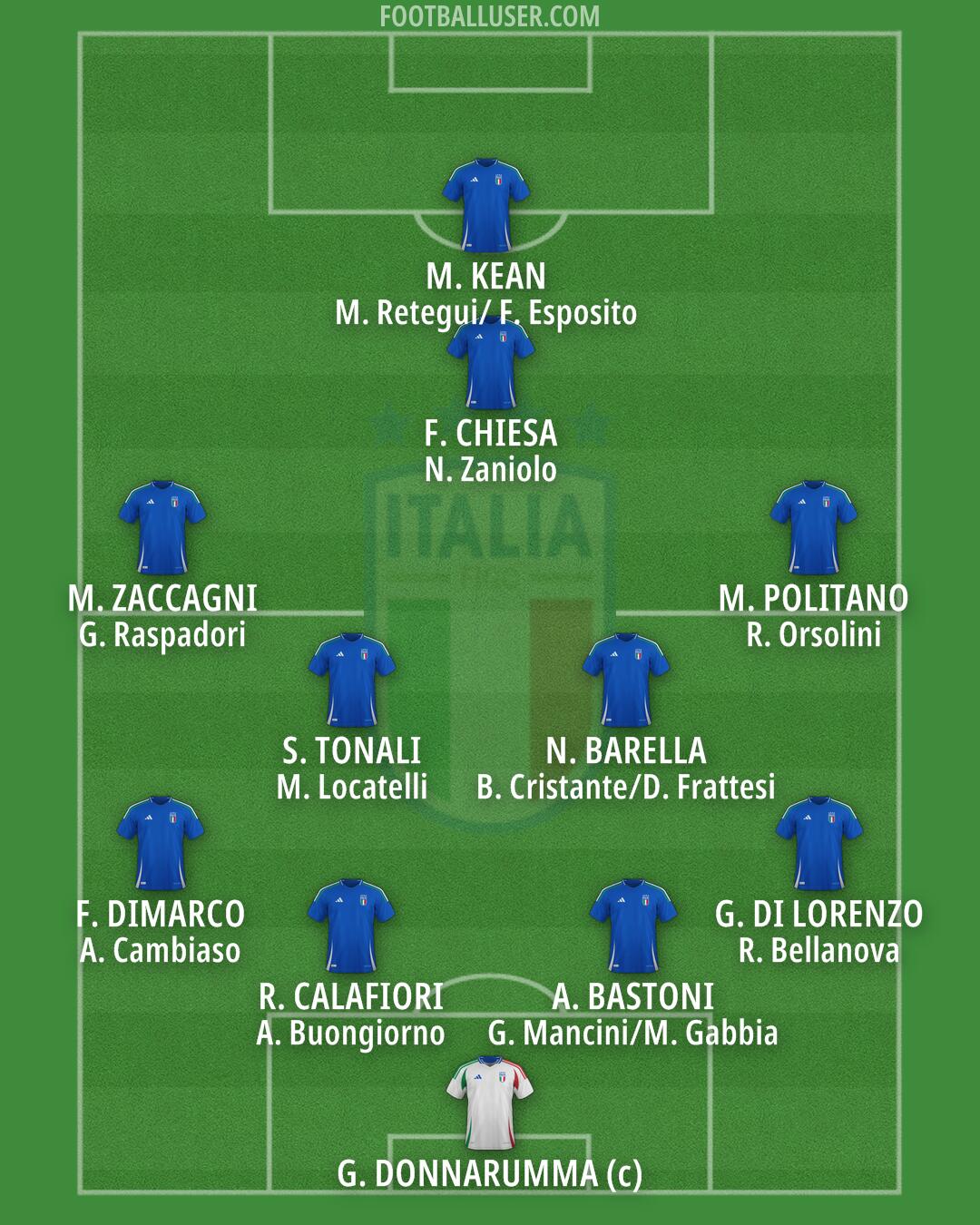
G. DONNARUMMA (c) · R. CALAFIORI (A. Buongiorno) · A. BASTONI (G. Mancini/M. Gabbia) · G. DI LORENZO (R. Bellanova) · F. DIMARCO (A. Cambiaso) · S. TONALI (M. Locatelli) · F. CHIESA (N. Zaniolo) · M. POLITANO (R. Orsolini) · M. ZACCAGNI (G. Raspadori) · M. KEAN (M. Retegui/ F. Esposito) · N. BARELLA (B. Cristante/D. Frattesi)Heavy emphasis on defensive solidity and quick transitions defines the Italy lineup in this 4-5-1 formation. This system focuses on maintaining a compact block to deny space between the lines while looking to break forward quickly once the ball is won. The team aims to absorb pressure and strike through vertical movements that exploit gaps in the opposition.
Gianluigi Donnarumma (c) commands the area from goal, acting as the foundation for the defensive unit. In front of him, a flat back four provides the primary resistance. Alessandro Bastoni acts as a ball playing defender with his ability to pass out from the back, while Riccardo Calafiori provides cover and support. The wide defenders, Giovanni Di Lorenzo and Federico Dimarco, are tasked with maintaining the width of the block when defending deep but must be ready to push up and overlap when the team transitions into attack.
The midfield engine room relies on a double pivot to shield the back four. Nicolò Barella and Sandro Tonali sit in front of the defenders to intercept passes and break up play. Barella brings his high pressing intensity to disrupt the opponent, while Tonali works to recover possession and connect the back line to the forward players. Ahead of them, Matteo Politano and Matteo Zaccagni occupy the half spaces to link play, with Federico Chiesa operating in the attacking midfield role to drive directly at the defense and create chances.
A lone striker, Moise Kean, leads the line to provide a focal point for the attack. He is tasked to hold up the ball and allow the advancing midfielders to join the play. The attacking structure depends on the wide players and the attacking midfielder to support him, often creating overloads in central areas. When the team loses the ball, the front players must press immediately to prevent the opposition from building momentum.
This formation offers several tactical advantages, particularly its ability to remain compact when defending against teams that dominate possession. By packing the central areas with five midfielders, Italy can force opponents to the flanks. Additionally, the presence of fast players like Federico Chiesa allows for rapid transitions that can catch a high defensive line off guard.
The 4-5-1 setup prioritizes defensive stability and quick counter attacks to exploit space. It is best suited for matches against technically superior sides where controlling the middle of the pitch is vital.