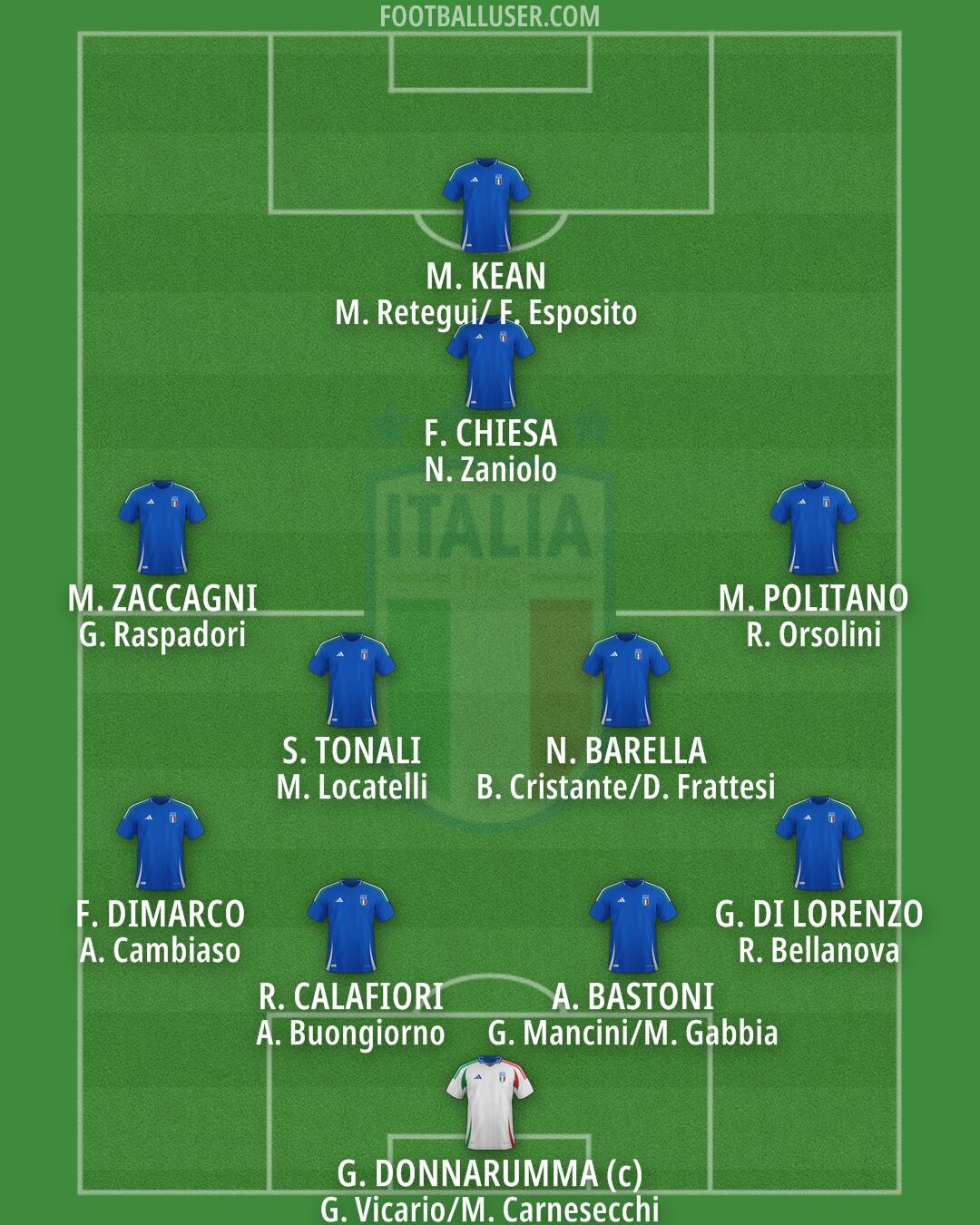

Italy National Football Team Formation
 January 6, 2026


Starting Lineup
G. DONNARUMMA (c) (G. Vicario/M. Carnesecchi) · R. CALAFIORI (A. Buongiorno) · A. BASTONI (G. Mancini/M. Gabbia) · G. DI LORENZO (R. Bellanova) · F. DIMARCO (A. Cambiaso) · S. TONALI (M. Locatelli) · F. CHIESA (N. Zaniolo) · M. POLITANO (R. Orsolini) · M. ZACCAGNI (G. Raspadori) · M. KEAN (M. Retegui/ F. Esposito) · N. BARELLA (B. Cristante/D. Frattesi)A high pressing and transitional identity defines Italy in this 4-5-1 formation. The lineup aims to squeeze opponents in their own half before launching quick vertical attacks. This system relies on heavy work rates across the pitch to regain possession and move the ball quickly toward the forward line.
Gianluigi Donnarumma (c) guards the goal and acts as the primary shot stopper with his massive presence. Ahead of him, a flat back four maintains a high line to compress the space. Alessandro Bastoni works as a ball playing defender with a wide passing range, while Riccardo Calafiori covers the left side. Giovanni Di Lorenzo provides width on the right, while Federico Dimarco pushes up the left flank to support the attack. The defensive unit must stay compact to prevent long balls from breaking through the lines.
The midfield operates as a central block consisting of five players. Sandro Tonali and Nicolò Barella form a double pivot to shield the back four and intercept passes. Nicolo Politano and Matteo Zaccagni occupy the central areas to connect the defensive layer to the attack. Federico Chiesa plays as an attacking ten, roaming between the lines to find pockets of space and drive the ball forward. This midfield group must shift laterally to cover the width of the pitch when defending.
In the attacking phase, the team utilizes a lone striker in Mateo Kean. Kean works to hold up the ball and press the opposing center backs to disrupt their build up. The team builds attacks through wide areas where players like Federico Chiesa and the full backs can create overloads. The wingers and attacking midfielders look to cut inside to create central presence, while the movement of the midfielders creates passing lanes for the lone striker.
Italy gains a significant advantage through the ability to press high in coordinated waves. The midfield group creates numerical superiority in central areas, making it difficult for opponents to play through the middle. Another strength is the speed of transition, as players like Federico Chiesa can exploit gaps immediately after a turnover. The overlapping runs from Federico Dimarco and Giovanni Di Lorenzo also provide constant width to stretch the opposition.
This 4-5-1 formation builds a compact wall that is difficult to break down through the center. It is best suited for games against possession based teams where Italy can sit in a mid block and strike on the break.