
Racing Club Football Formation
 January 7, 2026


Starting Lineup
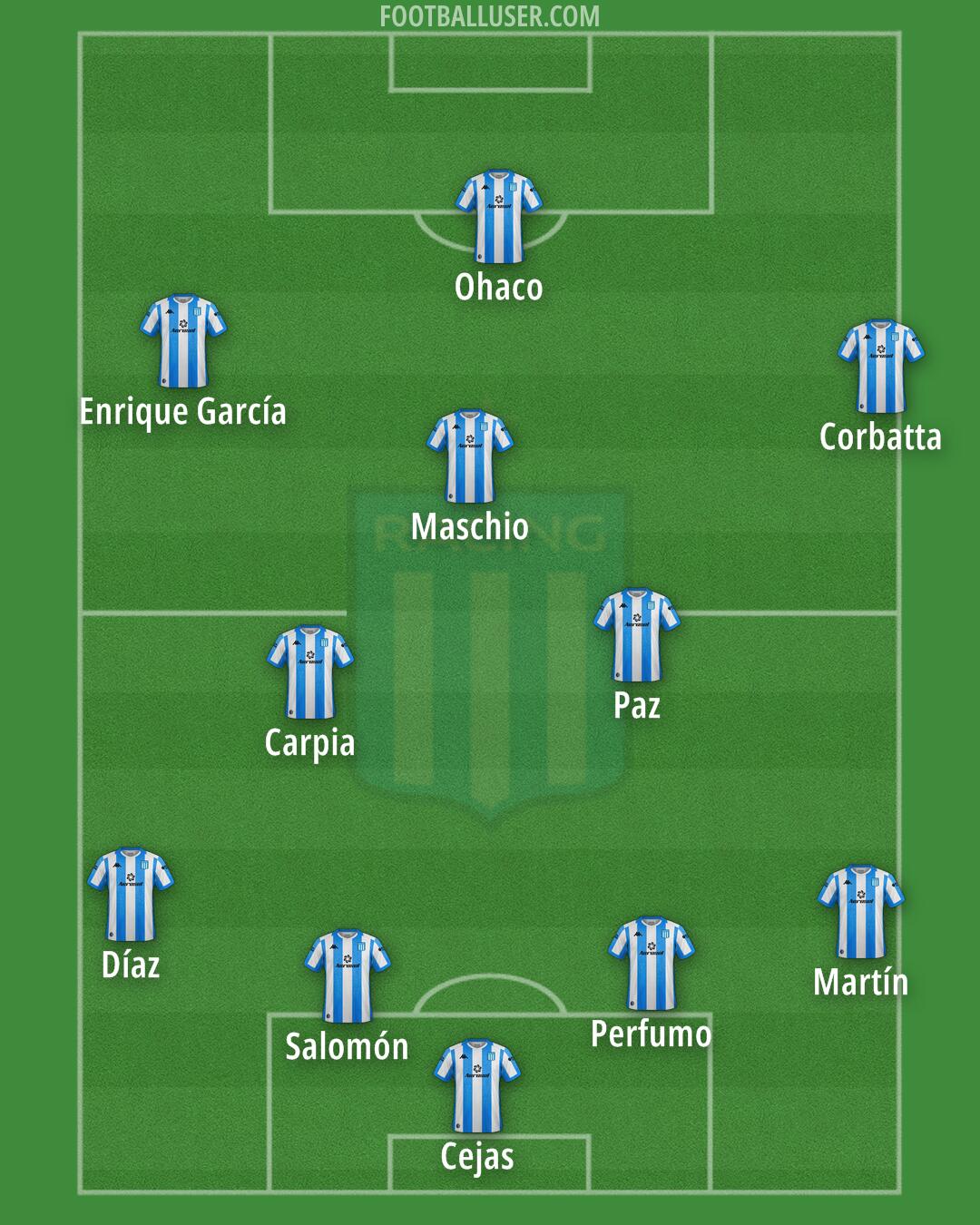
Cejas · Martín · Perfumo · Salomón · Díaz · Paz · Carpia · Corbatta · Maschio · Enrique García · OhacoA high pressing and vertical identity defines Racing Club as they line up in a 4-3-3. This formation seeks to win the ball back quickly in the opponent half and drive forward with speed. Racing Club relies on intense movement to force errors and create chances through quick transitions.
In goal, Cejas acts as the last line of defense. The back four consists of Martín on the right and Díaz on the left, while Perfumo and Salomón occupy the central roles. Martín and Díaz act as wide defenders who push up to support the attack, while Perfumo and Salomón hold a high line to keep the team compact. Perfumo provides aerial strength and leadership in the box, whereas Salomón focuses on covering space and intercepting passes.
The midfield works to control the center of the pitch through a combination of roles. Paz and Carpia operate in the central areas to shield the defense and break the lines with their passing. Maschio plays as an attacking ten, sitting just behind the strikers to create chances. Maschio connects the midfield to the front line, looking to find pockets of space between the opposition lines. Paz and Carpia must track back to prevent counter attacks while also driving the ball forward during possession.
The attacking unit focuses on width and directness. Enrique García and Corbatta occupy the wide positions as wingers, looking to cut inside or deliver crosses into the box. Ohaco leads the line as a lone striker, tasked with holding up the ball and pressing the opposition defenders. The movement from Enrique García and Corbatta creates space in the middle for Maschio to exploit.
This formation offers significant advantages through its ability to press high in coordinated waves. The proximity of the players allows them to swarm the ball carrier quickly. Another strength is the potential for wide overloads when Martín and Díaz overlap the wingers. This forces the opposition defenders to shift constantly, creating gaps in the central areas for the midfielders to run into.
This 4-3-3 is built for a team that wants to dictate play through aggression and speed. It is best suited for matches against opponents who struggle to play out from the back under pressure.