
Morocco National Football Team Formation
 January 7, 2026


Starting Lineup
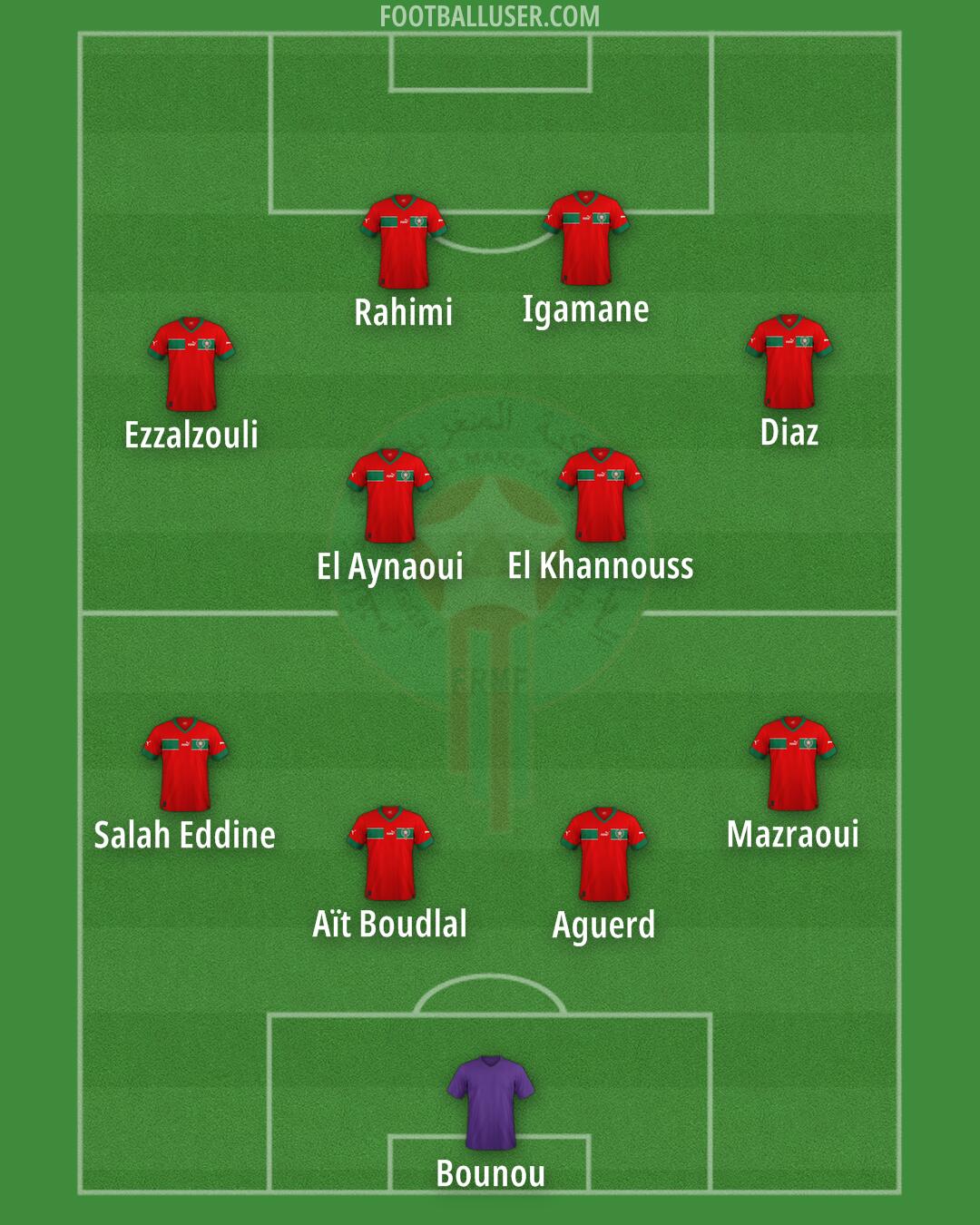
Igamane · Rahimi · Diaz · El Khannouss · Ezzalzouli · Mazraoui · Bounou · Aguerd · Aït Boudlal · El Aynaoui · Salah EddineHigh pressing and verticality define Morocco in this 4-2-4 formation. The team looks to win the ball high up the pitch and quickly move it toward the goal to catch the opposition out of position. This lineup relies on directness and speed to break lines rather than slow build up play.
Bounou guards the goal and organizes the back line from deep. A flat back four consists of Mazraoui at right back and Salah Eddine at left back, both of whom are tasked to push up and support the attack. Aguerd and Aït Boudlal act as the central pairing, where Aguerd uses his aerial strength and ability to play long passes to start transitions. The defensive unit stays compact to prevent central penetration while the full backs provide the necessary width.
A double pivot controls the center of the park. El Aynaoui acts as the primary shield for the defense, looking to intercept passes and break up play. Beside him, El Khannouss works to connect the defense to the attack with his passing range and ability to drive forward into space. This two man midfield must cover large areas of the pitch to prevent the team from being overrun during transitions.
The attacking force is heavy with four players positioned high up the field. Rahimi and Igamane operate as the two central forwards, working to hold up the ball and make runs into the channels. On the flanks, Ezzalzouli and Diaz provide width and directness. Ezzalzouli and Diaz look to cut inside or cross into the box, forcing the opposition defenders to stay wide and leave gaps in the middle for the central attackers to exploit.
Morocco gains a significant advantage through their ability to press high in coordinated waves, forcing turnovers in dangerous areas. The presence of four attackers allows for wide overloads when Mazraoui or Salah Eddine overlap to create two on one situations on the wings. Furthermore, the speed of transition allows the team to isolate wide players in one on one situations very quickly after winning the ball.
This 4-2-4 formation prioritizes aggressive attacking intent and rapid vertical movement. It is best suited for matches against opponents that play a high line or struggle to manage intense pressure in their own half.