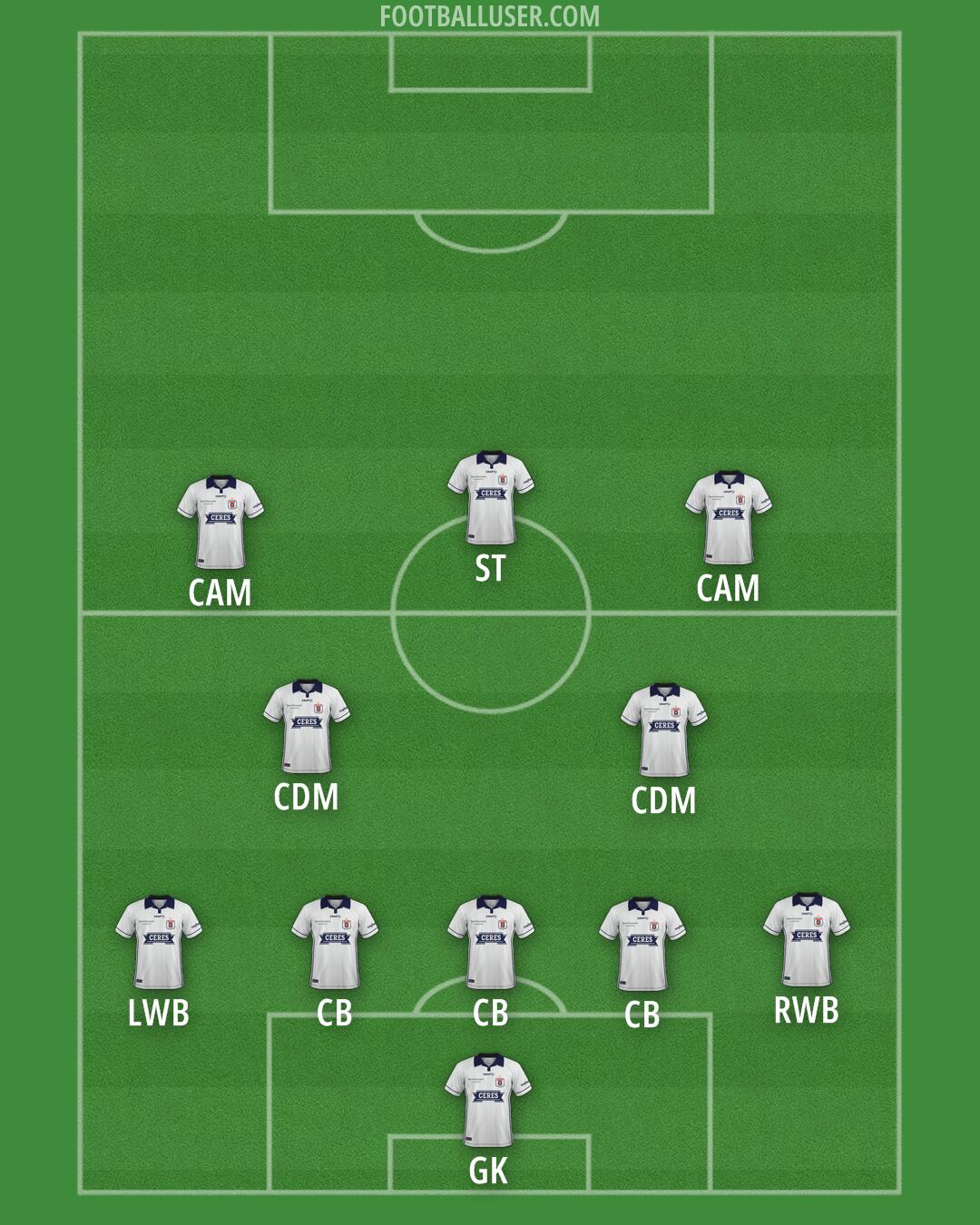

AGF Football Formation
 January 7, 2026


Starting Lineup
GK · CB · CB · CB · RWB · LWB · CDM · CDM · CAM · ST · CAMA heavy emphasis on defensive solidity and quick transitions defines the AGF 5-2-3 formation. This lineup aims to control space between the lines while remaining compact when the ball is lost. By utilizing a deep block or a high press depending on the game state, AGF looks to absorb pressure before breaking forward with speed. The formation is built to absorb attacks and strike through direct passing into wide areas.
The goalkeeper sits behind a back five that provides significant coverage across the width of the pitch. A central CB holds the line, while the RCB and LCB sit slightly wider to manage the half spaces. To provide width, the RWB and LWB push high up the flank to support the attack. These wing backs must track back quickly to prevent crosses, while the three central defenders work together to block passes and win aerial duels.
Midfield duties fall to a central pair consisting of the RCM and LCM. This double pivot acts as the heartbeat of the team, with the LCM and RCM tasked to shield the back five and intercept play. They must sit deep to protect the defense but also need to step up to connect the play to the front three. These players focus on breaking the line with vertical passes and ensuring the team maintains its compactness in the middle of the park.
In the attacking third, the team moves forward with three players positioned high. The ST acts as the focal point to hold up the ball and bring others into play. On the flanks, the LW and RW cut inside to create goal scoring chances, acting almost as attacking midfielders. This movement creates space for the RWB and LWB to overlap and deliver crosses into the box. The front three also lead the press to force turnovers in the opposition half.
AGF finds success through several tactical advantages inherent in this 5-2-3 setup. The presence of five defenders makes it very difficult for opponents to find gaps in the central zone, creating a dense block. Because the LW and RW cut inside, the team creates wide overloads when the wing backs push forward. This allows the side to control the wings while keeping enough bodies in the center to defend against counter attacks.
This formation provides a robust platform for teams that want to balance defensive security with lethal counter attacking. It is best suited for matches against ball dominant opponents where controlling space is more important than dominating possession.