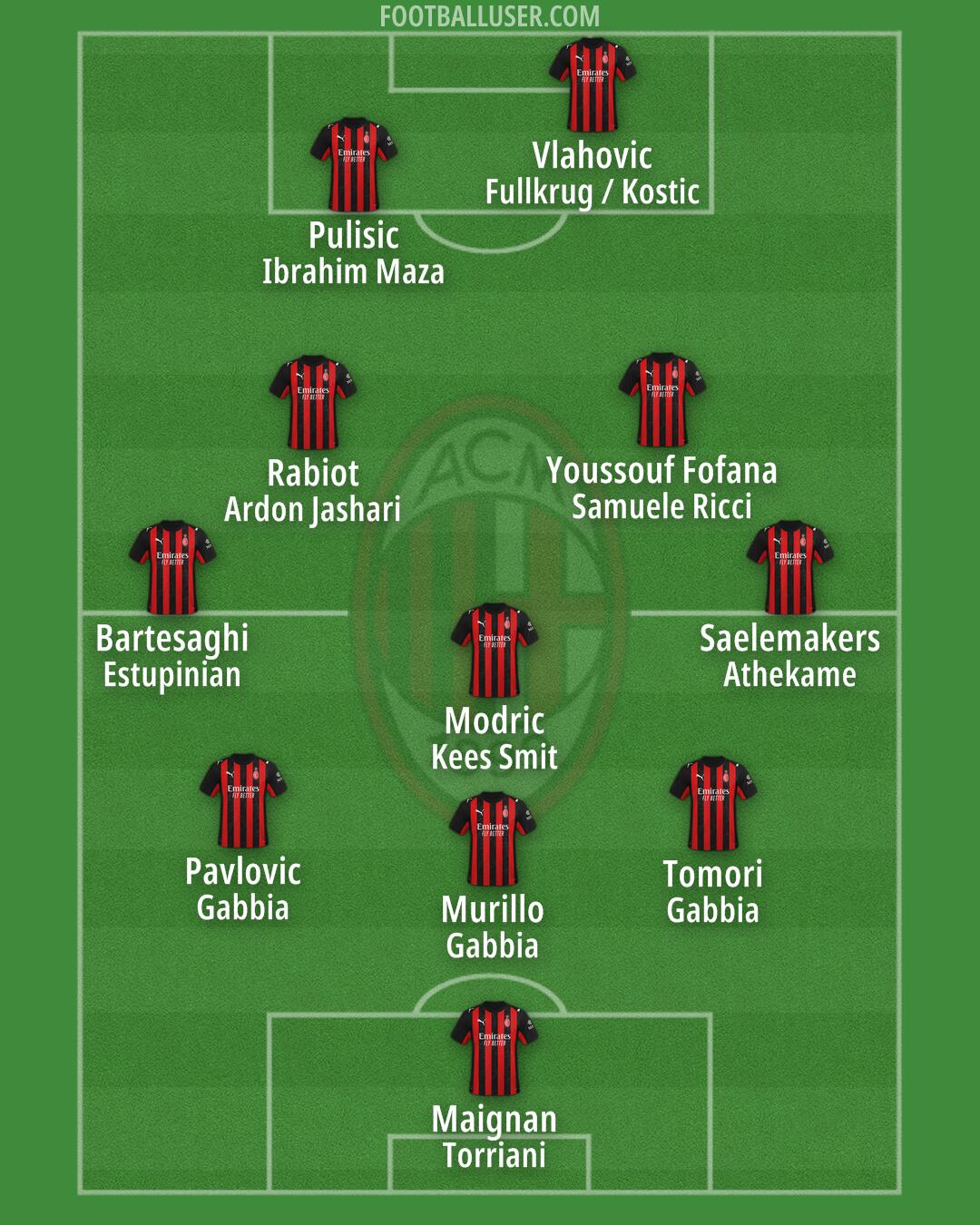

Milan Football Formation
 January 8, 2026


Starting Lineup
Maignan (Torriani) · Pavlovic (Gabbia) · Murillo (Gabbia) · Tomori (Gabbia) · Vlahovic (Fullkrug / Kostic) · Pulisic (Ibrahim Maza) · Saelemakers (Athekame) · Rabiot (Ardon Jashari) · Youssouf Fofana (Samuele Ricci) · Modric (Kees Smit) · Bartesaghi (Estupinian)A heavy focus on midfield control defines Milan and their 3-6-1 formation. This lineup is built to dominate the center of the pitch and control the tempo through high possession and central density. By clogging the middle, the team aims to suffocate opponents and manage the game through short passing combinations.
Mike Maignan sits between the posts to anchor the defensive unit. In front of him, a back three consists of Tomori, Murillo, and Pavlovic. Tomori acts as the right center back, while Pavlovic covers the left side. Murillo holds the central position to direct the line. This back three is expected to step up to compress the space, while Maignan uses his sweeping ability to intercept long balls. The defenders must remain compact to prevent any quick breaks through the middle.
The heart of the Milan lineup relies on a dense midfield block. Bartesaghi operates as the first defensive midfielder to shield the back three, supported by Saelemakers and Modric who sit deeper to break the lines with their passing range. Modric provides veteran control in the pivot, while Rabiot, Youssouf Fofana, and Pulisic push higher to link the play. This grouping allows the team to transition from a deep block to a pressing machine by stepping up in unison.
Moving into the final third, Vlahovic operates as a lone striker. The attacking movement relies on the three attacking midfielders to feed him through the middle or play wide to create openings. Pulisic often cuts inside to drive at the defense, while Rabiot and Youssouf Fofana make runs into the box to support the striker. Vlahovic must hold up the ball to allow the incoming runners to find space in the penalty area.
This formation offers significant tactical advantages through numerical superiority in the center. By packing six players into the midfield, Milan can easily win second balls and control the rhythm of the match. The ability to press high in coordinated waves from the midfield trio makes it difficult for opponents to build from the back. Additionally, the central density forces opposing teams to play wide, where the three center backs can defend against crosses.
Control of the center remains the core identity of this 3-6-1 formation. It is a setup best suited for facing teams that try to play through the middle, as it allows for total dominance in the central zones.