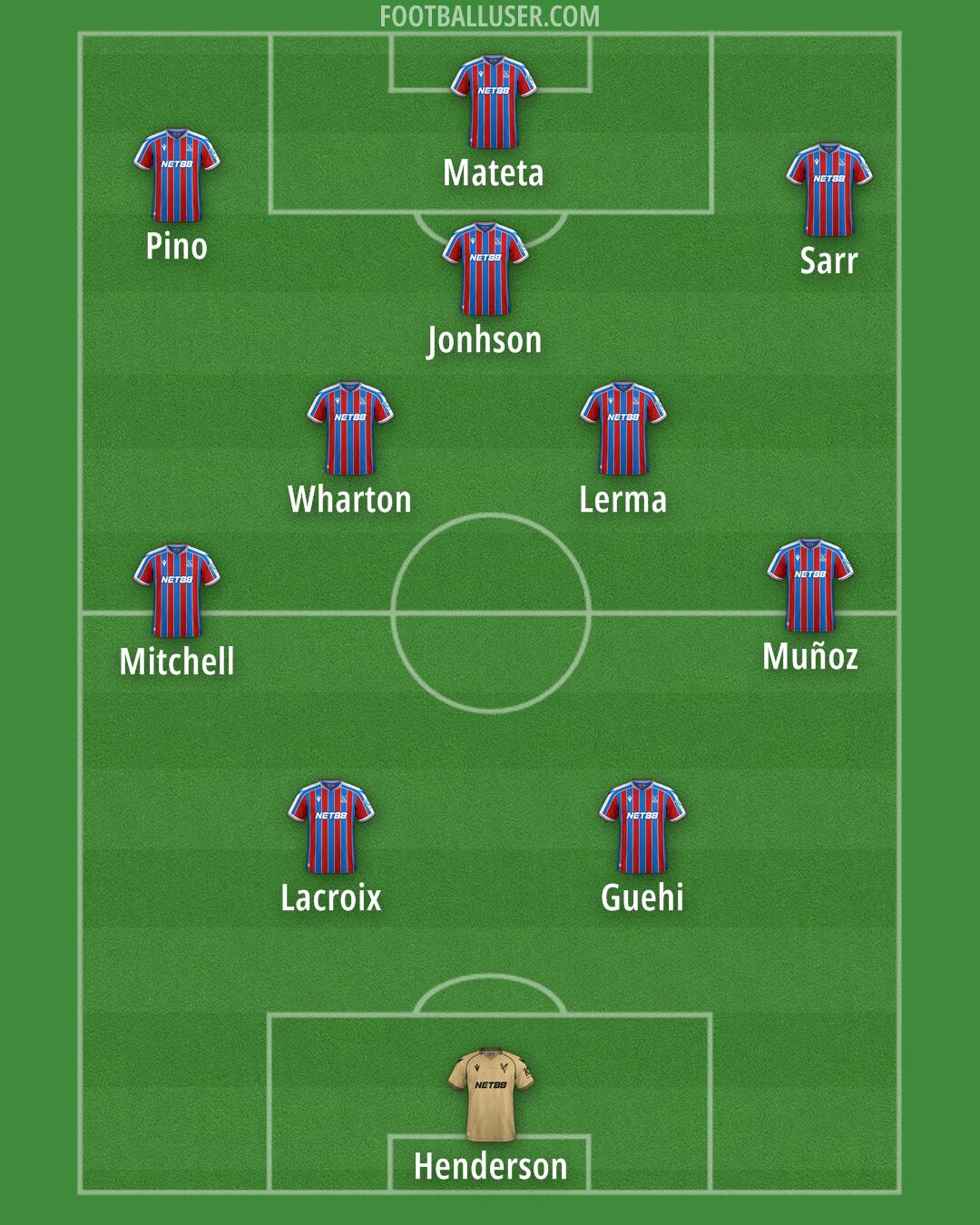
Crystal Palace Football Formation
 January 8, 2026


Starting Lineup
Mitchell · Lacroix · Guehi · Muñoz · Mateta · Wharton · Lerma · Sarr · Pino · Jonhson · HendersonA high pressing and vertical identity defines Crystal Palace in this 2-4-4 formation. The team aims to win the ball high up the pitch and move forward quickly to catch the opposition out of position. This lineup focuses on heavy pressure in the final third to force turnovers, relying on quick transitions to overwhelm the defense.
Henderson sits between the posts to command the penalty area. The defensive line consists of a narrow pair of central defenders, Lacroix and Guehi, who must stay compact to cover the large spaces behind them. Guehi brings aerial strength and composure when playing the ball out from the back. Because there are no traditional full backs, these two central defenders must step up to intercept passes and track runners in wide areas.
The midfield functions as a box to control the center of the pitch. Mitchell and Muñoz operate as the double pivot, sitting deep to shield the two defenders and break up play. In front of them, Wharton and Lerma act as the two attacking midfielders to connect the defense to the front four. Wharton looks to drive forward and break the line with his passing, while Lerma uses his energy to press and win back possession.
An aggressive front line provides constant pressure on the opposition back line. Mateta and Jonhson act as the two central forwards, tasked with holding up the ball and making runs into the channels. Sarr and Pino occupy the wide areas as wingers, looking to cut inside or deliver crosses into the box. This front four works together to press in waves, making it difficult for opponents to build play from the back.
This formation offers significant advantages through its ability to press high in coordinated waves. The presence of four attackers and two attacking midfielders creates numerical superiority in the final third, often isolating wide players in one on one situations. Crystal Palace can also utilize the speed of transition to exploit gaps left by an advancing opponent.
This 2-4-4 formation creates a heavy attacking presence designed to suffocate the opponent in their own half. It is best suited for matches where the team needs to dominate the ball in the attacking third and force errors through relentless pressure.