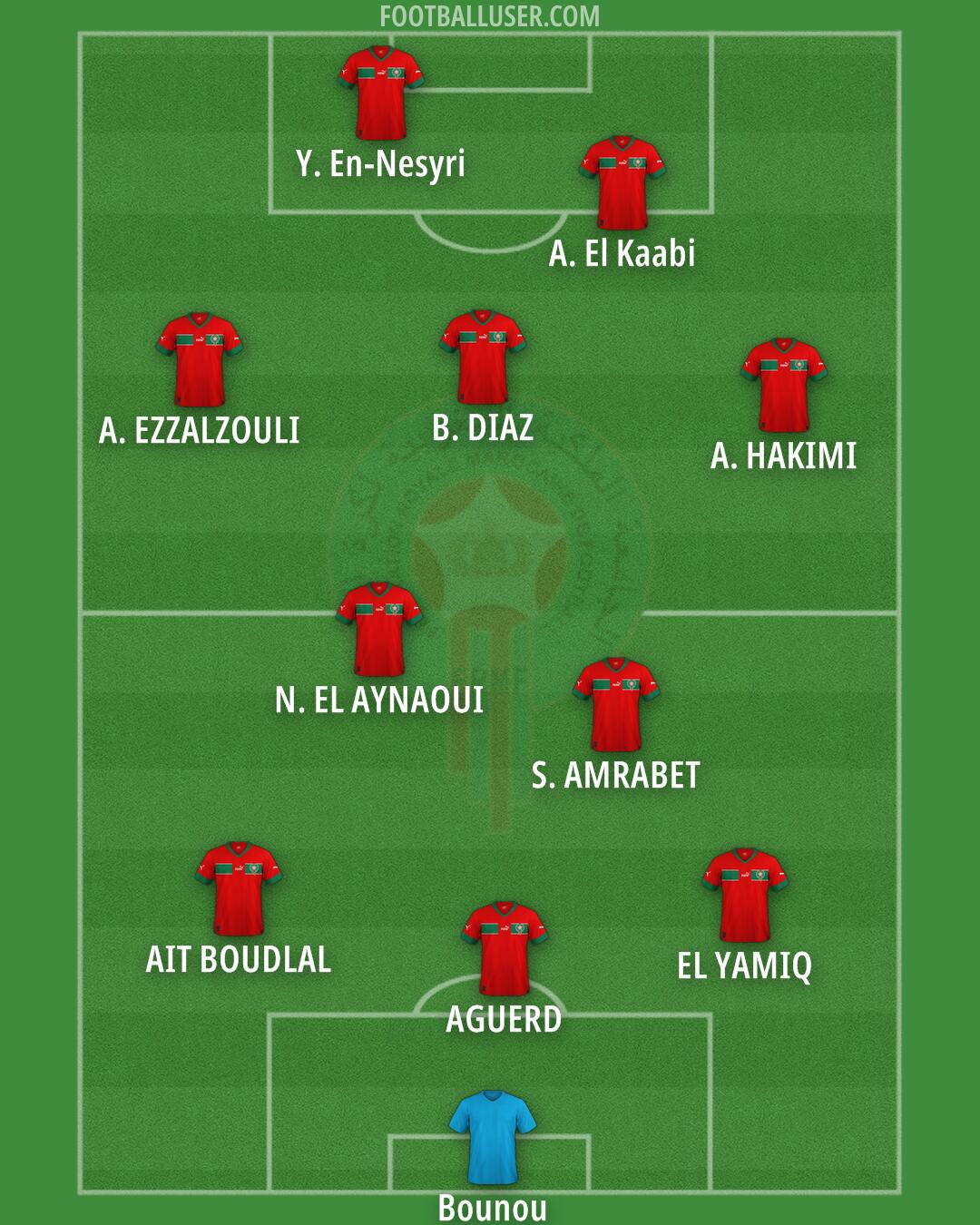

Morocco National Football Team Formation
 January 8, 2026


Starting Lineup
Bounou · AGUERD · EL YAMIQ · AIT BOUDLAL · N. EL AYNAOUI · S. AMRABET · A. HAKIMI · B. DIAZ · A. EZZALZOULI · A. El Kaabi · Y. En-NesyriA focus on defensive solidity and rapid transitions defines Morocco as they deploy a 5-4-1 formation. This lineup looks to sit deep and absorb pressure before breaking forward through quick vertical passes. By crowding the central areas, the team aims to force opponents wide and minimize space between the lines.
Bounou acts as the last line of defense in goal, organizing a back five that can shift as a unit. The central trio consists of AGUERD, S. AMRABET, and N. EL AYNAOUI, who provide significant aerial strength and physical presence to block crosses and intercept passes. On the flanks, EL YAMIQ and AIT BOUDLAL operate as wing backs, tasked with tracking back to form a deep block or pushing high to support the attack. This defensive unit relies on staying compact to prevent any penetration through the middle.
The midfield quartet operates in a compact block to shield the back line. B. DIAZ and A. HAKIMI occupy central roles, with the latter using his high energy to drive forward and cover large distances. A. EZZALZOULI works to link the play, while A. El Kaabi operates in the attacking midfield role to find pockets of space behind the opposition midfielders. This midfield group works to intercept the ball and immediately look for the runners in the final third.
In the attacking phase, Y. En-Nesyri serves as a lone striker, using his aerial strength to hold up the ball and contest long passes. The attack relies on the movements of A. El Kaabi to find gaps in the defense, while the wing backs provide width. When Morocco win the ball, the forwards press the opposition backline to force mistakes, allowing the team to transition from a deep block to an attacking stance instantly.
One major advantage for Morocco is the ability to create numerical superiority in the defensive third, making it very hard for opponents to find openings. The formation also allows for quick transitions where A. HAKIMI and the wing backs can overlap to create wide overloads. This setup makes the team very difficult to break down when they sit deep and defend in a compact block.
Morocco relies on a disciplined defensive unit and a strong presence in the air to frustrate opponents. This formation is best suited for matches against teams that dominate possession, allowing the side to absorb pressure and strike on the break.